

Best Flooring for High Traffic Areas

When you’ve got a busy home, the debate over the best flooring for high traffic areas almost always narrows down to two heavy hitters: Luxury Vinyl Plank (LVP) and porcelain tile. These two are the real workhorses, offering an incredible mix of durability, water resistance, and style. They're pretty much the go-to choices for hallways, kitchens, and entryways—the places where life gets a little chaotic.
Choosing Floors for Busy Homes
Picking a floor for a home that’s always in motion can feel like a massive decision, but it doesn’t have to be overwhelming. Let's be real, your floors take a beating from kids, pets, and the constant back-and-forth of daily life. This guide is here to make that choice easier by putting the top options head-to-head.

We’re going to get into what makes materials like LVP and porcelain tile so tough. Think of this as your practical guide to finding a floor that not only survives the daily grind but looks great doing it for years to come. For a deeper dive into the whole selection process, our guide on how to choose flooring for your new home is a great place to start.
And if you’ve got four-legged family members, don't forget to factor them into the equation. These insights on pet-friendly flooring options can be a real lifesaver.
Feature | Best For... | Why It Works |
|---|---|---|
Scratch Resistance | Homes with pets and kids | The tough-as-nails wear layer on LVP or the natural hardness of porcelain stands up to claws, toys, and everything in between. |
Water Resistance | Kitchens, mudrooms, bathrooms | LVP is usually 100% waterproof, while porcelain just doesn't absorb water. This means no warping or damage from spills. |
Easy Maintenance | Busy families and individuals | A quick sweep and the occasional mop are all it takes. No special treatments, no fuss. |
Style Versatility | Any design aesthetic | You can find options that mimic everything from rustic hardwood to sleek natural stone, so you never have to sacrifice style for durability. |
What Makes a Floor Truly Durable?
Before we dive into the side-by-side comparisons, let's get on the same page about what "durable" actually means for your floors. It’s not just about handling foot traffic. It's the whole package: how well it resists scratches, whether it shrugs off water, and how much elbow grease it takes to clean up after a chaotic week.
Trying to make sense of the technical jargon on a product label can be overwhelming, but there are a few key ratings that cut right through the marketing fluff. These are the numbers the pros look at to see if a floor can really go the distance.
Decoding Durability Ratings
When you’re staring at a wall of flooring samples, you’ll see specific industry ratings that measure toughness. Understanding these is your secret weapon for making a smart investment.
AC Rating (Abrasion Class) for Laminate: This scale runs from AC1 to AC5 and tells you how well a laminate plank stands up to abrasion, stains, and impact. For any busy part of your home, you'll want to look for AC3 or higher. AC3 is built for heavy residential use, while AC4 and AC5 are what you’d find in a commercial space, so you know they can handle just about anything.
PEI Rating (Porcelain Enamel Institute) for Tile: This is the go-to rating for ceramic and porcelain tile wear resistance, graded from Class 1 to Class 5. A Class 1 tile is strictly for walls, but a tile with a Class 4 or 5 rating is tough enough for heavy-duty residential and even commercial traffic. For example, that's exactly what you'd want for an entryway in a busy Baltimore County home that sees a lot of muddy boots.
Wear Layer Thickness for Vinyl (LVP/LVT): This might be the single most important number for vinyl flooring. The wear layer is the clear top coat that protects the beautiful design underneath from scuffs, scratches, and stains. It’s measured in mils (one-thousandth of an inch). For high-traffic spots in your house, a 12 mil wear layer is a decent starting point, but 20 mil or more is where you get serious protection, especially with pets.
Think of the wear layer as the screen protector for your floor. A thicker one gives you a much better shield against the daily grind of dropped keys, dragged chairs, and dog claws, keeping your floor looking new for years.
These ratings give you the power to choose wisely based on how you actually live. A mudroom in a Harford County home, for instance, needs top-tier water resistance and a high PEI-rated tile. On the other hand, a main hallway that gets tons of foot traffic but fewer spills might be better served by an LVP with a thick wear layer for scratch protection.
If you want to dig deeper into weighing these factors, check out our other material selection tips for your new home.
Comparing the Top Flooring Options for Busy Homes
Alright, let's get down to the nitty-gritty. When you're designing a home that needs to stand up to everyday life, you're looking at a few key players in the flooring game. We’re going to look at the big three—Luxury Vinyl Plank (LVP), Porcelain Tile, and Engineered Hardwood—not with some generic pro/con list, but by putting them in real-world situations you’ll actually face.
The All-Around Champion: Luxury Vinyl Plank (LVP)
There’s a good reason LVP has exploded in popularity. It’s the ultimate chameleon, blending toughness, good looks, and a comfortable feel underfoot. Its secret is a layered construction that gives it resilience and a slight cushion that other hard surfaces just don't have.
Imagine a finished basement that doubles as a playroom. You need something that can take a beating from dropped toys, spilled juice, and constant running around. LVP is perfect here. It's also much warmer and quieter than tile, making it a cozier spot for kids to sprawl out on the floor.
Luxury vinyl's rise isn't a fluke; its engineered design is a game-changer. The key is its protective wear layer, which usually runs from 12 to 28 mil. For a truly busy home, you want to look for something with 20 mil or higher—that's where it becomes exceptionally tough. In fact, a 2022 survey found that 78% of facility managers picked LVP for commercial spaces because it’s incredibly scratch-resistant and totally waterproof.
The Indestructible Option: Porcelain Tile
If you're looking for flooring that is just about bulletproof, porcelain tile is your answer. It's incredibly dense and hard-fired, making it almost impossible to scratch, dent, or damage with water. This is the stuff you put in the real battlegrounds of your home.
Think about the mudroom of a White Marsh, Maryland home during a slushy winter or a rainy spring. Porcelain tile just shrugs off muddy boots, dripping coats, and whatever grit gets dragged in. It won't warp or stain, and cleaning it is as easy as a quick wipe-down. It's the same story for kitchens and bathrooms, where it stands up to dropped pans, pet claws, and constant foot traffic without breaking a sweat.
The Bottom Line: While porcelain tile is undeniably tougher, LVP offers a warmer, quieter experience. The right choice really depends on the room's job. Do you need absolute, bomb-proof resilience against water and scratches (tile), or a more comfortable, quieter surface for living areas (LVP)?
This decision tree can help you sort through your priorities to see which path makes the most sense for you.
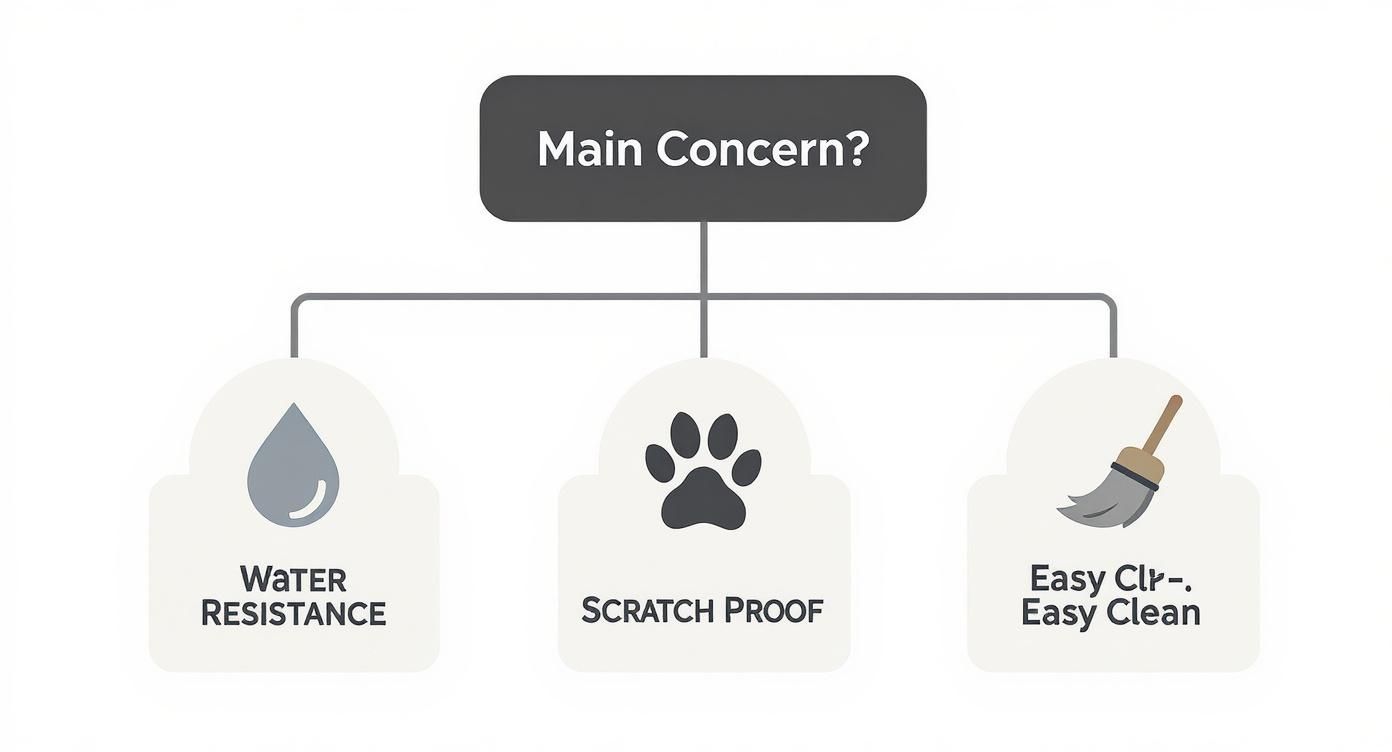
As you can see, if water and scratches are your biggest fears, tile is the clear winner. But if you're trying to find that sweet spot between easy cleaning and everyday comfort, LVP is often the better fit.
The Timeless Classic: Engineered Hardwood
For those who just can't give up the classic, authentic beauty of real wood but need something practical for a busy family, engineered hardwood is a fantastic solution. It’s made with a real hardwood layer on top, but it's bonded to a super-stable core of high-quality plywood.
That core is what makes all the difference. It prevents the wood from expanding and contracting with humidity changes, which is a big deal in homes across Prince George's County and Harford County. You get that timeless, elegant look that adds serious value to a home, but with a structure built for modern life. It’s not as invincible as tile or LVP, but a quality engineered wood with a tough factory finish holds up beautifully to everyday traffic.
Side-by-Side Flooring Comparison
Sometimes, just seeing the specs laid out next to each other makes the decision click. Here’s a quick rundown of our top three contenders to help you weigh the trade-offs.
Flooring Comparison for High-Traffic Homes
A side-by-side look at the top flooring choices, evaluating them on key factors for a busy household.
Flooring Type | Average Cost (per sq. ft. installed) | Typical Lifespan | Best For... | Key Durability Feature |
|---|---|---|---|---|
Luxury Vinyl Plank (LVP) | $4 - $10 | 15-25 Years | Basements, playrooms, kitchens, any room with moderate to heavy traffic. | A thick, protective wear layer (ideally 20 mil+) that resists scratches and is 100% waterproof. |
Porcelain Tile | $8 - $20 | 50+ Years | Entryways, mudrooms, kitchens, bathrooms—anywhere moisture and heavy wear are constant. | An extremely hard, non-porous surface that is virtually scratch-proof and completely waterproof. |
Engineered Hardwood | $6 - $15 | 20-40 Years | Living rooms, dining rooms, and main living areas where classic style is a priority. | A multi-layer core that provides stability and a durable factory-applied finish to protect the real wood veneer. |
Each of these materials is an excellent choice, but they each have their own ideal role in a home. For more ideas and to see how other homeowners have approached this, feel free to explore our collection of articles on flooring choices.
Ultimately, the best choice comes down to matching the material’s strengths to your family's lifestyle. That's where I go a step further. Using my unique proprietary visualization tools, I can actually show you how each of these floors will look in your new home, right next to your cabinet and countertop selections. It's a hands-on service that takes all the guesswork out of the process, ensuring the durable floor you pick is also one you'll absolutely love for years to come.
A Closer Look at Tile and Epoxy Floors
While LVP and engineered hardwood are fantastic all-around choices, some spaces in a home are just brutal on floors. Let’s zoom in on two titans of toughness that are built for those high-stress zones: porcelain tile and epoxy coatings.
When we talk about nearly indestructible flooring, these two are in a league of their own. They offer specific solutions for the most demanding parts of a house, like mudrooms, basements, and workshops.
The Unsung Hero: Epoxy Coatings
Most people think of epoxy flooring for garages, but its incredible resilience makes it a surprisingly smart choice for certain spots inside the home. An epoxy coating is a two-part resin we apply directly over a concrete subfloor. It cures into a hard, seamless, and totally non-porous surface.
Picture a basement that has to do it all—a workshop, a home gym, and a storage area. Epoxy is a perfect fit. It stands up to chemicals, oils, and heavy impacts from dropped tools or weights without chipping or staining. And because it's seamless, there are no grout lines or cracks to trap dirt, making cleanup ridiculously simple.
Porcelain Tile: The Reigning Champion
For most high-traffic areas inside a home, porcelain tile is the undisputed king of durability. It's made from a finer, denser clay and fired at much higher temperatures than standard ceramic tile. The result? It's exceptionally hard and absorbs less than 0.5% of water, making it a powerful weapon against the wet, messy reality of daily life.
Think about a busy entryway in your Edgewood or White Marsh, Maryland home during a rainy spring. Porcelain tile won’t warp or buckle from tracked-in water, and it easily shrugs off scratches from the gravel and grit stuck to the bottom of shoes. It’s pretty much the ultimate "set it and forget it" flooring for mudrooms, kitchens, and bathrooms.
Year after year, porcelain tile is recognized as one of the toughest flooring options out there, with a proven lifespan that can easily exceed 50 years when it’s cared for. Its ability to resist scratches, stains, and fading is why it's a top pick for both homes and commercial spaces. In fact, a 2023 durability study gave porcelain tile the highest possible score—a PEI rating of 5—for wear resistance. You can find more insights about these flooring tests to see how different materials really stack up.
Feel and Functionality: The Tile Trade-Off
So, what's the catch? Well, one key thing to consider is how porcelain tile feels underfoot. It’s noticeably harder and cooler to the touch than LVP or engineered hardwood. While that coolness can be a welcome feature during a humid Maryland summer, some folks prefer a warmer surface in living areas.
This is where smart design comes into play. You don't have to choose between durability and comfort—you can get the best of both worlds by using area rugs.
Add Warmth and Comfort: A plush area rug in the center of a living room with porcelain floors adds that softness and warmth right where you need it.
Define Spaces: In an open-concept layout, rugs are a great way to create distinct zones, visually separating a seating area from a dining space.
Protect Where It Counts: The exposed tile around the rug’s perimeter still guards the main walkways, giving you that maximum durability in the most demanding spots.
The real beauty of porcelain tile is its sheer resilience. By pairing it with area rugs, you can create a cozy, inviting atmosphere without sacrificing the unparalleled durability that makes tile the best flooring for high traffic areas.
Of course, getting that long-lasting performance depends entirely on proper installation. For anyone interested in the nitty-gritty, we've put together some helpful tile installation tips that cover the essentials.
While the builder I represent provides high-quality homes, I go a step further—offering my clients unique proprietary visualization tools, hands-on service, and access to visualizers that help you bring your dream space to life. We can play around with different sizes, colors, and grout options in a virtual model of your space. It's a process that helps bring your dream home to life, ensuring every choice—from the floors to the cabinets—is a perfect reflection of your style.
Don't Sacrifice Style for Durability
Let's be honest, when you hear "durable flooring," you might picture something boring and industrial. But that's an outdated idea. The best flooring for your high-traffic areas doesn't force you to choose between toughness and taste. Today's materials are incredible, offering a huge range of colors, textures, and patterns that can nail any aesthetic you're going for.
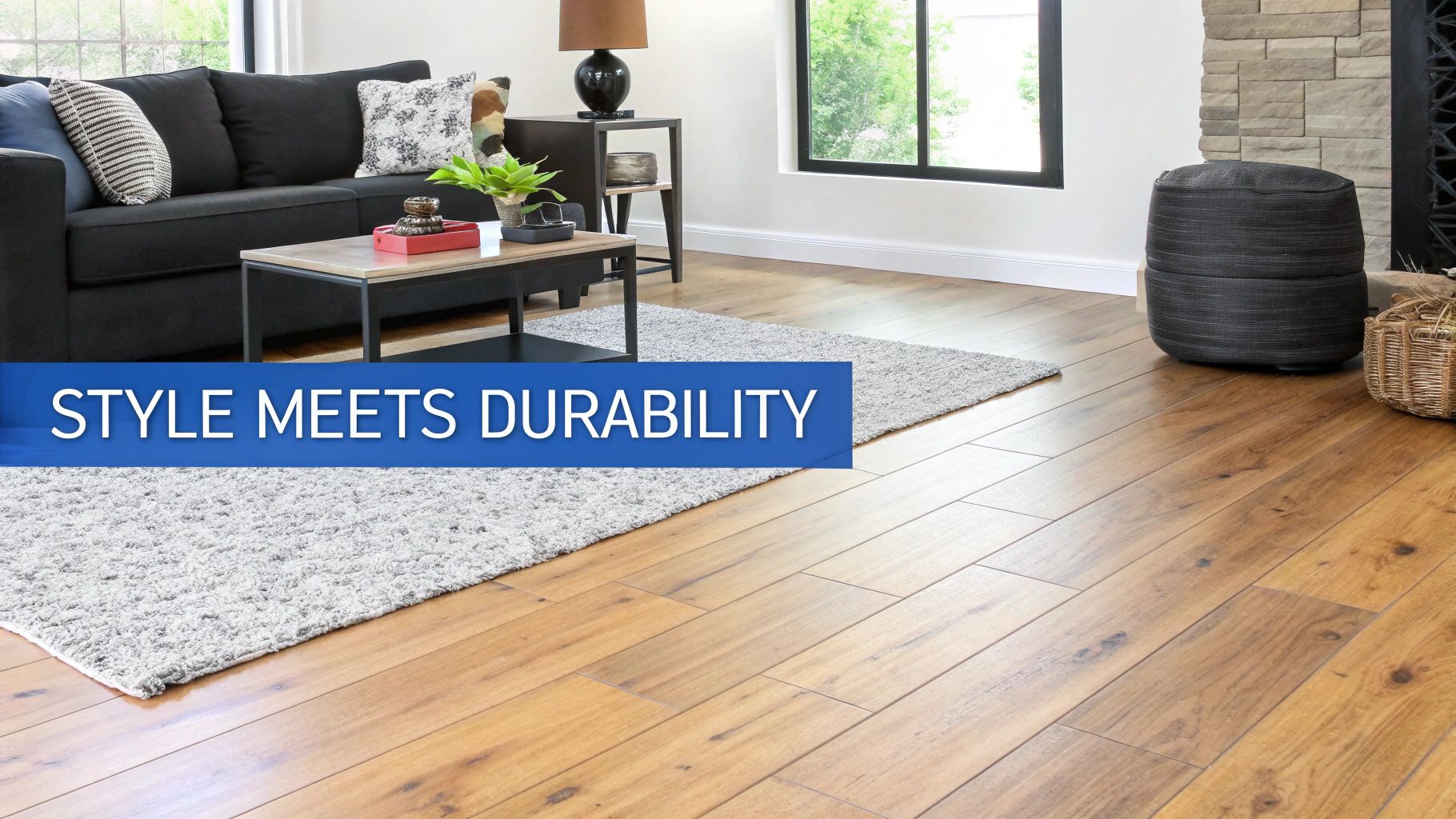
Function and beauty really can go hand-in-hand. Your floors are the foundation of your home's look and feel, tying together all the other inspiring interior designs for new homes. The trick is finding that sweet spot where a floor that can handle real life also happens to be the one you love to look at.
From Farmhouse Charm to Modern Sleek
Let's get practical. Here’s how you can get the style you want with a floor that’s built to last.
Cozy Farmhouse: Craving that warm, rustic charm? Wide-plank Luxury Vinyl Plank (LVP) is your answer. It brilliantly fakes the look of reclaimed wood, complete with authentic grain patterns and even saw marks. The best part? It's 100% waterproof and resists scratches like a champ.
Sleek and Modern: If you’re all about clean lines, go for large-format porcelain tiles. Using big tiles, like 24x48 inches, means fewer grout lines, which gives you a seamless, minimalist vibe. A solid gray or a faux-concrete finish is perfect for a contemporary design that’s also ridiculously easy to clean.
Timeless Traditional: For that classic, elegant feel, engineered hardwood brings the genuine beauty of wood but with better stability. A deep, rich oak or hickory floor creates a sophisticated backdrop for any space, whether it’s a formal dining room in Baltimore County or a cozy living room in Harford County.
The hardest part is always trying to imagine how a tiny sample will look across a huge room, especially next to your cabinets and paint. This is where a lot of design mistakes happen.
Bringing Your Vision to Life
This is exactly where I help my clients avoid that guesswork. I don't just hand over a few samples and wish you luck. I provide access to proprietary visualization tools that let you see it all come together. We can digitally lay down that dark-hued engineered hardwood in your kitchen and see precisely how it looks with your countertop choice.
These visualizers take all the "what ifs" out of the equation. We can swap materials, colors, and finishes in real-time on a virtual model of your home. It's a game-changer for creating a space that feels cohesive and perfectly you.
When you work with me, we’re not just picking materials; we’re designing a home you’ll love down to the last detail. Let's start making your vision a reality.
Got Questions About High-Traffic Flooring? We've Got Answers.
Choosing the right floor for the busiest parts of your home is a big deal. You're not just picking a color; you're making a long-term investment in how your home looks, feels, and holds up to daily life. Let's tackle some of the most common questions that pop up during this process.
What's the Best Scratch-Proof Flooring for Dogs?
When it comes to our four-legged friends, porcelain tile is the clear winner. Paws down. Its surface is so hard and dense that even the sharpest claws from a case of the "zoomies" won't leave a mark. It's about as close to indestructible as a floor can get.
If tile isn't your thing, the next best bet is a quality Luxury Vinyl Plank (LVP). The key here is to look for a thick wear layer—don't settle for anything less than 20 mil. Think of it as a heavy-duty screen protector for your floors; it’s designed to take the brunt of the abuse so the beautiful design underneath stays pristine.
Can Engineered Hardwood Handle High-Traffic Areas?
Absolutely, but you have to be smart about which one you pick. The real durability of engineered hardwood boils down to two critical factors: the hardness of the wood species on top (check its Janka rating) and how thick that top veneer is.
For example, a tough wood like hickory or white oak is going to stand up to dents and dings far better than a softer wood. And a thicker veneer is your lifeline—it means you can actually sand and refinish the floor down the road, maybe even a couple of times, breathing new life into it after years of wear. It gives you that genuine wood look and feel with better stability, but just know it won't ever be as bulletproof against deep scratches as LVP or tile.
How Important Is It to Hire a Pro for Installation?
I can't stress this enough: professional installation is non-negotiable. It's the one area where you absolutely shouldn't try to save a few bucks. The most expensive, durable flooring in the world can (and will) fail if it’s not put down correctly. A subfloor that isn't perfectly flat can cause LVP planks to pull apart or tiles to crack under pressure.
A professional installer isn't just a cost; they're your insurance policy. They ensure the subfloor is properly prepped, which is crucial for protecting your manufacturer's warranty and guaranteeing your new floor looks and performs exactly as it should for years to come.
Will My Flooring Choice Actually Impact My Home’s Resale Value?
Oh, absolutely. Think about it from a buyer's perspective. Walking into a home with beautiful, high-quality, and durable floors is a huge plus. Here in areas like Baltimore County and Harford County, a home with modern, well-maintained flooring immediately catches the eye.
Flooring with timeless appeal—like a classic engineered hardwood or a realistic wood-look LVP in a neutral tone—tends to give you the best bang for your buck. Of course, you should pick a floor you love living with, but choosing a material that is both beautiful and resilient is one of the smartest long-term decisions you can make for your home's value.
Choosing the perfect floor is about more than just finding something that can take a beating; it’s about making a space feel like your space. At Customize Your Home, I do more than just sell you materials. I offer a hands-on service, and with my proprietary visualization tools, you can see exactly how different floors will look in your new home before you commit. It completely takes the guesswork out of the equation.
Let's build a home you'll love from the ground up. You can explore all your options over at https://www.customizeyourhome.com.
Comments