

What Is Home Warranty Coverage? A Simple Guide

So, what exactly is a home warranty?
Think of it as a service contract, a friendly safety net designed to cover the repair or replacement costs when your home's major systems and appliances decide to call it quits from normal, everyday use.
It’s completely different from your homeowner's insurance, which is there for big disasters like fires, floods, or a tree crashing through your roof. A home warranty is your go-to for the everyday breakdowns that can wreak havoc on your budget.
Demystifying Home Warranty Coverage
Let's use an analogy that might hit closer to home. You have car insurance for accidents, right? But you might also have an extended warranty for when the engine or transmission gives out unexpectedly. A home warranty is the exact same concept, just for your house. It’s there to shield you from the shockingly high cost of fixing things that just wear out over time.
Picture this: it's the hottest day of the year in White Marsh, and your air conditioning unit just dies. Instead of frantically searching for a trustworthy technician and staring down a bill that could be thousands of dollars, you just make one call to your home warranty company. They handle the rest.
Home Warranty vs Home Insurance At a Glance
It’s incredibly common for people to mix these two up, but they play very different roles in protecting your home and your wallet.
Here's a quick table to set the record straight.
Feature | Home Warranty Coverage | Homeowner's Insurance |
|---|---|---|
Primary Purpose | Covers repairs from normal wear and tear | Protects against sudden, accidental events |
Typical Covered Items | HVAC, plumbing, major appliances | Fire damage, theft, storm damage, liability |
When It's Used | When a covered system or appliance breaks | After a major disaster or accident |
Requirement | Optional, but highly recommended | Usually required by mortgage lenders |
One key thing to remember is that a home warranty doesn't replace regular maintenance. Keeping up with routine care is still on you as the homeowner. Learning some essential HVAC maintenance tips, for example, is a great way to help your systems last longer and prevent unnecessary breakdowns in the first place.
On a national level, you can expect a home warranty policy to cost somewhere between $300 and $600 per year. When you do need to make a claim, there's a service call fee, which is usually between $75 and $125. This predictable cost model is what saves you from the financial shock of a sudden, four-figure repair bill.
You can learn more about these home warranty statistics by visiting our trusted partner.
So, What Does a Home Warranty Actually Cover?
Alright, let's get down to the nitty-gritty. You get the basic concept—a home warranty is a service contract that helps cover the cost of repairs when things break down. But what does that really mean when your refrigerator stops humming?
Think of it this way: your house is full of complex systems and expensive appliances. A home warranty is designed to protect these workhorses from the inevitable breakdowns that happen from normal, everyday use.
This is a great snapshot of how most plans break down what they'll cover.
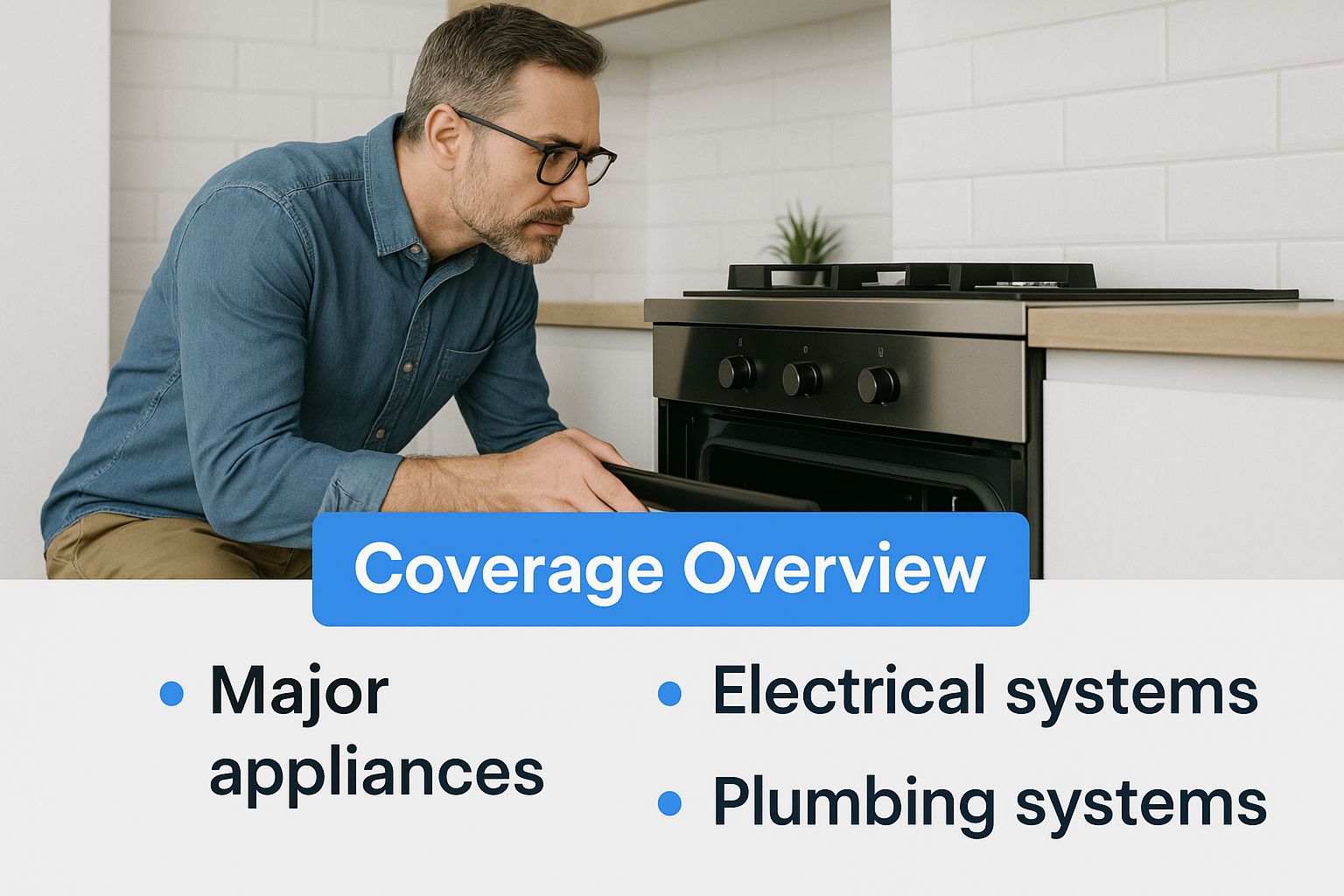
As you can see, everything falls into two main buckets: the systems running behind your walls and the appliances you use every single day.
The Big-Ticket Systems They Cover
These are the systems you don't really think about until they stop working. They're the expensive, complicated guts of your home that keep things comfortable and safe. When one of them fails, it's a huge headache. Luckily, most basic plans have your back.
HVAC System: We’re talking about your furnace and air conditioning. Picture your AC giving up the ghost during a sweltering July afternoon. A full replacement could easily set you back $5,000 or more. With a warranty, you just pay your service call fee and they send a pro to get it running again.
Plumbing: This covers things like leaky pipes, clogs, and, most importantly, your water heater. For example, if you wake up to a cold shower and find your water heater has burst, the warranty handles the repair or replacement of the unit itself. Just remember, the warranty fixes the unit, not the water damage it caused—that’s a job for your homeowner's insurance. We break that down further in our guide on understanding homeowners insurance coverage explained.
Electrical Systems: This is all about the wiring, circuit breakers, and outlets that power your life. Let's say an outlet in your kitchen stops working, or a breaker won't stop tripping. Your warranty covers the cost of getting an electrician to diagnose and fix the problem safely.
The Everyday Appliances They Cover
Next up are the appliances that make modern life possible. They’re the heart of your kitchen and laundry room, and when one goes down, your whole daily routine gets thrown off kilter.
Here’s what’s usually included in a standard plan:
Refrigerator
Oven and Cooktop
Dishwasher
Washer and Dryer
A broken dishwasher might not seem like a catastrophe, but a dead refrigerator definitely is. A home warranty gets a technician out to your house without you having to scramble to find someone trustworthy—or drain your savings account.
A home warranty is basically a repair budget for the most crucial and costly items in your house. It transforms a surprise four-figure bill into a predictable, manageable service fee.
What's Usually Not Included
Now for the fine print. A home warranty is awesome, but it doesn't cover everything. It’s designed for mechanical failures from normal wear and tear, not every possible problem.
Generally, you can expect things like cosmetic issues (a dent in the fridge door), problems caused by neglect (like never cleaning your dryer vent), or pre-existing conditions that were known before your coverage started to be excluded.
The single best piece of advice I can give is to read your contract carefully. That document is your rulebook, and knowing what's in it will save you a lot of frustration down the road.
The Real-World Benefits for Homeowners
Let’s be honest, beyond just fixing things, a home warranty really delivers one thing every homeowner craves: peace of mind. It’s the difference between a full-blown panic when something breaks and just making a phone call. The real magic is in protecting your budget and taking the headache out of finding help.
Picture this: it’s the middle of a brutal White Marsh heatwave, and your central air conditioning decides to quit. You're suddenly looking at a replacement bill that could easily top $4,000. For most of us, that's not just an inconvenience; it's a financial crisis. With a home warranty, that potential catastrophe shrinks down to a simple, predictable service call fee. Your savings can stay right where they belong—in your bank account.
Protection for Your Wallet
The number one reason people get a home warranty is for financial stability. It takes the wild, unpredictable spikes out of home repair costs and turns them into a planned, manageable expense. Instead of wiping out your emergency fund for a new water heater, you’re just paying your regular fee.
Let’s say you’re in Edgewood and your dishwasher springs a leak, threatening to ruin your new kitchen floors. A new dishwasher, with installation, can easily set you back over $800. With a warranty, that repair or replacement is handled for a tiny fraction of the cost, saving both your appliance and your finances. We have a lot more to say about this in our other articles on home protection.
Unbeatable Convenience and Access to Experts
The sheer convenience is another huge plus. When an appliance dies, the last thing you want to do is spend hours calling around, vetting repair companies, and hoping you picked a good one. This is especially true for busy families all over Harford and Baltimore County.
A home warranty cuts out all that guesswork. You make one call, and they send a pre-screened, qualified pro right to your door. It saves you an incredible amount of time, energy, and the stress of trying to solve a crisis all by yourself.
This streamlined process is such a relief. If you want to see how this works in practice, check out plans like the Go Assist Home Membership Benefits, which do a great job of showing how these memberships simplify home maintenance.
It’s no surprise the industry is growing so fast. The global home warranty market is currently valued at around $3.8 billion and is expected to climb to $5.56 billion by 2031. Why? Because homeowners are tired of uncertainty and want a reliable solution they can trust.
How to Navigate the Claims Process
Okay, so your dishwasher has started making a terrifying clanking sound, or your furnace decides to quit on the coldest night of the year in Prince George's County. What's next? A home warranty is only useful if you know how to use it, but the good news is that the claims process is usually pretty simple.

Knowing the steps before something breaks can make the whole experience feel less like a crisis and more like a minor inconvenience. It’s all about being prepared.
Your Step-by-Step Guide to Filing a Claim
When a covered item gives up the ghost, don't panic. Just follow this straightforward process to get things up and running again.
Review Your Contract: Before you do anything else, grab your policy and give it a quick scan. You want to confirm the broken appliance or system is actually on your coverage list. This one little step can save you a world of frustration.
Contact Your Warranty Provider: Most companies have an online portal or a 24/7 phone number to start a claim. You’ll need your policy number and a good description of what’s going on. Be specific! "The furnace is blowing cold air" is way more helpful than "The heater is broken."
Pay the Service Call Fee: As you file the claim, you'll be prompted to pay your service call fee. This is that flat fee we talked about earlier, and it's the only money you'll hand the technician for their visit, no matter how complex the repair ends up being.
Schedule the Service Appointment: The warranty company takes it from here. They'll reach out to a pre-screened, local technician in their network to set up a visit. You should expect a call or email from the service pro to find a time that works for you.
Diagnosis and Repair: The technician shows up, figures out what’s wrong, and decides on the best fix. If it’s a covered repair, they'll either handle it right then and there or order the parts they need. If the item is officially toast, the warranty company will step in to arrange for a replacement.
Pro Tip: Document everything! Snap a few pictures or take a quick video of the malfunctioning item before the technician arrives. This visual proof can be a lifesaver if any questions come up later.
A Real-World Example
Let's walk through a real-life scenario. Imagine it's a freezing January morning in White Marsh, and you wake up to a house that feels like an icebox. Your furnace has died.
Instead of freaking out about the potential bill, you hop online, file a claim, and pay your $100 service fee. A few hours later, a local HVAC company calls to schedule an emergency visit for that afternoon. The technician arrives, quickly finds that the furnace's blower motor is shot, and replaces it. The total cost for that part and the labor would have easily topped $600, but all you paid was your service fee. Your home is toasty again, and your budget is completely unscathed.
Learning to navigate these little homeowner hiccups is part of the journey. For more great advice, you can explore our other articles and find plenty of valuable coverage tips to help you stay prepared.
While we provide high-quality homes, we go a step further—offering our clients unique customization tools, hands-on service, and access to visualizers that help you bring your dream space to life. If you’re dreaming of a personalized home in one of our beautiful Maryland communities, let’s talk.
Choosing the Right Plan for Your Home
Alright, let's talk about picking the right home warranty plan. Think of it like a puzzle—you want to find the piece that fits your home and your budget just right, without paying for coverage you don't need.
The cost really comes down to two things: the annual premium and the service call fee. The premium is what you pay each year for the policy, and the service fee is a flat rate you pay every time a technician comes to your door.
You can generally expect to pay somewhere between $400 to over $700 a year for the premium. Service fees usually hover between $75 and $150 per visit. You'll often see an inverse relationship here: a lower annual premium might mean a higher service fee, and vice versa. It’s a trade-off, so you have to decide what makes more sense for your finances.
Finding Your Perfect Fit
Most home warranty companies don’t offer a one-size-fits-all solution. Instead, you'll usually find a few different tiers of coverage, making it easier to match a plan to your home’s specific quirks and needs.
And there’s a good reason these plans are becoming so popular. Homeowners are looking for a financial buffer against surprise repairs, especially as houses get older. In fact, the global home warranty market is expected to reach $15 billion by 2033. If you're curious, you can discover more insights about the home warranty market and see how the industry is evolving.
The first step to making a smart choice is understanding what your options are. Most companies package their plans in a few common ways.
Choosing a plan is all about knowing your home. An older house with well-loved appliances might need a more robust, all-inclusive plan. A brand-new build, on the other hand, might just need basic systems coverage to start.
Comparing Common Home Warranty Plan Types
So, what do these plans actually look like? Let's break down the typical options you'll come across. This little table should help you figure out which kind of plan makes the most sense for you.
Plan Type | What It Typically Covers | Best For Homeowners Who... |
|---|---|---|
Systems-Only Plan | The big stuff: HVAC, electrical, and plumbing systems. | Have newer appliances that are still under the manufacturer's warranty but want protection for their home's core infrastructure. |
Appliance-Only Plan | The everyday workhorses: your refrigerator, dishwasher, oven, washer, and dryer. | Aren't worried about their home's systems but know how expensive it is to replace a major appliance out of the blue. |
Combo Plan | The whole shebang, covering both major systems and essential appliances. | Want the ultimate peace of mind and protection for almost every major component in their home. |
At the end of the day, picking the right coverage is just another part of being a smart homeowner. As you're busy choosing the perfect flooring, countertops, and cabinets in one of our Maryland communities, think about adding a warranty plan to protect that beautiful new home.
Ready to build a home that's all you? Let’s connect and get the conversation started.
Taking the Next Step Toward Your Protected Home
Hopefully, you're feeling a lot more comfortable with the idea of a home warranty. At the end of the day, it's really about protecting your wallet from those gut-wrenching, unexpected repair bills. It saves you the headache of scrambling to find a reliable plumber at 10 p.m. and, most importantly, it gives you peace of mind. Now you can get back to focusing on the truly fun parts of owning a home.

Here, we believe in empowering homeowners right from the get-go. It's why we do more than just build beautiful, high-quality homes in amazing Maryland communities—from White Marsh and Edgewood to locations across Baltimore, Harford, and Prince George's County. We're all about providing a hands-on service and unique tools that let you build a home that is 100% you.
Creating a Space That’s All You
Your home should be a direct reflection of who you are, and we think you should be in the driver's seat when it comes to design. You get to be the one calling the shots and making the key decisions that turn a floor plan into a home.
With our unique process, you can:
Pick out the perfect flooring that ties your whole aesthetic together.
Choose the countertops and cabinets that will become the heart of your kitchen.
Select the tile and finishes that transform a bathroom into your own personal spa.
This hands-on approach is what makes a new house feel like your home from the second you walk through the door. It’s not just a structure; it's a space you’ve personally shaped for your family to grow into and love for years to come.
Building a new home is one of life's most exciting adventures, but staying organized is the secret to keeping it fun and stress-free. To help you juggle all the details, we put together a simple home buying checklist template to keep everything on track.
Ready to start designing a home you’ll be proud of in a community you’ll love? Let's talk. We're here to help you bring that vision to life, every single step of the way.
Still Have Questions? Let's Clear Things Up
It's totally normal to have a few questions floating around. Let's tackle some of the most common ones we hear about home warranties.
Is a Home Warranty Really Worth It for a Brand-New House?
You bet it is. While we build top-notch homes, think of a home warranty as your safety net after the manufacturer's warranties on individual items expire.
It’s a savvy move that protects you from surprise repair bills during those crucial first few years. You get peace of mind knowing you've bridged that potential coverage gap. For example, if your new dishwasher's one-year manufacturer warranty runs out and it breaks down in month 13, your home warranty would kick in to cover it.
Can I Just Call My Own Repair Guy?
This is a common question, and the answer is typically no. Your home warranty company has a network of pre-screened, trusted professionals they'll send out.
The upside? You don't have to waste your Saturday calling around and vetting contractors yourself. For busy homeowners in communities like White Marsh or Edgewood, that's a massive time-saver.
It's kind of like having a reliable handyman on speed dial. The warranty provider has already handled the legwork of finding qualified local pros, so you can relax.
How Is This Different From a Manufacturer's Warranty?
Great question, because they're two very different things. Here’s the breakdown:
A manufacturer's warranty is specific. It covers one single product—like your shiny new dishwasher—against defects from the factory, usually for just the first year.
A home warranty is broad. It's a service contract that covers multiple systems and appliances throughout your home from breakdowns caused by normal, everyday use.
You can also renew a home warranty each year, giving you long-term protection for the things you count on every day. It’s an extra layer of security that helps keep your home running like a well-oiled machine.
At Customize Your Home, we don't just build high-quality homes—we partner with you to create a space that feels completely you. With our hands-on service, you get to choose your own flooring, countertops, and finishes in our beautiful Maryland communities.
Ready to bring your dream space to life? Start your journey with us today.
Comments