

Discover what is a floor plan and how it guides home design

Ever felt a little lost trying to decipher a property listing? That's where a floor plan comes in—it's your secret weapon for understanding a home's true potential.
Think of it as a map of the house viewed from above, like you've gently lifted the roof off to see everything inside. It lays out the relationship between rooms, walls, doors, and windows, giving you an immediate sense of the home's flow and how you might live in it day-to-day.
Why Your Home's Floor Plan Is a Secret Weapon
A floor plan is more than just a drawing; it's the storybook of your future life. It shows you exactly where you'll host holiday dinners, which rooms will get the best morning sun, and how you’ll move from one space to another on a lazy Sunday. It’s the single most important tool for visualizing your life within those walls, long before you even set foot inside.
For instance, a quick glance can tell you if the kitchen is right next to the garage—a lifesaver when you're hauling in groceries. You can see if the primary bedroom is tucked away from the noisy living areas, creating a quiet retreat. It answers all those practical questions spinning in your head, like, "Will my giant sectional actually fit?" or "Are the kids' rooms far enough from the TV?"
The Blueprint for Your Lifestyle
At its core, a floor plan is the blueprint for your daily life. It shapes how your family connects, how you entertain, and how your home supports the way you want to live.
A floor plan doesn't just show you a house; it reveals a home's potential. It's the first and most critical tool for understanding if a space will truly work for you and your family.
This ability to visualize is incredibly powerful. In fact, adding a floor plan to a real estate listing can increase click-throughs from potential buyers by a whopping 52%. That stat alone shows just how vital these diagrams are. You can learn more about creating these visuals with tools from companies like SmartDraw.
To get an even better handle on their role, check out this great resource on real estate floor plans explained. Really understanding this document is your first step toward finding a home in a community like White Marsh, Maryland or Edgewood, Maryland that feels like it was designed just for you.
Learning the Language of Lines and Symbols
A floor plan can look like a jumble of lines and weird shapes the first time you see one. It’s a bit like trying to read a secret code. But once you get the hang of a few basic symbols, you'll be able to decode any layout like a seasoned pro.
This visual language is standardized, which means you can quickly understand how a home works, whether you're looking at a property in White Marsh or anywhere else in Baltimore County, Maryland. Lines show you where the walls, windows, and doors are, while little icons mark the spot for everything from the staircase to the kitchen sink.
Key Symbols to Know
Getting familiar with these common symbols is the first real step to understanding what is a floor plan is all about.
Doors: Look for a thin rectangle with an arc. That arc shows you the direction the door swings, which is super helpful for figuring out if your favorite armchair is going to block a walkway.
Windows: You'll see these as breaks in the exterior walls, usually drawn with a few parallel lines to represent the glass.
Appliances: Simple squares labeled 'REF' for the fridge or icons for the stove and dishwasher give you an instant read on the kitchen's work triangle.
This diagram really pulls together how all the different pieces of a floor plan work in harmony.
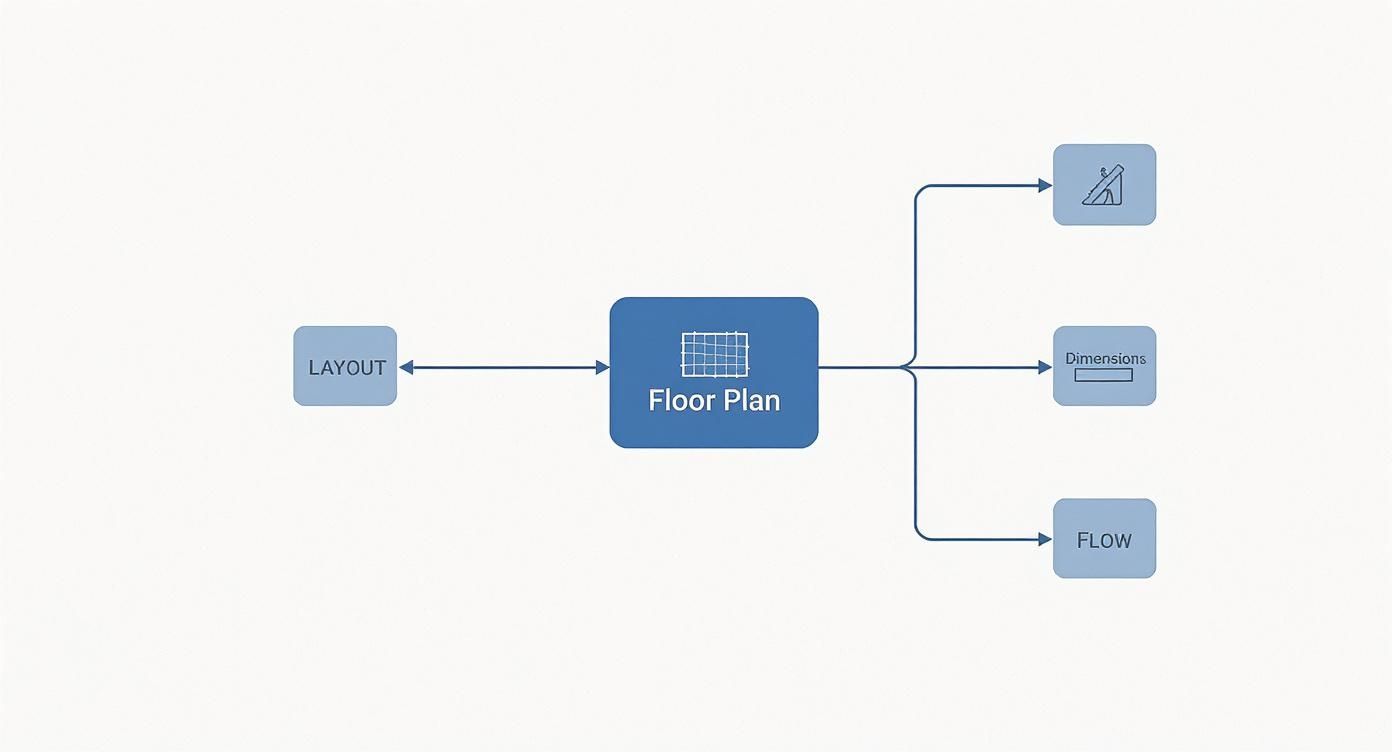
As you can see, the layout, dimensions, and overall flow are all communicated through this shared language of symbols. If you want to go even deeper, check out our guide on how to read house blueprints for a homebuyer—it's a great next step.
To truly master the language of lines and symbols that define your home's structure, learning how to read construction blueprints is an indispensable skill. It empowers you to see beyond the drawing and visualize the finished space.
Once you nail these basics, you're not just staring at lines on paper anymore. You’re actually seeing the future of your home in Harford County, Maryland, and that means you can make decisions with real confidence.
Finding a Home Layout That Fits Your Life
Think of a floor plan as the stage for your family's daily life. Everyone’s rhythm is different, so the layout of your home should feel like it was made just for you, not the other way around. It’s a lot like your wardrobe—it needs to fit your personal style and, more importantly, your lifestyle.
Finding that perfect fit, whether you're looking at homes in White Marsh, Maryland or anywhere in Harford County, Maryland, starts with understanding the basic designs out there.
Home layouts have always shifted to keep up with how we live. The 1970s gave us split-level homes, the 1990s made room for the home office, and since the 2000s, open-concept living has been the star of the show, merging kitchens and living rooms into one big, connected space. If you're curious, you can learn more about the evolution of floor plans to see how we got here.
Matching a Layout to Your Lifestyle
So, what’s the right fit for you? Let's walk through a few of the most popular styles with some practical examples.
Single-Level Ranch: These homes are all about accessibility. With everything conveniently located on one floor, ranch-style layouts are a dream for anyone who wants to ditch the stairs. Practical perk: carrying laundry is a breeze since bedrooms and the laundry room are often on the same level.
Open-Concept Layout: If your house is the go-to spot for holidays and get-togethers, an open-concept plan is probably your jam. It tears down the walls between the kitchen, dining, and living areas, creating a bright, social hub. This means you can keep an eye on the kids in the living room while you’re making dinner. For some inspiration, check out our guide on 10 open-floor plan design ideas.
Multi-Story Homes: Need a little separation? Two-story (or more) homes are fantastic for creating distinct zones. The main floor typically becomes the lively social center, while the upstairs offers quiet, private retreats for bedrooms. It’s a natural way to create balance for a busy family, especially if you work from home and need a quiet office space away from the action.
The best floor plan isn’t just about counting rooms. It’s about how those rooms connect to make your everyday life flow better. From day one, it should feel intuitive, like it was designed just for your family.
Picking the right layout is a massive first step, but the real fun begins when you make it your own. That’s where my proprietary visualization tools come in. We can take any of these foundational floor plans and start playing—swapping out flooring, testing cabinet styles, and previewing countertops—so you can see exactly how your choices will look in your new Baltimore County, Maryland home before a decision is finalized.
Using a Floor Plan to Personalize Your New Home
Okay, this is where the real fun starts. Once you've settled on a layout that feels right, the floor plan becomes your creative playground. It's the blueprint you'll use to pick the finishes, fixtures, and personal touches that turn a house into your home.
Think about the kitchen, for example. Seeing the counter space and cabinet layout in 2D helps you picture how different materials will look and feel in the space. An L-shaped kitchen might be the perfect spot for a dramatic quartz countertop, while a narrow galley style could really open up with lighter-colored cabinets. The floor plan gives you the context to choose finishes that aren't just beautiful but actually work for the room.

Bringing Your Vision to Life
It can be a real challenge to look at flat lines on paper and imagine what they’ll look like in three dimensions. While the builder I represent provides high-quality homes, I go a step further. That’s why I give my clients access to unique proprietary visualization tools that bring a 2D floor plan to life in a vibrant, 3D environment.
Forget the guesswork. My visualizer tools let you digitally play with different flooring, tile, and countertop combinations. You get a real-life preview of your choices before a single hammer swings.
This process lets you see exactly how that dark hardwood flooring looks next to your kitchen cabinets, or how a specific bathroom tile vibes with your vanity. It's an incredibly powerful way to make sure your new home in a community like White Marsh or Edgewood is a perfect reflection of you. In fact, this is a huge part of how we help people design your own home online with confidence.
My goal isn't just to connect you with a high-quality home from a trusted builder. It's to give you a hands-on service and access to visualizers that help you bring your dream space to life, making personal choices with clarity and genuine excitement. We’re here to help you turn a great floor plan into your dream home.
Common Floor Plan Mistakes and How to Avoid Them
A floor plan can look fantastic on paper, but even small oversights can turn into major daily annoyances. Learning how to spot these common mistakes is the secret to choosing a home that truly works for you, not just one that looks good in a drawing.
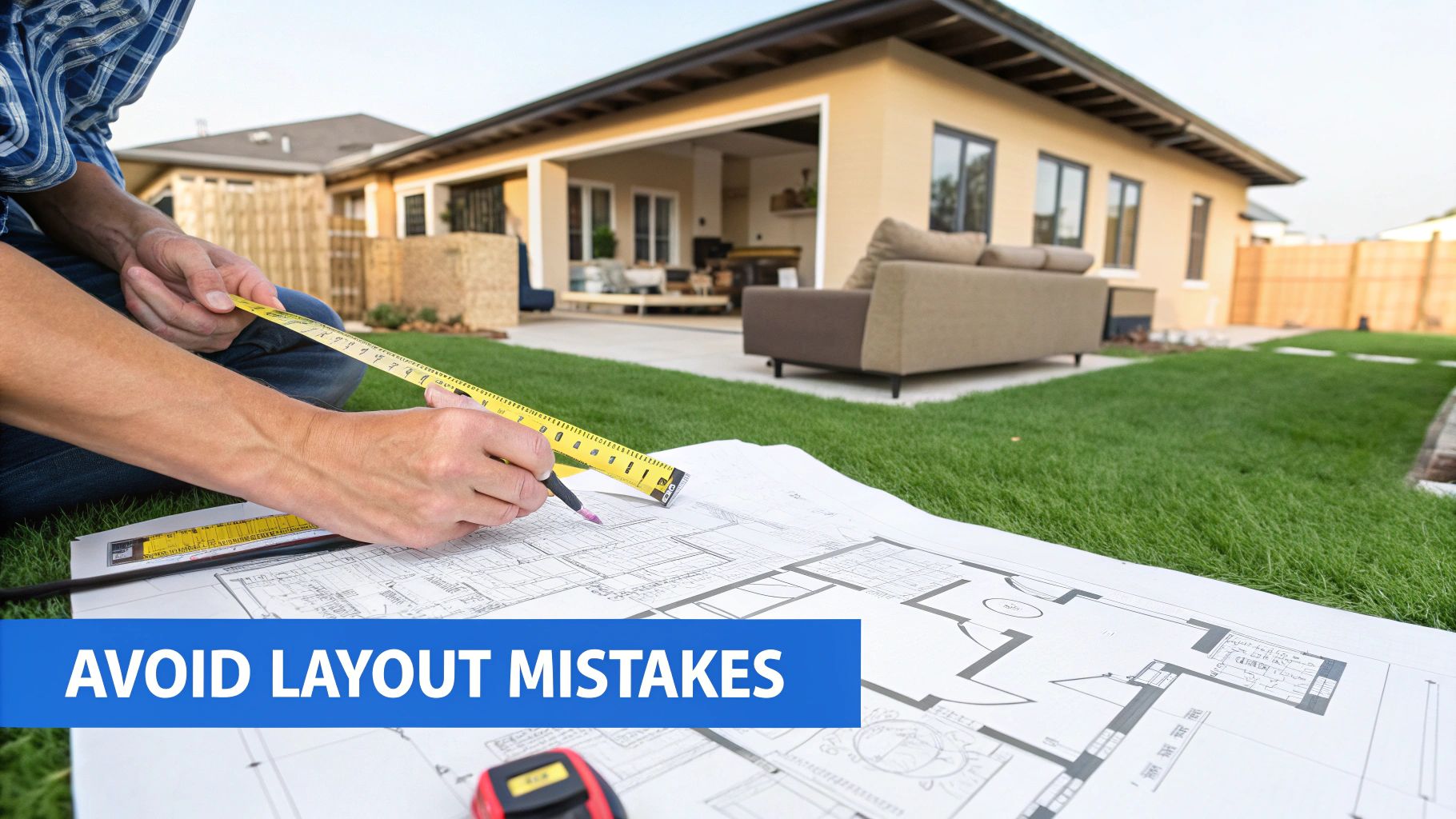
One of the biggest offenders I see is poor traffic flow. Think about it: squeezing past an open dishwasher just to get to the fridge, or a narrow hallway where everyone collides during the morning rush. These little daily frustrations really add up. A great practical test is to literally trace your common paths on the plan. Follow the journey from the garage to the kitchen with groceries, or from the kids' rooms to the laundry room. It should feel easy and logical.
Visualizing Your Life in the Space
Another classic mistake? Forgetting about your actual furniture. That primary bedroom looks huge until you realize your king-sized bed and two nightstands will barely leave you room to walk. You have to think about where your stuff will go from day one.
A well-designed floor plan anticipates how you live. We don’t just exist in rooms—we live on our furniture, and its placement can’t be an afterthought.
To make sure your plan is a good fit, keep an eye out for these potential red flags:
Inadequate Storage: Seriously, where will you put everything? Check for entry closets for coats, linen closets, and a decent-sized pantry. You can never have too much storage.
Poorly Placed Rooms: Is a bedroom right up against the wall of a noisy family room? That’s a recipe for disaster if you have light sleepers. Think about noise and privacy.
Lack of Natural Light: Take a hard look at the windows. A room with just one small, north-facing window is going to feel like a cave, no matter how you decorate it.
This is exactly why I provide my unique visualization tools. We can virtually drop your furniture into the floor plan and even play with finishes like flooring and countertops. It’s a hands-on way to catch these issues early, ensuring your new home in White Marsh or Harford County is a perfect match for your life.
My approach is a little different. I don't just hand you a blueprint and expect you to imagine the rest. I give my clients access to proprietary visualization tools that make a 2D floor plan feel like a living, breathing space. We can actually walk through your future home on-screen, playing with everything from flooring to countertops and watching your choices update right before your eyes. It’s all about making sure you feel 100% confident in every decision.
With the right tools, a floor plan isn’t just a diagram—it’s the interactive starting point for your dream home. You get to make decisions with clarity, not guesswork.
This whole process is designed to put you in the driver’s seat. My job is to help you realize your vision, right here in the communities I know and love. If you’re curious about what’s out there, our guide to new construction homes in Maryland for a perfect fit is a great place to start.
When you're ready to find and personalize a new construction home in Baltimore County, Maryland, Harford County, Maryland, or anywhere nearby, let's talk.
Contact me today to set up a time to chat, and let’s see how we can bring your vision to life together.
Got Floor Plan Questions? I've Got Answers.
Feeling a bit more comfortable with floor plans? Awesome! That's the first step. But as you dig in, questions always pop up. Here are a few I hear all the time from homebuyers just starting out.
What’s the Deal with the Scale on a Floor Plan?
You'll see something like 1/4" = 1'-0" on most plans. Think of it as a map's legend. This little ratio is the key to everything, telling you how the drawing relates to the real-life house. In this case, every quarter-inch you see on the paper represents one full foot of actual space.
It’s how you can be sure that the hallway won't be too narrow or that your king-sized bed will actually fit in the primary bedroom. It keeps everything in proportion.
How Are Floor Plans Different for a New Home?
For a brand new home, the floor plan is your everything. The house doesn't physically exist yet, so this drawing is your single source of truth! It's way more than just a layout; it's the blueprint for every single decision you'll make when customizing your space.
This is what lets you confidently pick out flooring, countertops, and cabinets, because you have a clear picture of the space they'll go into. My 3D visualization tools make this part of the process even more intuitive and, frankly, a lot more fun.
Can I Actually Change a Standard Floor Plan?
Yes and no. Big structural elements, like load-bearing walls, are usually locked in by the builder. You can't just decide to move a wall that's holding up the second story!
But where you have incredible power is in the finishes and non-structural details. The floor plan is your canvas.
This is where the magic really happens. You get to choose your ideal flooring, cabinetry, countertops, tile, and paint colors to transform the standard layout into a personalized space that is uniquely yours.
This customization is at the heart of what I do. With my help and proprietary tools, we can make sure your new home feels like you from the moment you walk in.
Open vs. Closed Floor Plans: What’s the Difference?
It really comes down to walls. An open floor plan tears them down, creating large, combined areas where the kitchen flows into the dining area and then into the living room. It's all about creating an airy, social vibe that’s great for gatherings.
A closed floor plan, on the other hand, is more traditional. Each room is a distinct, separate space with walls and doorways. This creates more privacy and gives you clearly defined zones for different activities.
Ready to take a floor plan and turn it into your dream home in a community like White Marsh or Edgewood? At Customize Your Home, I do more than just hand you a blueprint. I give you exclusive visualization tools that let you see exactly how your choices for flooring, cabinets, and tile will look in your space before a single nail is hammered.
Let’s start bringing your vision to life.
Explore what's possible at https://www.customizeyourhome.com.
Comments