

How to Choose a Home Builder for Your New Home

Alright, let's get down to it. Choosing a home builder is a massive decision—probably one of the biggest you'll make. You're not just hiring a company; you're trusting someone with the place your family will call home. It can feel overwhelming, but I'm here to walk you through it with a friendly, practical approach.
We'll skip the confusing jargon and get straight to what matters: how to research builders, the must-ask questions, and how to tell a genuinely great builder from just an okay one.
This guide is specifically for folks looking at production builders—the ones creating beautiful homes in planned communities. They're the ones who give you the power to really make a house your own by choosing things like:
Flooring
Countertops
Cabinets
Tile and finishes
Think of this as your playbook for finding a builder who not only delivers top-notch quality in communities like White Marsh or Edgewood but also makes the whole process feel supportive and collaborative.
Understanding the Builder Selection Process
The homebuilding world has been a bit of a rollercoaster lately. Net new orders for the big builders have seen a small dip, which has turned up the heat on competition. What does that mean for you? It's actually good news. Many builders are now offering some pretty sweet pricing incentives to win you over. You can get a feel for the current US homebuilding market trends at S&P Global.
With all that going on, you need a smart, structured way to approach your search. I find it helps to break the whole thing down into three core actions, as you can see in the visual below.
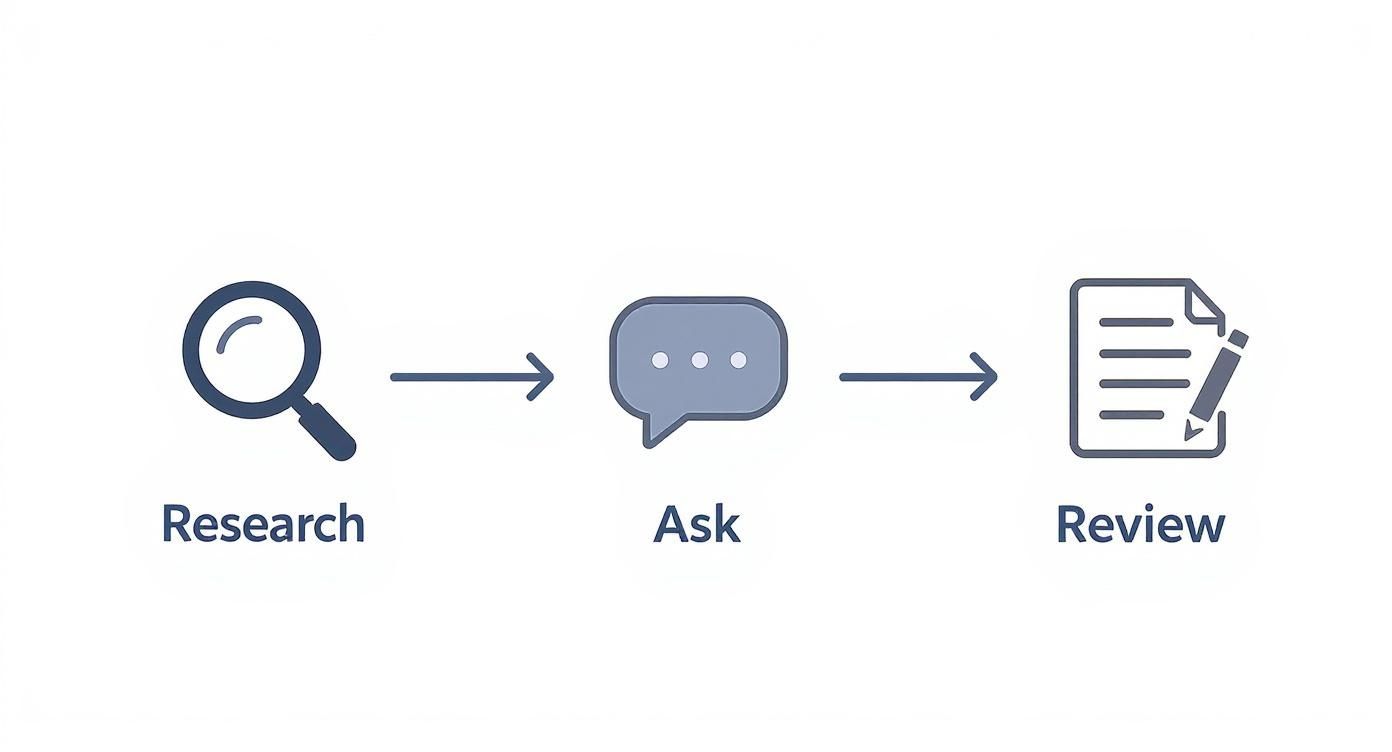
At its heart, this is a process of gathering solid info, having clear conversations, and getting everything locked down in writing. Each step naturally leads to the next, setting you up to make a confident choice without any last-minute surprises.
Key Builder Evaluation Criteria at a Glance
When you're just starting out, it's easy to get lost in the details. This table cuts through the noise and highlights the absolute must-haves to look for in any potential builder.
Criteria | Why It Matters | Quick Tip |
|---|---|---|
Portfolio & Experience | Their past work is the best predictor of your future home's quality. You want to see a history of success. | Look for homes that have a similar style to what you want. Don't just look at photos; visit a model home if you can. |
Reputation & Reviews | What are actual homeowners saying? This gives you the unfiltered truth about their process and customer service. | Dig beyond their website testimonials. Check Google Reviews, the Better Business Bureau (BBB), and local forums. |
Communication Style | A builder who communicates clearly and proactively will make the entire construction process far less stressful. | During your first meeting, pay attention to how they answer your questions. Are they direct and patient, or vague and rushed? |
Cost Transparency | Hidden fees and surprise costs are a homebuyer's worst nightmare. You need a builder who is upfront from day one. | Ask for a detailed cost breakdown. A good builder will have no problem explaining every line item. |
Warranties & Support | What happens after you get the keys? A solid warranty shows a builder stands behind their work. | Request a copy of their warranty documentation. Understand what’s covered (and for how long) before you sign anything. |
Think of these criteria as your initial filter. If a builder doesn't check these boxes, it's probably best to move on and focus on the ones who do. It saves you time and helps you zero in on the true contenders.
Laying the Groundwork to Research Potential Builders
Before you step into a breathtaking model home and get swept off your feet, it pays to do a little homework first. Seriously, this upfront research can be a total game-changer. It’s your chance to get a lay of the land and see who’s building in the areas you’re dreaming of—whether that’s a quiet suburb in Baltimore County, a convenient spot in White Marsh, or a new community in Harford County.
Think of it as your prep work. Doing it right sets the foundation for a smooth, successful home-building journey.
The first place most of us look? A builder’s website. Take a good look. Is it professional? Easy to get around? Can you clearly see their communities, browse floor plans, and maybe even take a virtual tour? A builder who puts effort into their website usually brings that same modern, customer-first attitude to the whole process.
Start Your Search Online
The hunt for the perfect home builder often begins right from your couch. Go ahead and start a list of builders who are active in the specific towns you’re considering, like Edgewood or somewhere in Prince George's County. A quick search for "new homes in your city" is a great way to kick things off.
As you click through their sites, keep an eye out for the details.
Portfolio and Past Projects: Do their homes have the look and feel you're going for? A solid photo gallery of finished homes is the best way to gauge their design style and the quality of their work.
Helpful Resources: Do they offer tools that actually help you? For instance, I provide my clients with unique proprietary visualization tools to help bring their dream space to life. A builder with their own visualizers—letting you play around with flooring, cabinet, and countertop options online—is showing they want you to have a great experience.
Clear Information: How easy is it to find what you need? If you’re struggling to find basic info like where they build or what floor plans they offer, that could be a red flag.
Digging for Genuine Reviews and Reputation
A builder's website is their highlight reel, but you need the whole story. That means tracking down real, unfiltered reviews from past customers. Polished testimonials are one thing, but what are actual homeowners saying on other sites?
A builder's reputation is built one home at a time. Checking reviews on Google, and local community forums gives you a much clearer picture of what the entire building journey will be like, from the first meeting to post-move-in support.
Don't just glance at the star ratings—read the comments. Are you seeing consistent praise for good communication, sticking to the timeline, and quality construction? That's a great sign. On the flip side, if you see a pattern of complaints about unresolved issues or poor service, it's definitely something to think about.
Verify Licenses and Insurance
This part is non-negotiable. Before you get too invested in any one builder, you absolutely have to confirm they are properly licensed and insured.
Every state has its own rules, but any reputable builder will gladly give you their license number. You can usually check it on your state's licensing board website. For example, in Maryland, you'd check with the Maryland Home Builder Registration Unit.
Insurance is just as critical. The builder needs to have both general liability insurance and worker’s compensation. This is what protects you from being on the hook if an accident happens on your property during construction. It’s a simple check that provides huge peace of mind.
It also helps to know who's running the show. A great builder is also a skilled general contractor, managing all the different trades and timelines. To get a better handle on this, check out our guide that explains what a general contractor is and why you need one.
While it's geared toward renovations, this article on how to find the best renovation contractor has some fantastic, universal advice on how to properly vet professionals. By putting in this effort now, you’re not just picking a builder; you’re choosing a partner for one of the biggest investments you'll ever make.
The Interview Process and Questions You Must Ask
Alright, you’ve done your homework online, sifted through reviews, and have a shortlist of builders. Now comes the most critical part of the whole process: talking to them face-to-face. Think of it less like an interrogation and more like a friendly chat where you're the one doing the hiring. After all, you’re looking for a partner to build your family’s future.
A great builder won’t just put up with your questions; they’ll welcome them. They get it—this is a massive decision. This conversation is your chance to see if your personalities click and if their communication style works for you.

This meeting is about digging much deeper than just asking, "So, how long have you been in business?" You’re trying to find a true partner for this journey.
Can I Make It My Own? (The Personalization Process)
For most people, the whole point of building a new home is making it truly theirs. This is where you finally get to choose the flooring you’ve pinned a hundred times, the countertops you've been dreaming of, and the cabinet style that will be the heart of your kitchen. How a builder handles this part of the process speaks volumes.
Here’s what you need to ask to get a feel for their design experience:
Walk me through your design and selection process from start to finish. You want a play-by-play. For example, do you meet at a design center? Do you get a dedicated consultant? How many hours are included?
Can I pop into the design center before I sign anything? Seeing the options with your own eyes is a game-changer. It gives you a real sense of their standard finishes and the kind of upgrades you can choose from.
How do you help people like me visualize our choices? This is where some builders really separate themselves from the pack. While the builder I represent provides high-quality homes, I go a step further—offering my clients unique proprietary visualization tools, hands-on service, and access to visualizers that help you bring your dream space to life.
Your goal is to find a builder who makes the design phase feel fun and collaborative, not stressful. A hands-on approach paired with modern tools can make all the difference in bringing your vision to life.
How Will We Stay in Touch? (Communication and Timelines)
Building a home is a marathon, not a sprint. Clear, consistent communication is the glue that holds everything together. You absolutely need to know who you’ll be talking to and how often you'll get updates.
Get right to the point with these questions:
Who is my one point of contact for the entire build? Having a dedicated project manager who knows your name and your project inside and out is crucial. It prevents things from getting lost in translation.
How often will I hear from you about my home’s progress? For instance, will I get a weekly Friday email with photo updates? Or is there an online portal I can check anytime? A good builder will have a system in place to keep you in the loop.
What’s the plan when things go wrong? Let's be real—delays happen. Whether it's a surprise storm or a material shortage, you want a builder who has a clear plan for letting you know and getting things back on track.
What Happens After I Move In? (Warranties and Support)
The day you get the keys isn't the end of your relationship with the builder. A solid warranty is their promise that they stand behind their work. Don't be timid about digging into the details here.
Drill down on their warranty coverage with these questions:
Can you send me a copy of your full warranty document? Don't just rely on a verbal summary. Get the document and read the fine print so you know exactly what’s covered and for how long.
What’s the process if I need to make a warranty claim? Is it a simple online form, or do you have to jump through hoops? Knowing this upfront can save you a ton of headaches later.
What, specifically, is covered under the workmanship, systems, and structural warranties? You should see something like one-year coverage for materials and labor, one year for systems (plumbing, electrical, HVAC), and ten years for major structural components.
To help you stay organized, we've put together a handy table with all the essential questions you should bring to your meeting.
Essential Questions for Your Builder Interview
Category | Question to Ask | What You're Looking For |
|---|---|---|
Experience & Reputation | How many homes have you built in this community? Can I speak to a few recent buyers? | A track record in your area and happy homeowners who are willing to vouch for them. |
Design & Customization | Can I see the design center before signing? What visualization tools do you offer? | Transparency and modern tools (like our visualizers) that help you see your choices. |
The Build Process | Who is my main point of contact? How often will I receive progress updates? | A single, dedicated contact (like a project manager) and a clear, proactive communication schedule. |
Budget & Costs | What’s included in the base price? What are the most common upgrades and their costs? | A detailed list of standard features vs. upgrades, so there are no surprises. |
Timeline | What’s the average build time for a home like the one I want? How do you handle delays? | A realistic timeline based on experience and a clear plan for communicating and managing setbacks. |
Warranty & Support | Can I review the full warranty document? What is the process for a service request? | A comprehensive, easy-to-understand warranty and a simple process for post-move-in support. |
Use this table as your guide during the interview. It's not about catching them in a "gotcha" moment; it's about making sure you have all the information you need to make the best choice for your family.
The residential building market is huge, growing from $4,313.42 billion to $4,505.05 billion worldwide. In the US alone, there are over 456,000 home building businesses. That means you have options, putting you in the driver's seat. You have the power to choose a builder who gives you straight answers and shows a real commitment to your long-term happiness. Walking into these meetings prepared is the first step toward building a house you’ll love.
Getting a Grip on Contracts, Costs, and Financing
Alright, let's get into the part that often feels the most overwhelming: the money. But here’s the thing—a good, transparent builder will make this conversation feel clear and straightforward, not like a high-pressure sales pitch. When you can demystify the financial side of things, you’re well on your way to picking a home builder you can truly trust.
Think of the contract as the blueprint for your entire project. It's absolutely crucial that you understand it. Don't be intimidated by a thick stack of papers. A great builder will happily sit down and walk you through every line.
What to Look for in Your Builder Contract
First up, you’ll see the base price. This is what the house costs with all the standard, out-of-the-box features. The most important question you can ask right now is, "What's actually included as standard?"
My advice? Get a detailed list of every single standard inclusion before you even dream of signing. For example, if the contract just says "kitchen appliances," that's a red flag. It should specify the brand and even color. This clarity saves you from a world of expensive surprises down the road.
You'll also run into terms like allowances. This is essentially a budget the builder sets for items you get to personalize, like your countertops or light fixtures. For instance, your contract might have a $3,000 allowance for lighting. If the chandeliers you fall in love with total $3,500, you’ll pay that $500 difference out of pocket. A good follow-up question is always, "Is this allowance realistic for the level of quality I'm looking for?"
Then there are change orders. This is the official paperwork you’ll fill out if you decide to change something after the contract is signed—say, adding built-in bookshelves in the living room. It documents the new cost and any potential delay to the timeline. Just be aware, making changes once construction has started can get expensive fast.
How to Handle Material Costs and Price Swings
It’s no secret that the price of building materials can be a real rollercoaster. We’ve all seen how much the cost of lumber, drywall, and other essentials can jump around. This is a conversation you absolutely must have with any builder you’re considering.
Ask them point-blank: "How does your contract protect me from surprise material price increases?"
A builder worth their salt will have a clear, fair policy. Some lock in prices with their suppliers at the start of the project, while others might have a specific clause that outlines how any unforeseen cost changes are handled. That kind of transparency is what protects you from getting a massive, unexpected bill.
These costs are tied to big economic trends. In fact, effective tariff rates for construction goods have recently hit a 40-year high of 25% to 30%. This directly impacts what builders pay for materials, which can trickle down to you. Builders who have solid, long-standing relationships with their suppliers are often in a much better position to manage these price swings. You can read more about these construction industry cost factors on deloitte.com.
Your Financing Options
Getting a loan for a new construction home works a little differently than for a resale. Many builders have what they call preferred lenders. Working with them can have some real perks, like a super smooth closing process or even credits that reduce your closing costs, because that lending team already knows the builder's process inside and out.
But that doesn't mean you shouldn't shop around. You always have the right to choose your own lender.
Get a loan estimate from the builder's partner and at least one or two others. Compare the interest rates, fees, and terms side-by-side to make sure you’re truly getting the best deal for your family.
It's also a smart move to understand what a contingency fund is and how it can be a lifesaver. For more on that, take a look at our guide on what a construction contingency is and why you need one. It’ll give you some extra peace of mind.
Bringing Your Vision to Life with Design Choices
Okay, you've done the hard part. You’ve sifted through builders, asked all the right questions, and finally made your choice. Now for the fun stuff—turning that floor plan into a home that feels like you. This is where your personality gets to shine in every room.
When you work with a production builder, the design process is a guided journey where you get to pick your flooring, countertops, cabinets, tile, and more. It’s an exciting series of choices that come together to create your perfect space.
Making the Most of Your Design Appointment
Walking into your design center appointment can feel a little intimidating, but a bit of prep work makes all the difference. I always tell people to start gathering inspiration early. Pin everything you love on Pinterest or save images to a folder. When you have a visual collection, it's so much easier for you and the design consultant to get on the same page.
You also need to have a budget in mind for upgrades. Seriously, know your priorities. Are you willing to splurge on gorgeous, durable quartz countertops but perfectly happy with the standard lighting fixtures for now? Figure that out beforehand. It helps you make smart decisions on the fly without getting overwhelmed by all the beautiful options.
The design phase is where a builder's true colors show. The best ones offer tools and support that make this feel like a fun, creative collaboration, not a stressful exam.
The Power of Seeing It All Come Together
Here’s where some builders really pull ahead of the pack. Have you ever tried to imagine how gray cabinets, a specific granite, and a tile backsplash will look together just by holding up a few tiny samples? It's tough. And it leaves way too much to chance.
Now, picture this instead: I provide my clients hands-on service and access to unique visualizers that show you exactly how your selections will look in your new kitchen or bathroom before anything is installed. Honestly, it's a game-changer. It takes all the guesswork and anxiety out of the equation, letting you play around with different combinations until you find the one you love.
See Your Kitchen: Instantly see how that cabinet color you’re considering pairs with different countertop styles.
Visualize Your Bathroom: Test drive various tile patterns for your shower or floor without any commitment.
Perfect Your Palette: Make sure all your finishes—from flooring to fixtures—flow together beautifully.
This turns what could be a really stressful series of decisions into a creative and genuinely enjoyable process. The goal is that when you walk into your finished home, you're not just happy—you're thrilled because you've already seen it all come to life.
Planning Your Space Beyond the Finishes
While you're dialing in your interior design choices, don't forget to think about how you'll actually live in the space. Figuring out how your furniture will fit and how your family will move through each room is just as crucial as picking the perfect paint color. A great way to get a feel for this is by learning how to read house blueprints with our homebuyer's guide. It really helps you visualize your daily life before the first wall even goes up.
It's also the perfect time to think about other practical additions that add value and peace of mind. For instance, if you're in an area with unpredictable weather like Maryland, talking to your builder about a backup power system is a smart move. You can learn how to choose a home generator to find one that fits your family's needs. Planning for these kinds of details during the build is almost always easier and cheaper than trying to add them later.
Ready to Find Your Perfect Builder?
You've put in the work, learned what to look for, and figured out the crucial questions to ask. Now you're ready to pick a home builder who feels like a true partner in this journey. It all comes down to solid research, asking the right things, and ultimately, trusting your gut about who you can build a great relationship with.
Remember, this isn’t just a transaction; it’s a partnership. A great builder doesn't just put up walls—they make the whole experience feel exciting and collaborative. If you want a closer look at what that entire journey entails, our complete guide to the new home construction process breaks it all down.
Let's Build Your Dream Home Together
If you're looking for a new home in top Maryland communities—whether it's White Marsh, Edgewood, or other amazing spots in Baltimore County, Harford County, or Prince George's County—we'd love for you to see what makes our approach different.
While the builder I represent provides high-quality homes, I go a step further—offering my clients unique proprietary visualization tools, hands-on service, and access to visualizers that help you bring your dream space to life. No more guesswork, just confidence in your design.
Building a home should be an exciting milestone, not a stressful ordeal. My process is designed to give you clarity, control, and a final result you'll absolutely love for years to come.
Ready to build a home that feels perfectly you? Get in touch to see our available homes and learn how my process can make all the difference.
Got Questions About Building a New Home? We've Got Answers.
Building a new home is a huge milestone, and it’s totally normal to have a long list of questions. Let’s be honest, it's not something you do every day! We get it. Here are some straight-up answers to the questions we hear most often, so you can feel confident every step of the way.
What's the Difference Between Builder Types?
You’ll hear a few terms thrown around, but this guide focuses on production builders. A production builder—that’s us—builds homes in a planned community on land they already own. We offer a collection of fantastic, time-tested floor plans that we know work for modern families. The fun part for you is making it your own by getting to pick your flooring, countertops, cabinets, tile, etc. It’s the perfect middle ground: you get a personalized, brand-new home without the headaches of starting completely from scratch.
How Long Does It Take to Build a Home?
This is the big one, isn't it? The honest answer is: it depends. The timeline can stretch or shrink based on things like the size of your home, the complexity of your design choices, and how quickly the local permitting office moves. Even the weather can throw a wrench in the schedule.
As a general rule of thumb, plan for the whole process to take about 7 to 12 months for most builders, 5 to 6 months for us—from the day you sign the papers to the day we hand over the keys. A good builder will give you a clear schedule and keep you in the loop every step of the way, especially if there are any hiccups.
Is the Price of a New Home Negotiable?
This is a tricky one. With new construction, the base price of the home itself is usually set in stone. But that doesn't mean there's no wiggle room.
Often, the negotiation comes in the form of incentives. Depending on the market and the specific community, a builder might offer to help with your closing costs, give you a credit to spend on upgrades in their design center, or even throw in a premium appliance package. For example, you might see an offer for "$10,000 towards closing costs" or "a free gourmet kitchen upgrade." It absolutely never hurts to ask your sales consultant what promotions are on the table.
Here at Customize Your Home, we think building your perfect home in a community like White Marsh or Edgewood should be exciting, not stressful. With our one-of-a-kind visualization tools, personal service, and an absolute obsession with quality, we make sure you get a home you’ll love for years to come.
Ready to see what makes us different? Let’s start the conversation at https://www.customizeyourhome.com.
Comments