

How to Choose Interior Doors for a Cohesive Home Design

When it comes to choosing interior doors, it’s really a balancing act between style, function, and material. You want something that fits your home's design but also meets your day-to-day needs. It's best to think of doors as more than just dividers—they're architectural features that shape a room, control noise, and pull your entire design together.
Why Your Interior Doors Matter More Than You Think
So, you're getting a new home. Picking out interior doors might seem like a minor detail compared to, say, kitchen countertops, but they have a huge impact on your home's character and overall feel. Doors aren't just barriers; they're one of the most interactive design elements in your house, offering privacy, defining style, and adding that final, polished touch.
This guide will walk you through all the nitty-gritty details, from weighing the pros and cons of different materials to finding a style that clicks with your home's vibe. I'll share some practical tips and real-world advice to help you feel totally confident in your decisions.
A Note on Customization and Quality
In my new home communities across Maryland, I let my clients personalize everything from flooring to cabinets. But one thing I pre-select is the interior doors, and I want to explain why. The doors we install in our homes—whether in White Marsh, Edgewood, or anywhere in Baltimore and Harford County—are high-quality models.
Honestly, it's one of those decisions that guarantees long-term value and saves you a ton of hassle down the road. You can use my visualization tools to see how your other design choices come together, and our guide on how to design your own home online is a great place to start.
As you get started, it's smart to look at resources like a comprehensive guide to prioritizing home improvement projects. This helps you see how your door selection fits into the bigger picture, ensuring everything comes together to create a cohesive, well-thought-out home.
What's Inside Matters: A Look at Door Materials and Cores
Alright, let's talk about what a door is actually made of. This is where you get into the real nitty-gritty of quality and performance. The material and core construction are what separate a door that feels flimsy and lets every sound through from one that feels solid, substantial, and helps keep your rooms quiet.
You'll hear two main terms thrown around: hollow-core and solid-core. Getting the difference between these is probably the most important decision you'll make, as it directly impacts the feel of your home.
Hollow-Core Doors: The Budget-Friendly Option
Hollow-core doors are exactly what they sound like. Inside, they have a honeycomb-like structure made of cardboard, which is then covered by a thin skin of wood veneer or a molded composite material.
They're incredibly lightweight and easy on the wallet, which is why they're often used for closets, pantries, and other low-traffic spots where sound isn't a big concern. For example, the door to a linen closet doesn't really need to block noise. Because they're so light, they're also easy to install and don't put much strain on the door frame. The downside? They offer almost no sound insulation and can be dented or punctured pretty easily.
Solid-Core Doors: The Sweet Spot for Quality and Quiet
Now we're talking. Solid-core doors are a serious upgrade. They're filled with a solid material—usually a composite wood product like MDF (medium-density fiberboard) or particleboard—and then wrapped in a high-quality wood veneer.
The difference is night and day. They feel heavy and sturdy in your hand, and their biggest win is sound dampening. A solid-core door is a fantastic noise-blocker.
Ever had a home office right next to the kids' playroom? A solid-core door can be a sanity-saver. I’ve seen them make a massive difference in laundry rooms and bedrooms, too. It’s one of those small upgrades that truly elevates your daily life.
They're the perfect choice for any room where you want a bit of peace and privacy, like bedrooms, bathrooms, and home offices.
Solid Wood Doors: The Gold Standard
For pure, unmatched beauty and that classic, hefty feel, nothing beats a solid wood door. We’re talking doors crafted from a single species of wood, showcasing beautiful, natural grain patterns.
They are the ultimate sound-blockers and feel incredibly durable. Of course, this premium quality comes with the highest price tag. They also need a bit more care, as solid wood can sometimes warp or swell in very humid climates if not properly sealed and maintained. For instance, a solid pine door might be a beautiful choice for a bedroom, but it requires careful finishing to prevent issues.
The appeal of wood is timeless, and it’s not just about looks—it’s a long-term investment. The global market for wooden interior doors was valued at $40.5 billion in 2024 and is projected to hit $65 billion by 2034. That kind of growth tells you that quality wood and composite doors are a feature that homebuyers value, adding real, lasting worth to homes in communities from White Marsh to Edgewood.
To help you sort through these choices, here’s a quick-glance table comparing the different core types.
Comparing Interior Door Core Types
Door Core Type | Typical Material | Best For | Pros | Cons |
|---|---|---|---|---|
Hollow-Core | Honeycomb cardboard or plastic with a thin wood veneer or composite skin | Closets, pantries, low-traffic areas | Inexpensive, lightweight, easy to install | Poor sound insulation, easily damaged |
Solid-Core | Composite wood, particleboard, or MDF core with a wood veneer | Bedrooms, bathrooms, offices, high-traffic areas | Excellent sound-dampening, feels substantial, durable | More expensive than hollow-core, heavy |
Solid Wood | Solid planks of a single wood species (e.g., oak, pine, cherry) | Any room where premium quality and aesthetics are desired | Best sound insulation, classic beauty, highly durable | Most expensive, can be prone to warping if not maintained |
As you can see, the right choice really depends on the specific room and your priorities—balancing budget, durability, and the need for quiet.
If you're a visual person, this little decision tree can help you map out your choices based on style, privacy needs, and how the door needs to function.
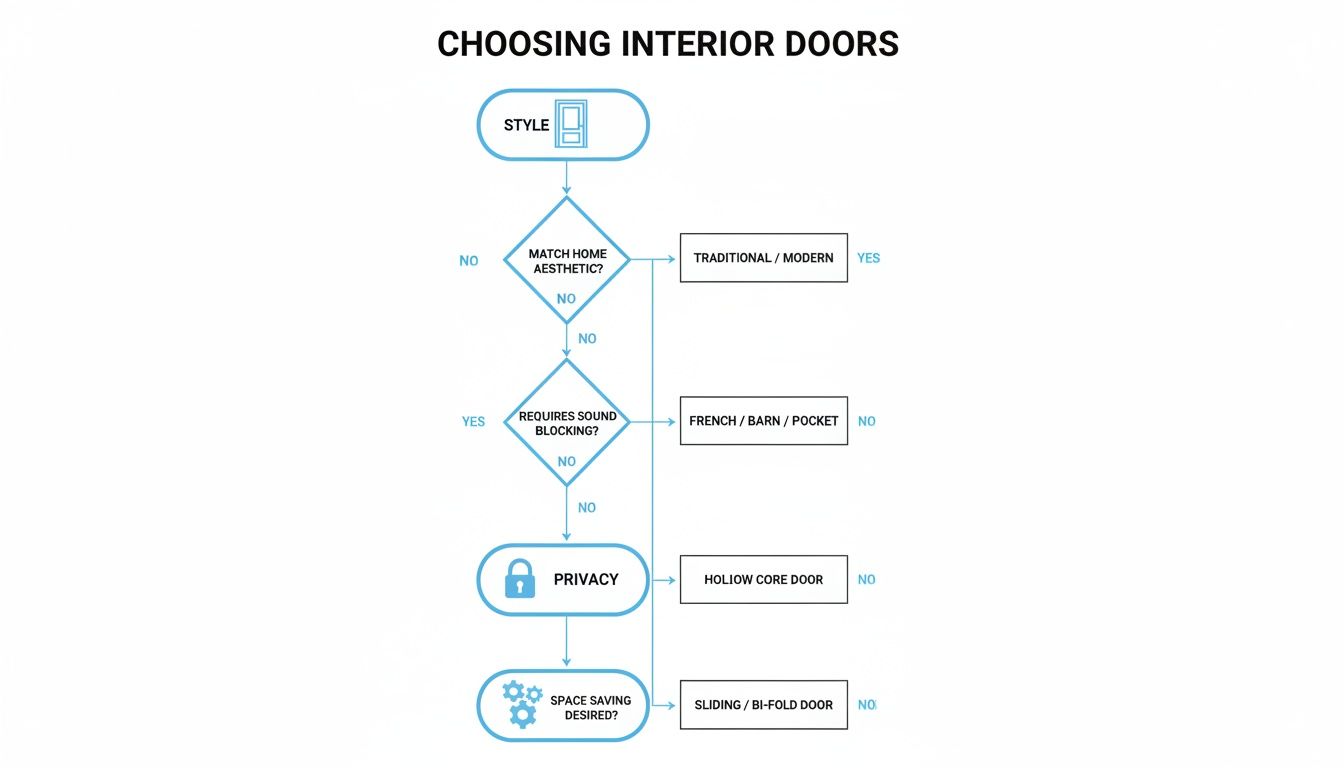
As the flowchart suggests, start with your home's overall style, then dial in on the practical needs of each space.
Don't Forget About Glass and Other Materials
Doors don't have to be solid slabs of wood! Incorporating glass panels is a fantastic way to let natural light flow through your home, making spaces feel bigger and brighter.
For a clean, modern vibe where you want maximum light, you can even explore ultra clear glass options for doors. If you need light and privacy, frosted, reeded, or textured glass is a perfect solution for places like a home office, pantry, or even a master bathroom. For instance, a pantry door with a frosted glass panel that says "Pantry" is a classic, charming touch.
Finding a Door Style That Fits Your Home's Vibe
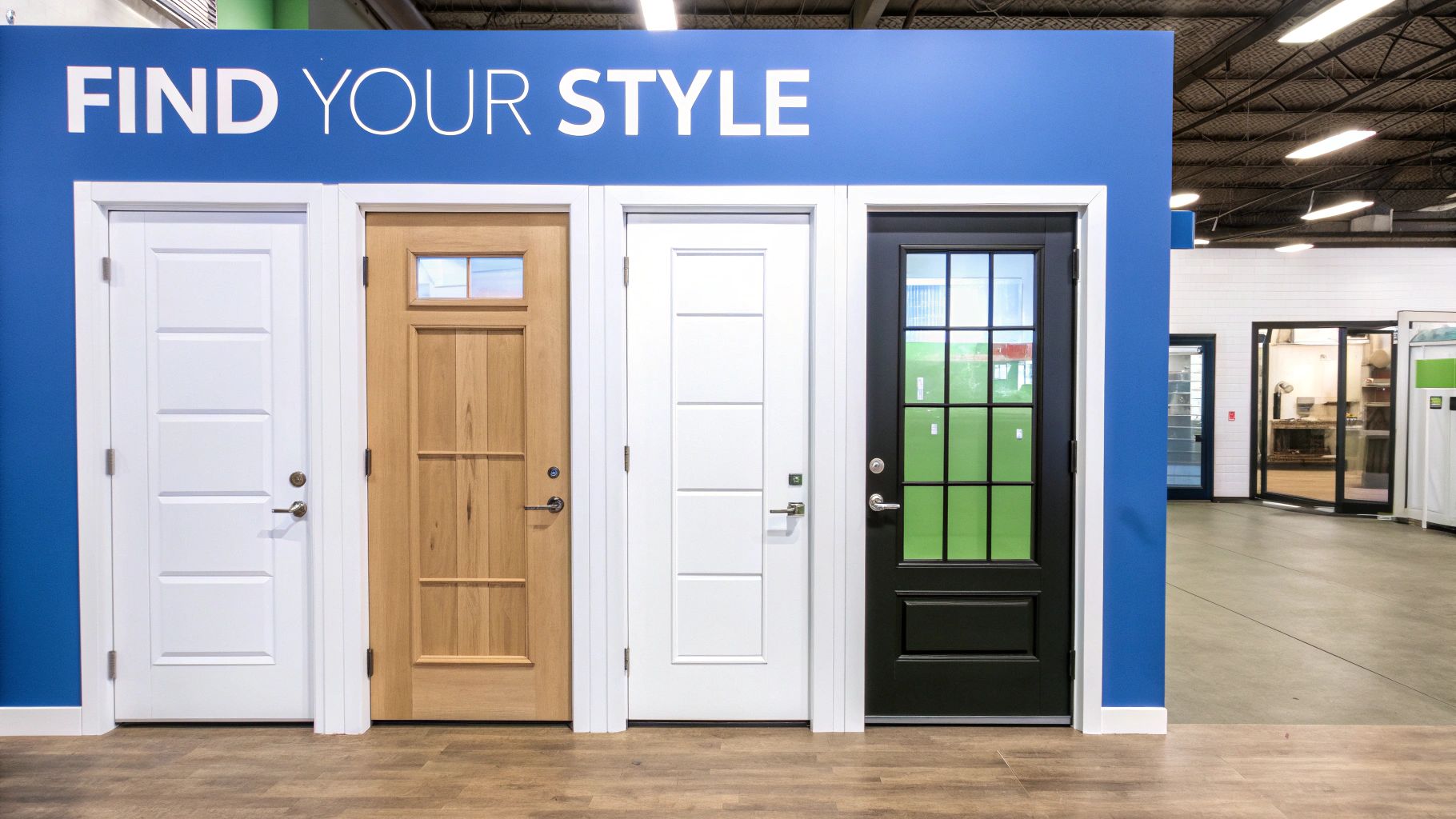
Alright, this is where the fun really begins—picking a style that gives your home its personality. Doors are so much more than just a way to close off a room; they're a huge part of your home's visual story. They can blend in quietly or stand out as a bold statement piece.
Think of it this way: your door style is like the right accessory for an outfit. It needs to pull everything together. The goal is a cohesive look that feels intentional, whether your new home has a modern minimalist retreat, a cozy farmhouse, or a timeless, traditional elegance.
Classic Styles That Always Work
Some door designs are classics for a reason. They’re versatile, look great in almost any setting, and are a safe but sophisticated bet for most homes.
Panel Doors: These are the true chameleons. A classic six-panel design gives off a traditional, almost stately vibe. But a simpler two or three-panel Shaker door? That’s the sweet spot for modern farmhouse and transitional styles. Picture a clean, white Shaker door in a kitchen with dark countertops—it just works.
Flush Doors: If you're going for a clean, contemporary look, you can't beat a flush door. Its perfectly flat, unadorned surface is the definition of minimalism. It doesn't fight for attention, which is perfect when you want your furniture, art, or other architectural details to be the star of the show.
French Doors: With their signature glass panes (we call them "lites" in the biz), French doors are all about letting light flow through your home. They create an open, airy connection between spaces—ideal for a home office or dining room where you want separation without total isolation.
When I’m working with clients in Baltimore County or Harford County, this is the point where we break out the visualization tools. Seeing how a six-panel door looks next to your actual flooring choice makes all the difference.
Modern Trends and Creative Choices
While the classics are great, don't overlook some of the exciting modern trends that can inject a ton of personality into your space. These choices can turn a simple doorway into a true design feature.
Barn doors, for example, have moved beyond the farmhouse and into pantries, offices, and master bathrooms. They slide on a track, saving you precious floor space and adding a cool architectural element. Another favorite of mine is adding frosted or reeded glass inserts to panel doors. It's a fantastic compromise between letting in light and maintaining privacy.
Don’t be afraid to think outside the box with unique panel layouts. Doors with horizontal panels can make a hallway feel wider, while a single, large panel creates a very modern and dramatic effect. These subtle choices have a big impact on the final feel of a room.
Color is another game-changer. White is always a safe bet, of course. But painting your interior doors a dramatic charcoal gray or a deep, moody navy can add an incredible layer of sophistication. If that idea sparks your interest, our guide on how to choose paint colors for your home is packed with inspiration.
Ultimately, the right style is the one that feels like a natural extension of your home’s story—and your own.
Thinking Beyond the Swing: Different Door Types
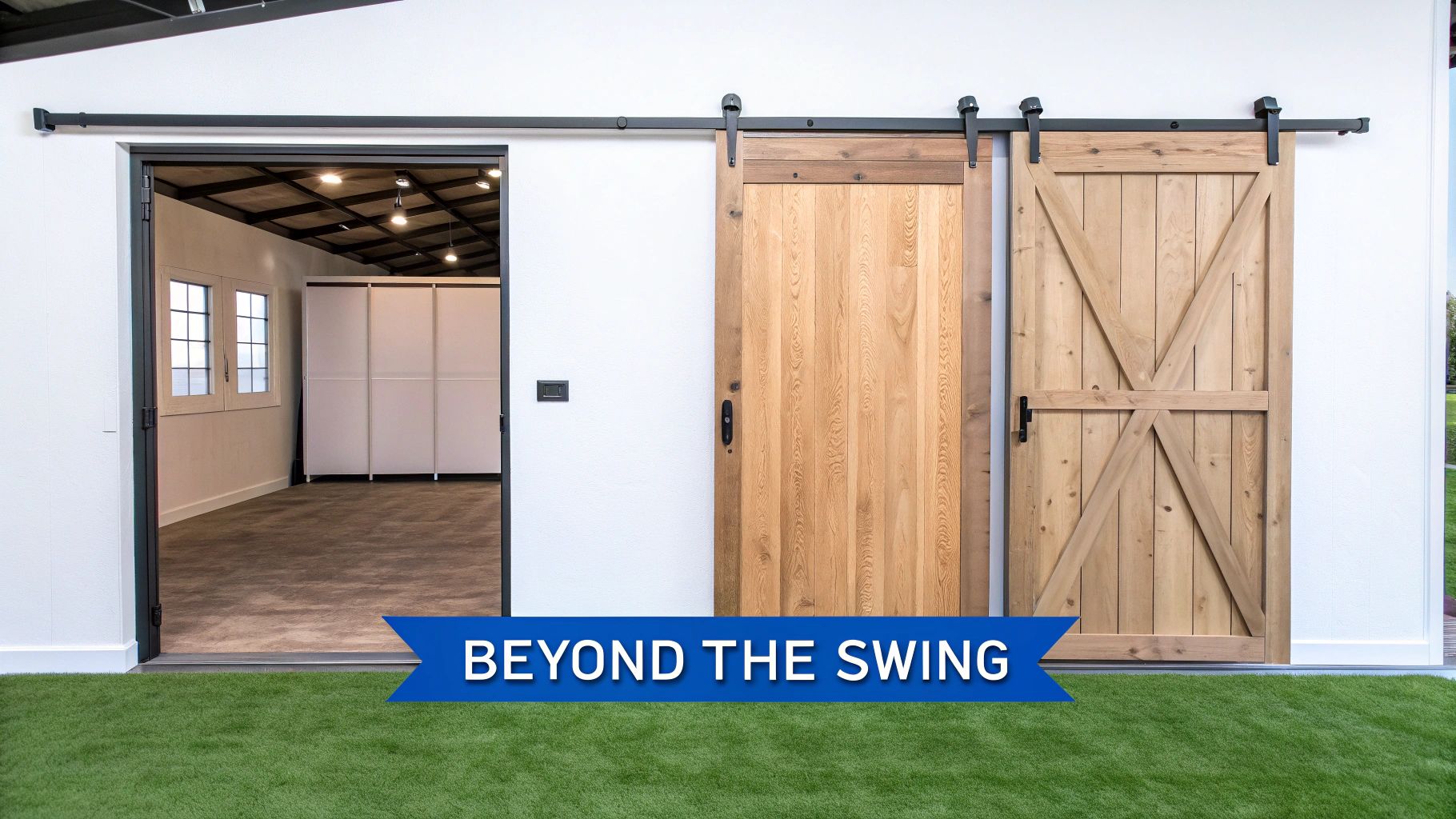
How a door opens and moves is just as important as how it looks. The classic swinging door is a reliable workhorse, but let’s be honest—sometimes it’s not the smartest tool for the job. Exploring different door types can unlock hidden potential in your floor plan, making rooms feel bigger and way more functional.
This is a key part of the design process. When my clients are customizing their homes in Maryland communities like White Marsh or Edgewood, we look at the entire flow of a space. You'd be surprised how often swapping out a standard door for a different mechanism completely changes how a room can be used.
Space-Saving Wonders: Pocket Doors
Ever been in a small bathroom or tight laundry room where the door swing makes things feel incredibly cramped? This is where a pocket door is a true hero. These doors slide right into a hidden compartment inside the wall, completely disappearing when they’re open.
Because they don't swing out into the room, you gain back valuable square footage. Imagine a small home office off a busy hallway; a traditional door would eat up precious space, but a pocket door maintains an open feel while still offering privacy when you need to focus.
They are a fantastic solution for:
Powder Rooms: Maximizing every inch in a small guest bathroom.
Walk-in Closets: Allowing for more storage and easier access without a door in the way.
En-suite Bathrooms: Creating a seamless transition from a bedroom to a bathroom.
Making a Statement with Barn Doors
Barn doors have exploded in popularity, and for good reason. They slide along a track mounted above the doorway, acting as a moving piece of wall art. While they offer less sound privacy than a traditional door, they are perfect for separating spaces where a solid seal isn't critical.
Think of them as a stylish way to define zones in your home. I've seen clients use them beautifully to close off a pantry from the kitchen, a home office from a living area, or even a master bathroom from the bedroom. They add a touch of rustic or industrial charm and become an instant focal point.
The Practicality of Bifold and Sliding Doors
For closets, bifold doors are often the standard. They fold in on themselves, giving you wide-open access to the entire closet at once—much better than a swinging door that blocks half of it.
Similarly, sliding doors (often seen as mirrored closet doors) operate on a track and are great for wide closets where you don't have room for a bifold to fold out. Both are practical, space-efficient choices for storage areas.
Choosing the right door mechanism profoundly impacts your home's flow and even its long-term value. While swinging doors remain the most popular choice, holding a 61.4% market share, understanding how different types work lets you make smarter, more functional design decisions. Smart choices now can pay dividends later, especially in the thriving residential markets of Baltimore and Harford County.
One important thing to remember is sound. While pocket and barn doors are great for saving space, they don't seal as tightly as a well-fitted swinging door. This means they're less effective at blocking noise. For rooms where quiet is a top priority, like a bedroom or a dedicated media room, a high-quality, solid-core swinging door is still your best bet.
For more ideas on managing noise levels, check out our guide on how to soundproof a room for total peace and quiet.
By thinking beyond the simple swing, you can create a home that not only looks great but works better for your everyday life.
Why High-Quality Doors Are a Smart Investment
When you're designing your new home, it’s all about the exciting choices—picking out flooring, countertops, and cabinet styles. So, you might be wondering why interior doors aren't usually on that list of custom options. I want to give you a little insider perspective on why that is, because it's a decision we make with your long-term satisfaction in mind.
It really comes down to guaranteeing quality and durability from the moment you move in. I’ve seen it time and time again: a cheap, flimsy door quickly becomes a daily headache. A hollow door might look okay on day one, but soon enough, it starts to warp, stick in the frame, or just feel cheap every single time you close it.
That's why we pre-select high-quality, solid-core doors for every home we build. It ensures that a premium feel is baked right into the house. It's one less thing for you to worry about.
The Built-In Benefits of a Better Door
Think of it as an upgrade we’ve already taken care of for you. It's a foundational choice that protects your investment and saves you from the small, everyday frustrations that come with poor-quality hardware. This is a core part of what it means to build a home that's truly well-made.
Here’s what that commitment actually feels like in your day-to-day life:
Flawless Function: Your doors will hang perfectly square and swing smoothly. They'll close with that satisfying, quiet click—no rattling, no sticking.
Peace and Quiet: The difference in soundproofing between a hollow and solid door is massive. A solid-core door helps turn bedrooms, nurseries, and home offices into the quiet retreats they're meant to be.
A Feeling of Quality: You can literally feel the difference. The substantial weight of a solid door gives you a sense of durability every time you touch it, adding to the overall premium feel of your home.
This focus on lasting quality isn't just a hunch; it's a trend. The global interior doors market is expected to balloon from USD 39.09 billion in 2025 to USD 62.47 billion by 2035. That kind of growth points to a clear demand for durable, stylish doors as more people build and renovate. You can discover more insights about this growing market and see why putting quality first is such a smart move.
A Hands-On Approach to Your Dream Home
While the doors are our promise of foundational quality, your personal style is what turns a house into a home. This is where my hands-on service and unique visualization tools really shine. We get to focus all your creative energy on the elements that truly define your home’s look and feel—the flooring, tile, and finishes you’ll interact with every single day.
Imagine using a visualizer to see exactly how your chosen dark floors will look next to your light gray kitchen cabinets. That’s the kind of confidence and control I provide my clients in communities from White Marsh to Edgewood.
By taking the structural integrity of your doors off your plate, we free you up to focus on the fun stuff. My proprietary tools help you bring your vision to life, making sure every choice you make works together beautifully. It's a partnership: we handle the built-in quality, and you bring the style.
Answering Your Top Questions About Interior Doors
Let's tackle some of the most common questions that come up when you're choosing interior doors. Getting these sorted out early on can save you a lot of headaches and make the entire process feel way less daunting.
What’s the Deal with Pre-Hung vs. Slab Doors?
This one trips people up all the time, but it's pretty simple.
A "slab" is exactly what it sounds like: just the door panel itself. No frame, no hinges, nothing else. You'd really only buy a slab if you're swapping out a single damaged door and your existing frame is in perfect shape.
A "pre-hung" door, on the other hand, is the full kit and caboodle. It arrives already mounted perfectly within its own frame, with the hinges already attached. For a new home, pre-hung is the only way to go. It ensures the door is perfectly square and will swing smoothly right from the get-go.
Why Does Everyone Talk About a Door’s Weight?
It might seem like a small detail, but the weight of a door tells you a lot about its quality. Heavier doors are almost always solid-core or solid wood, and that density is what makes them so effective at blocking sound. This is a total game-changer for creating private retreats in bedrooms, home offices, or nurseries.
But it's not just about soundproofing. A heavier door just feels more premium. There's a satisfying, solid "thump" when it closes, not a hollow rattle. It’s one of those subtle, everyday details that makes a home feel truly well-built.
How Do I Pick Hardware for an Accessible Home?
If you're thinking about long-term accessibility, function is everything. When it comes to door hardware, lever-style handles are a far better option than standard round knobs. Why? Because you can open them with an elbow or the back of your hand if your hands are full or if gripping is a challenge. We provide lever style handles for free, for many builders, this is an upgrade.
Thinking about wider doorways and easier-to-use hardware are fantastic first steps. For a deeper dive, check out our guide on aging-in-place home modifications; it’s packed with practical tips for making your home safe and comfortable for the long haul.
At Customize Your Home, we handle the foundational quality so you can focus on what makes a house feel like your home. Our doors are already selected for top-tier durability, and my hands-on design service and visualization tools help you dial in every detail, from the countertops to the flooring. Let’s build a home in White Marsh, Edgewood, or Baltimore County that’s a perfect reflection of you. Visit us today to get started.
Comments