

Tankless Water Heater Vs Tank Which Is Right for Your Maryland Home

When you're trying to decide between a tankless water heater vs a tank model, it boils down to one key difference. A traditional tank heater keeps a big reservoir of water hot and waiting, while a tankless system fires up to heat water the moment you need it. The right choice really depends on what you value more: a large, ready supply for everyone to use at once, or an endless stream of hot water for just one or two things at a time. Frankly, for most busy families, the sheer reliability of a tank system usually wins out, which is why we include them as a standard feature in all of our homes.
Choosing the Right Water Heater for Your Home
Welcome to one of the most important decisions you'll make for your home's comfort and your wallet! Picking a water heater can seem daunting, but we're here to break it down in simple, friendly terms.
Picture a classic tank heater like a trusty savings account for hot water. It keeps 40-50 gallons hot and ready to go, so you can run the dishwasher, do a load of laundry, and have someone take a shower all at the same time without a problem. It’s like having a minivan for your family's hot water needs—it’s practical, reliable, and built to handle everyone’s demands at once.
A tankless heater, on the other hand, is like paying on the go—it heats water instantly, right when you turn on the faucet. While that sounds great in theory, it can't always keep up with the demands of a busy household. This guide will give you an honest, practical comparison geared toward homeowners right here in Maryland communities like White Marsh and Edgewood, and show you why the dependable tank heater is the best choice.
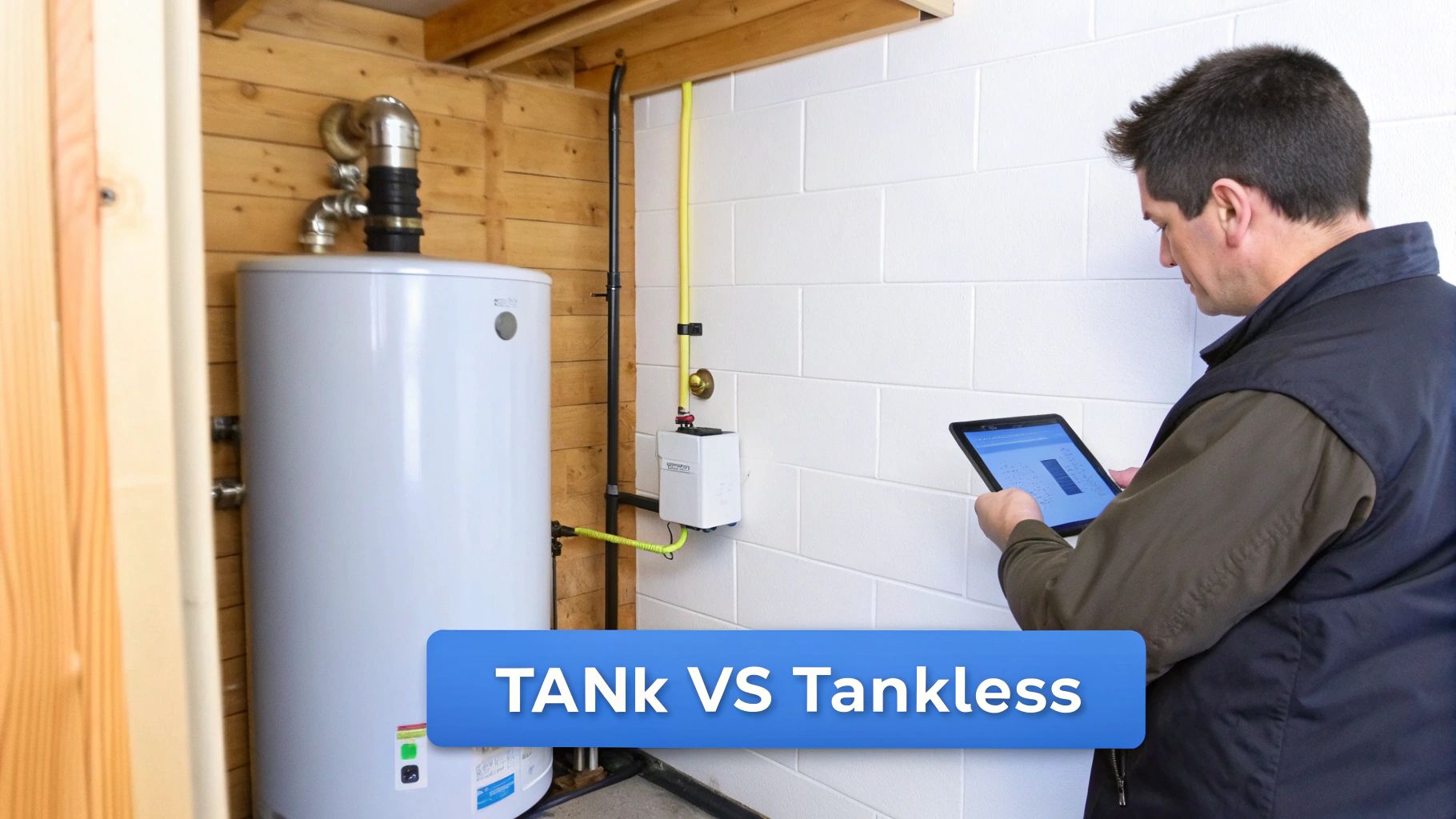
We're going to get into the real-world performance, costs, and day-to-day reliability of each system because we believe in making smart, practical choices. It’s exactly why we make high-efficiency tank water heaters the standard in our homes. They deliver the consistent, heavy-duty performance that modern families in Baltimore County and Harford County really need. You can get into even more detail in our guide on how to choose a water heater for your home.
While the builder I represent provides high-quality homes, I go a step further—offering my clients unique proprietary visualization tools, hands-on service, and access to visualizers that help you bring your dream space to life.
Let’s jump right into a quick side-by-side look.
Tank vs. Tankless at a Glance
This table cuts straight to the chase, highlighting the essential differences and showing why the dependable tank model is our go-to choice.
Feature | Traditional Tank Heater | Tankless (On-Demand) Heater |
|---|---|---|
Upfront Cost | Lower. The initial purchase and installation are much more budget-friendly. | Higher. You're looking at a pretty significant upfront investment. |
Hot Water Supply | Large, ready supply. Perfect for serving multiple showers and faucets at once. | Endless, but limited flow. Can't keep up if multiple people need hot water at the same time. |
Installation | Simple & Standard. A straightforward job for any licensed plumber. | Complex. Often requires costly upgrades to your gas line or electrical panel. |
Maintenance | Minimal. Usually just needs a simple annual check that many homeowners can do themselves. | Specialized. Needs annual professional descaling, which is a must in Maryland. |
How Each System Works in Your Daily Life
Let's get past the technical jargon and talk about what really matters: how your water heater actually performs when you need it most. The whole tankless vs. tank debate really boils down to how your family lives and uses hot water from one day to the next.
Picture a hectic morning in your Harford County home. The kids need to shower for school, you're throwing in a load of laundry, and the dishwasher is still going from last night. This is precisely where a traditional tank water heater proves its worth. It’s like having a deep reservoir of hot water ready and waiting.
With a pre-heated, 50-gallon supply on standby, a tank heater can easily serve multiple faucets and appliances all at once. You can have a shower running, the kitchen sink on, and the washing machine filling up without anyone getting a sudden, shocking blast of cold water. This consistent, reliable performance is exactly why we include high-efficiency tank water heaters as the standard in our homes. For example, you can start a load of whites on a hot cycle and hop in the shower without ever worrying about the water turning cold. That's a practical benefit you can count on every single day.
The On-Demand Experience With a Tankless Heater
Now, let's replay that same morning but with a tankless system. These units are pretty clever—they heat water instantly as it flows through them. Because they only kick on when you need them, they can cut water heating costs by 24-34% a year. That's a serious saving and a big reason they're becoming more popular.
But here’s the catch. This on-demand approach has a very real limitation: its flow rate. A tankless heater is rated for how many gallons of water it can heat per minute.
If you try to run too many hot water taps at the same time, you'll quickly overwhelm the unit. The result? That hot shower suddenly turns lukewarm, water pressure might dip, and the dishwasher won't clean as well. It forces you to start scheduling your hot water usage, which just isn't practical for a busy family. It's also a good idea to understand how the plumbing itself needs to be set up; we cover this in our guide on what rough-in plumbing is and why it matters.
Why Consistent Supply Beats Endless Hot Water
The big marketing pitch for tankless heaters is "endless" hot water, but that promise comes with a huge asterisk. It's only endless if you're doing one thing at a time. For a family living in a Baltimore County or White Marsh home, the ability to handle simultaneous demand is far more important.
The comfort of knowing you can run multiple hot water appliances without a second thought is a practical luxury. A tank water heater provides that peace of mind, ensuring your daily routines run smoothly without interruption or compromise.
Think about these real-life moments:
Hosting Guests: When family comes to visit, the demand for showers, laundry, and dishes skyrockets. A tank heater handles that surge without breaking a sweat.
The Evening Rush: After dinner, you might be bathing the kids while the dishwasher is running. A tank system delivers consistent hot water to both without a problem.
Weekend Chores: Powering through multiple loads of laundry requires a steady, high-volume supply of hot water—something a tank is designed for.
At the end of the day, the steady, dependable output of a modern tank water heater is simply a better fit for the dynamic needs of a busy household. It’s about practical performance, not just theoretical efficiency.
Comparing Upfront Costs and Lifetime Expenses
When you're choosing the features for your new home, every single dollar in your budget matters. Let's cut to the chase and talk about the real numbers in the tankless water heater vs tank debate, looking past the sticker price to what you'll actually spend over the long haul.
One of the biggest reasons we install traditional tank water heaters is their upfront affordability. A high-quality, modern tank heater simply costs less to buy and install. For families in Baltimore County or Harford County, that frees up a significant chunk of your budget for the fun stuff—like picking the flooring, countertops, cabinets, and tile that you're really excited about. For example, the money saved on installation could be the difference that lets you upgrade from laminate to quartz countertops in your dream kitchen.

Unpacking the Initial Investment
Right out of the gate, the cost difference between these two systems is pretty stark. A tank water heater is familiar territory for any licensed plumber, which keeps the installation straightforward and the labor costs predictable. It’s tried-and-true technology that doesn't force you to re-engineer your home's systems.
Tankless heaters, on the other hand, have a reputation for hidden costs that can make the initial quote swell. Because they need a massive jolt of energy to heat water on the fly, they often demand expensive upgrades to your home's infrastructure.
Gas Line Upgrades: A tankless unit might need a bigger gas line than your home was built with, which means a plumber has to run new, larger pipes.
Electrical System Rework: Electric tankless models are power-hungry. They can require a new, dedicated high-amperage circuit, meaning you're also paying an electrician for new wiring and maybe even a main panel upgrade.
Venting Modifications: These units frequently need special (and pricey) stainless steel venting that has to be routed directly outside, adding a whole new layer of complexity and cost.
These "surprises" can easily tack on hundreds, if not thousands, of dollars to the final bill, making the tankless option a much heavier financial lift from day one.
The Lifetime Cost Equation
The main selling point for tankless heaters has always been long-term energy savings. And it's true, they only heat water when you need it, which eliminates the standby heat loss that can waste 20-30% of the energy a tank heater uses. This efficiency story is driving the tankless market, which is expected to hit $10.76 billion by 2035 with promises of saving homeowners $100-200 a year.
But that's not the whole story. Modern tank water heaters have come a long way. Thanks to much better insulation and smarter designs, the energy-saving gap between the two has shrunk considerably. When you run the numbers, the incredibly high upfront cost of a tankless system means the payback period—the time it takes for those energy savings to actually cover your initial investment—can stretch out to 15 years or more.
For the average family, a high-efficiency tank water heater offers the best of both worlds: immediate affordability and excellent long-term value. The peace of mind that comes with a lower initial investment and predictable maintenance costs is invaluable.
On top of that, tankless units just cost more to maintain. Maryland's water can be hard, which means tankless heaters need a mandatory descaling service every year from a specialized technician. If you skip it, mineral buildup can clog and destroy the sensitive internal parts. That’s an ongoing expense you just don't have with a simpler tank heater.
When you weigh all these factors, the reliable and cost-effective tank water heater emerges as a smarter financial move for most families. It delivers the hot water you need without the eye-watering price tag or the long, uncertain wait for a return on investment. Choosing smart, efficient features is a huge part of personalizing your home, and we cover more great ideas in our post on the top 10 energy-efficient home features for 2025.
Does It Keep Up With Your Family? A Real-World Performance Check
When you're choosing between a tankless water heater and a traditional tank model, the technical specs don't tell the whole story. What really matters is how it performs during your family's daily rush hour. For any busy household, especially in a community like White Marsh or Edgewood, a reliable supply of hot water isn't a perk—it's essential.
The biggest advantage of a traditional tank water heater is its ability to deliver a massive amount of hot water to multiple places all at once. It's built for the beautiful chaos of a family's morning routine.
Think about it: It's 7:15 AM. You're showering, your partner is rinsing dishes at the kitchen sink, and the washing machine is churning through a load of towels. A properly sized tank heater handles this without breaking a sweat. It just pulls from its big, pre-heated reserve, making sure nobody gets a surprise blast of cold water.
The Tankless Flow Rate Problem
Now, let's look at the same scenario with a tankless water heater. These on-demand units are limited by their flow rate, which is just a fancy way of saying how many gallons per minute (GPM) they can heat on the fly. In a high-demand home, this can be their Achilles' heel.
If you push a tankless unit past its limit by running too many hot water taps at the same time, it simply can’t keep up. You end up with what plumbers call a "water sandwich"—a sudden, shocking burst of cold water mid-shower—or just a lukewarm stream from the faucet. It forces you to become a hot water scheduler, making sure only one or two major appliances are running at once.
A tank water heater is designed for peak demand. It provides predictable, robust performance, ensuring your family's routine is never interrupted by a shortage of hot water. This reliability is why we confidently include them in every home we build.
To get a feel for your own needs, it helps to know the demand of your fixtures. For instance, understanding how shower GPM impacts your home is a great starting point. A modern low-flow showerhead might only use 1.5 GPM, but an older one could be pulling 2.5 GPM or more. If you run two of those showers at once, you’re already asking for up to 5 GPM—a demand that many tankless models struggle with, especially during a Maryland winter when the incoming water is much colder.
Why Consistent Volume Beats an "Endless" Supply
The promise of "endless" hot water from a tankless system sounds amazing, but that’s only if it's for a single, long use, like filling a giant tub. A tank heater, on the other hand, makes a different, more practical promise: plenty of hot water for everyone, all at the same time.
A tank heater really shines in these common household moments:
Bath Time for the Kids: You can fill the tub for the little ones while the dishwasher is running after dinner. A tank system handles that split demand effortlessly.
Weekend Laundry Blitz: Powering through multiple loads of hot-water laundry is no big deal. The tank reheats its reserve quickly, so the next load gets just as hot as the first.
Hosting for the Holidays: When guests are over, your hot water demand can easily double or triple. That reserve capacity in a tank heater is a lifesaver, keeping everyone comfortable without anyone having to take a chilly shower.
For families in Baltimore County and Harford County, the choice is pretty clear. The dependable, powerful output of a modern tank water heater just delivers a better daily experience. It supports your lifestyle without making you think twice, delivering the performance you count on, right when you need it. That peace of mind is priceless, and it's a standard of comfort we believe every homeowner deserves.
Maintenance and Longevity: What to Expect Down the Road
When you’re investing in a core system for your home, you want something that’s going to work reliably for years, not cause headaches. In the tankless water heater vs tank debate, the long-term maintenance and dependability are huge. Let's be honest, nobody wants to get hit with a surprise cold shower or a complicated, expensive repair bill.
This is one area where the good old-fashioned tank water heater has a serious advantage. Its design is dead simple—it's a technology that's been proven and perfected over decades. There are no fancy circuit boards or delicate heat exchangers to worry about. It’s just a straightforward, tough system that gets the job done.
That simplicity is its biggest selling point. It means pretty much any licensed plumber in Maryland, from Edgewood to White Marsh, can work on it. Parts are cheap and easy to find, so if a problem does pop up, you’re not waiting weeks for a special order to come in.
The Low-Fuss Care of a Tank Water Heater
Keeping a modern tank water heater in good shape is refreshingly simple. A handy homeowner can handle most of it, though it’s never a bad idea to have a pro give it a once-over each year. The routine is predictable and doesn't demand a specialist.
Here’s what it usually involves:
Checking the Anode Rod: Think of this little metal rod as a bodyguard for your tank. It attracts corrosive minerals in the water, sacrificing itself to keep the tank from rusting out. A quick check every year or two can easily add years to your heater's life.
Flushing the Tank: Once a year, you just need to drain a bit of water from the bottom valve to clear out any sediment. This keeps it running efficiently and stops those weird gurgling sounds you sometimes hear from older heaters.
That’s about it. These simple steps, paired with the heater’s rugged build, give it a dependable lifespan of 10 to 15 years. It’s a true workhorse appliance that you can mostly set and forget.
The Higher Demands of Tankless Systems
Tankless water heaters are amazing pieces of technology, but that tech comes with a much stricter maintenance schedule. All those tiny internal pathways are like magnets for mineral buildup, especially in places with hard water—which is a lot of Baltimore County and Harford County.
To keep them from clogging up, tankless units require mandatory annual descaling. This isn't a quick DIY task; it involves a trained technician flushing the whole system with a chemical solution to break down the scale. If you skip this, you're risking clogs, poor performance, and eventually, a total system breakdown. It'll often void your warranty, too.
A tankless heater might last up to 20 years on paper, but hitting that number requires perfect, consistent annual service. For most families, the proven 10-15 year lifespan of a modern tank heater—with its lower repair costs and easy-to-find parts—is simply the more reliable and practical choice.
This specialized service adds a recurring cost every single year and makes you dependent on technicians who know your specific brand. If you're already worried about the mineral content in your water, you might want to check out our guide to whole-house water filtration systems to improve water quality everywhere in your home.
When you add up the higher cost for specialized labor and brand-specific parts, owning a tankless heater can get surprisingly pricey over its lifetime. The simple, affordable, and dependable nature of a high-efficiency tank water heater is exactly why we install them in all our homes. It’s about giving our clients peace of mind, knowing their home’s essential systems are built to last without a lot of fuss.
So, Which Water Heater Is Right for Your Home?
After diving into the pros and cons in the great tankless water heater vs. tank debate, it's pretty clear why modern, high-efficiency tank water heaters are still the best fit for most families. They hit that sweet spot of being affordable upfront, powerful enough for a busy household, and incredibly reliable with straightforward, inexpensive upkeep. It’s all about practical value and a hassle-free experience day in and day out.
Think of this decision as just one piece of a bigger puzzle. As you customize your home, it's smart to look at the whole picture, including other Energy Efficient Home Upgrades that boost comfort and save you money in the long run. Your water heater is really a cornerstone of a comfortable, efficient home.
Why We Still Swear By Tank Water Heaters
There’s a simple reason we put high-efficiency tank water heaters in every home we build across White Marsh, Edgewood, and the rest of Baltimore and Harford Counties: they just work. They deliver the steady, high-volume hot water a family needs without the sticker shock or the complicated maintenance that often comes with tankless systems. You get the performance you need from day one, no questions asked.
Our goal has always been to build homes that are not only beautiful but also practical and dependable. We believe in installing systems that fit your life, not the other way around, ensuring your home is a place of comfort, not a source of constant headaches. A tank heater is a true workhorse, built to handle morning showers, a load of laundry, and the dishwasher all running at once without missing a beat.
This chart breaks down the maintenance for both types, and you can see how much more direct the process is for a traditional tank system.
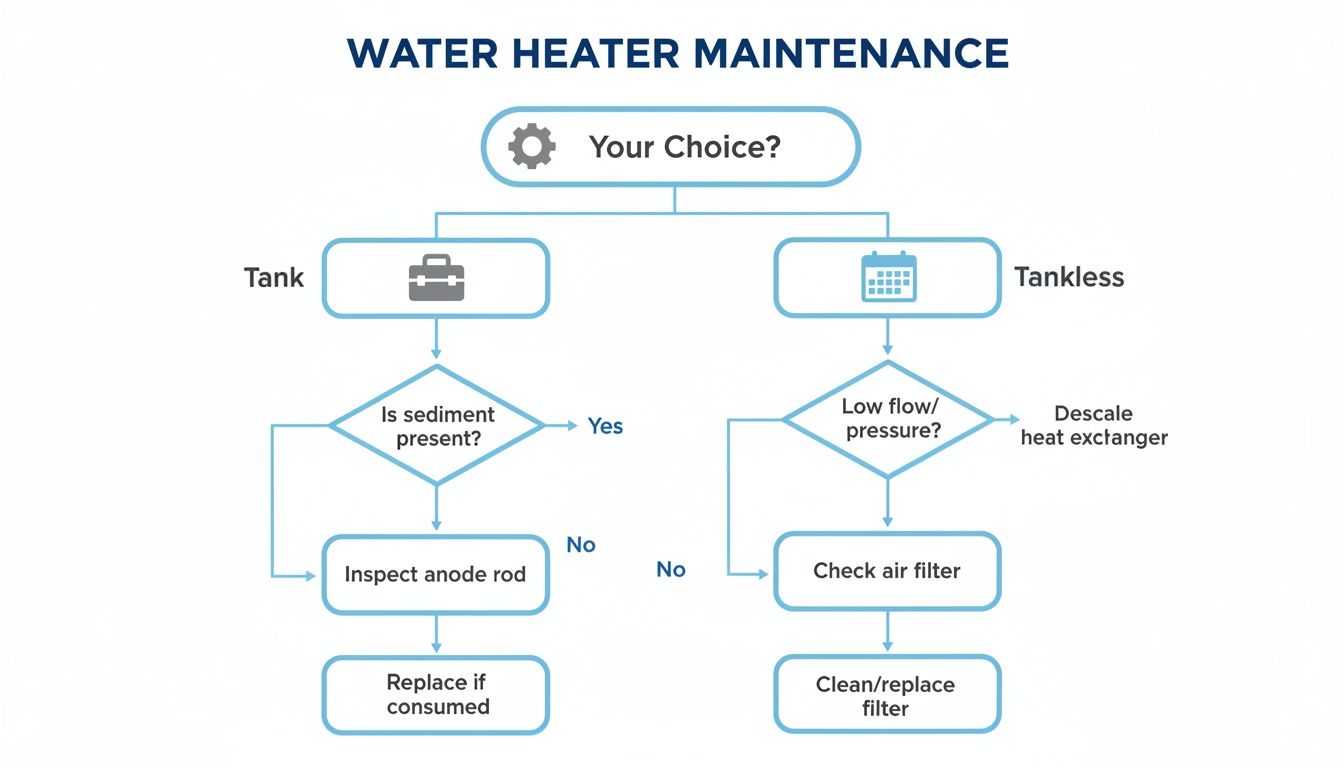
As the graphic shows, upkeep for a tank heater is less frequent and doesn't always require a specialist, unlike the mandatory annual descaling that tankless models need to stay in top shape.
I'm Here to Help With Every Detail
Choosing the right features for your home is about more than just the big mechanical systems. It’s about making smart, practical choices that make your daily life better. My job is to guide you through these decisions, offering hands-on service and our own unique visualization tools to help you see your ideas come to life. Whether we’re picking out countertops, finding the perfect tile, or deciding on cabinet finishes, I’m here to make sure every detail feels right.
While the builder I represent provides high-quality homes, I go a step further—offering my clients unique proprietary visualization tools, hands-on service, and access to visualizers that help you bring your dream space to life.
Ready to see what’s possible? If you’re looking for a new home in one of our Maryland communities, let's talk. Together, we can build a space that’s perfectly suited to you, from the foundation right down to the final finishes.
Water Heater FAQs
When you're digging into the whole tankless vs. tank water heater debate, a few questions always seem to pop up. We hear them all the time from homebuyers, so let's get you some straight answers.
Are Modern Tank Water Heaters Actually Energy Efficient?
You bet. The tank heaters of today are nothing like the energy hogs from a decade ago. They’re now built with some seriously beefy insulation that slashes standby heat loss. This means the water stays hot for much longer without the burner constantly kicking on, closing the efficiency gap with tankless models quite a bit.
Can I Still Get "Endless" Hot Water With a Tank Heater?
Okay, so it's not literally endless like a tankless system, but a properly sized tank delivers more than enough hot water for a family's daily chaos. A 50-gallon tank, for example, can handle a couple of showers back-to-back while the dishwasher is running, no problem. It all comes down to making sure the tank is the right size for your crew, which is something we dial in for every home we build.
For most families, "simultaneous hot water" is way more important than "endless hot water." A tank heater is a champ at sending hot water to the shower, the kitchen sink, and the laundry room all at once. No more surprise cold showers.
Which System Is Easier To Get Repaired?
Tank water heaters are the clear winner here. They're built on straightforward, time-tested technology. Just about any certified plumber from White Marsh to Edgewood can work on them, and parts are easy to find and affordable. Tankless systems, on the other hand, often need a specialist with specific training, and their replacement parts can be pricier and harder to source.
At Customize Your Home, we're all about making smart choices that just make life easier. That's why we put high-efficiency tank water heaters in our homes—they provide the rock-solid performance that busy families actually need. Ready to build a home that fits you perfectly? Let's start customizing your home today.
Comments