

Your Guide to Whole House Water Filtration Systems

Ever wonder about the water that comes out of your taps? A whole house water filtration system is like a personal security guard for your home's entire water supply. It's installed right where the main water line enters your house, making sure every single drop is treated before it ever reaches a faucet, showerhead, or appliance.
This isn't just about making your drinking water taste better. This is about everything—the water you shower in, the water that washes your clothes, and the water that runs through your expensive dishwasher. It’s a complete solution for a healthier, happier home.
Your Home’s Personal Water Guardian
Think of your home’s plumbing as its circulatory system. A little pitcher filter you keep in the fridge is like taking a single vitamin; it helps in one isolated spot. A whole house system, however, is like adopting a healthy diet for the entire system. It’s a comprehensive approach that ensures every faucet delivers cleaner, better water.
These systems are also called Point-of-Entry (POE) systems because they're installed right where your water supply "enters" your property. From that central point, the purified water branches out to your water heater, kitchen, bathrooms, and laundry room. That smart placement is the secret to its effectiveness.
Beyond the Drinking Glass
Sure, better-tasting drinking water is a huge plus, but the real magic of a whole house system is how it elevates your entire home life. The benefits ripple out into almost every daily routine.
Here are a few practical examples of the upgrades you'll notice:
Healthier Showers: Filtering out chlorine and other chemicals means you’re not absorbing them through your skin or inhaling them as steam. For instance, if you often feel like your skin is dry and itchy after a shower, or your color-treated hair fades too quickly, filtered water can make a noticeable difference. The result? Softer skin and healthier hair.
Appliance Protection: Sediment, minerals, and chlorine are tough on your appliances. They build up inside your dishwasher, washing machine, and water heater, leading to breakdowns and expensive repairs. A good filter acts as a bodyguard for your essential equipment, helping that new washing machine you picked out last its full lifespan.
Brighter, Softer Laundry: Have you ever noticed your new white towels turning a bit dingy or your favorite t-shirts feeling stiff? Hard minerals and chemicals in the water are often the culprits. Filtered water lets your detergent work properly, so you use less of it while keeping your fabrics vibrant and soft.
A whole house system is a fundamental upgrade to your home's infrastructure. It’s not just about improving the water you drink; it’s about enhancing your quality of life and protecting your investment.
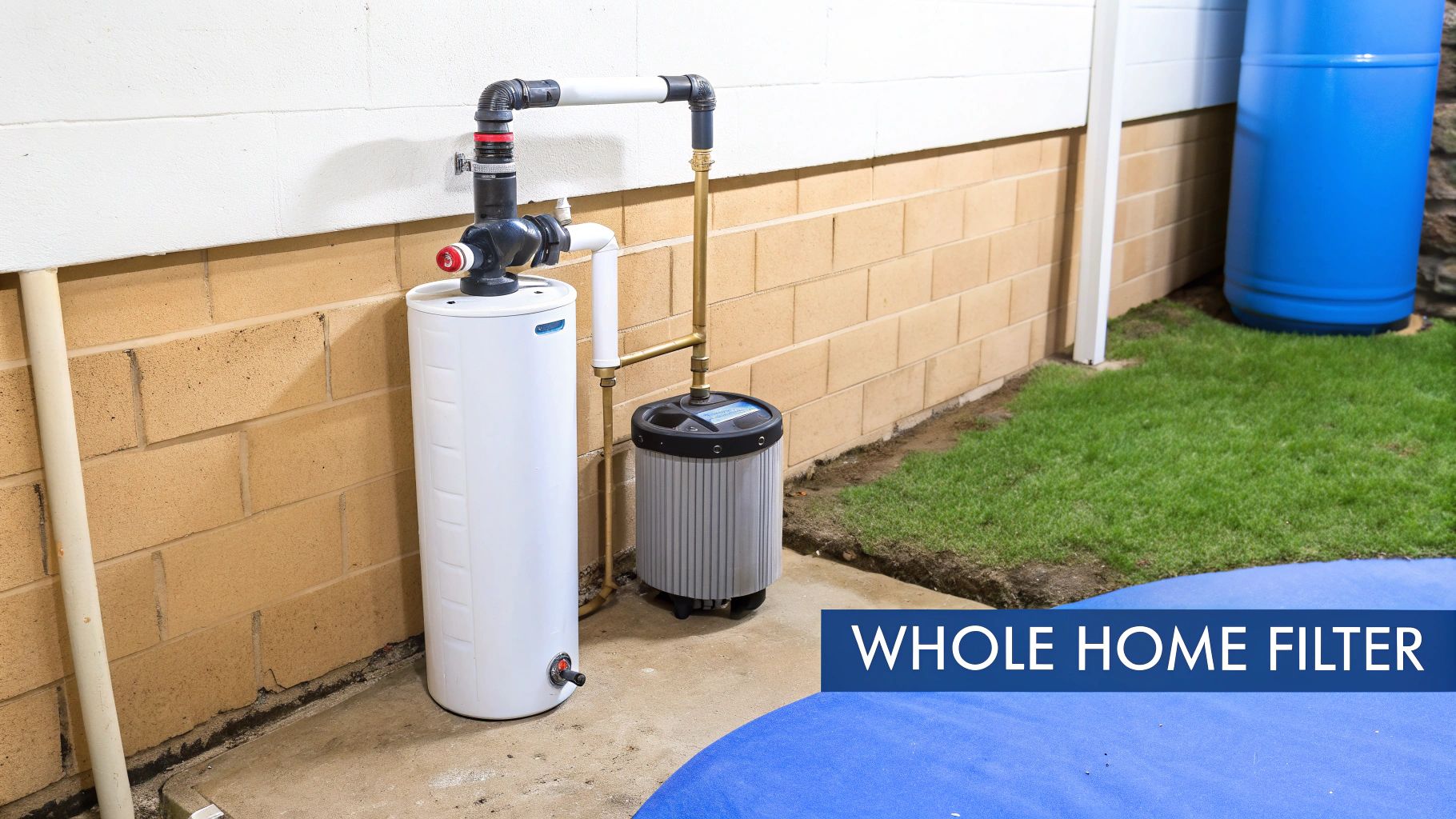
Whole House vs Faucet Filter At a Glance
This quick comparison helps you see the real difference between treating all your water versus just one tap.
Feature | Whole House System (Point-of-Entry) | Faucet Filter (Point-of-Use) |
|---|---|---|
Water Treated | All water entering the home | Only water from one specific faucet |
Installation | Professional installation required | Simple DIY, screws onto the faucet |
Benefits | Protects plumbing, appliances; better showers | Improves taste/odor for drinking & cooking |
Initial Cost | Higher ($$$) | Low ($) |
Maintenance | Less frequent (every 3-12 months or longer) | More frequent (every 2-3 months) |
Best For | Comprehensive, whole-home protection | Budget-friendly, targeted drinking water |
As you can see, it really comes down to whether you want a targeted fix or a complete, home-wide solution.
Growing Demand for Cleaner Water
It’s no surprise that more homeowners are making this a priority. The global market for water filtration systems is on track to hit around USD 35.2 billion by 2034. This growth is fueled by a simple fact: people are more aware of what's in their water and are actively looking for ways to create healthier homes.
Of course, a filter is only as good as the source it's treating. To truly ensure purity, it’s smart to also consider routine water tank cleaning. When you pair a clean source with a powerful filter, you get the ultimate peace of mind.
Here in Maryland, from White Marsh to Edgewood and all over Baltimore County and Harford County, the first step is always understanding what's in your local water. While the builder provides high-quality homes, I go a step further—offering my clients unique proprietary visualization tools, hands-on service, and access to visualizers that help you bring your dream space to life. We'll look at smart, foundational upgrades like this to ensure your home is as healthy as it is beautiful.
How Different Water Filtration Systems Work
Diving into the world of whole house water filtration systems can feel a bit overwhelming, kind of like learning a new language. But trust me, it's a lot simpler than it sounds. The best way to think about it is like you're assembling a specialized team, where each player has a unique job to do to protect your home's water.
Let's break down the key players and the technologies they use. Getting a handle on how they work is the first step to choosing the right setup for your home, whether you're customizing your new place in White Marsh, Edgewood, or anywhere in between.
The Bouncer: Sediment Filters
First up is the humble sediment filter. This is the hardworking bouncer at the front door of your plumbing system. Its one and only job is to stop the big, chunky stuff from getting inside.
This filter is essentially a very fine screen, catching all the undissolved gunk floating around in your water.
What it catches: Dirt, sand, rust flakes from old city pipes, and other gritty debris.
Why it's important: It's your first line of defense. A practical example is how it prevents the tiny aerator screen on your kitchen faucet from getting clogged with sand, which would otherwise reduce your water flow to a trickle. By taking out all this abrasive material, it also stops your other, more sophisticated filters from getting clogged up and wearing out too soon.
Think of it this way: the sediment filter clears the way so the rest of the team can focus on the microscopic threats. It’s a simple piece of equipment, but it's absolutely essential.
The Purifier: Activated Carbon Filters
Next on the team is the activated carbon filter. If the sediment filter is the bouncer, this is the master purifier. It’s like a super-absorbent sponge packed with a massive internal surface area, making it perfect for grabbing and holding onto chemical contaminants.
The magic happens through a process called adsorption (with a "d"), where impurities literally stick to the carbon's surface like tiny magnets. This is what really tackles the invisible issues that make your water taste and smell off.
An activated carbon filter is your best weapon against that "tap water" taste and swimming pool smell. It’s what turns your municipal water into something crisp, clean, and genuinely refreshing.
It’s a champ at removing things like:
Chlorine and chloramine (the chemicals cities use for disinfection)
Volatile organic compounds (VOCs)
Funky tastes and odors
Pesticides and herbicides
For most folks on city water in places like Baltimore County and Harford County, a one-two punch of sediment and carbon filtration is the core of a fantastic whole house system.
The Specialist Players: UV Purifiers and Water Softeners
Sometimes, your water has unique challenges that require calling in the specialists. This is where technologies like UV purifiers and water softeners come into play.
A UV purifier is basically a high-tech security system for your water. It uses ultraviolet light to zap and neutralize microscopic organisms on a biological level. It doesn't actually remove anything—instead, it scrambles the DNA of bacteria, viruses, and other pathogens so they can't reproduce and make you sick. This is a must-have for homes on well water, which isn't disinfected by a municipal facility.
A water softener, on the other hand, is built to fight one very specific problem: hard water. "Hardness" is just a term for high levels of dissolved minerals, mainly calcium and magnesium. A softener uses a clever process called ion exchange to swap those hard mineral ions for soft sodium ions. The result is a total game-changer.
No more crusty white scale buildup on your faucets and shower doors.
Soaps and detergents lather up beautifully, so you use less.
Your water heater, dishwasher, and other appliances run more efficiently and last a whole lot longer.
Most modern whole house water filtration systems are designed to work as a team, often starting with sediment pre-filtration and activated carbon as the foundation. While those single-faucet filters have been popular for years, there's a huge trend toward these comprehensive, point-of-entry systems. In fact, whole-house units are projected to be the fastest-growing segment of the market as more people decide they want total home protection. You can explore the market trends on water treatment systems to see just how much priorities are shifting.
When you're customizing your new home, you get to pick out all the beautiful things like flooring and countertops. Thinking about your water quality is every bit as important. With my hands-on service and unique visualization tools, I help my clients understand these foundational choices, ensuring their new home isn't just stunning but also a healthy, comfortable place to live from day one.
Choosing the Right System for Your Home
Alright, now that you've got the lay of the land on the different types of water filters, let's get down to the brass tacks: picking the right one for your home. This isn't about buying the fanciest gadget on the shelf. It’s about matching the system to your family’s actual, day-to-day life.
Think of it like choosing your kitchen cabinets. You'd pick a style and finish that fits your family's lifestyle—maybe a durable, easy-to-clean option if you have kids. Your water filter is the same deal; it needs to be the right size and have the right features for your household.
Start With Your Local Water Report
First things first: you need to know what you’re up against. The best way to do that is to grab a copy of your local water quality report, sometimes called a Consumer Confidence Report (CCR). This is basically a report card for your tap water, spelling out exactly what’s in it and at what levels.
If you're in one of our local communities like White Marsh, Edgewood, Baltimore County, or Harford County, you can usually find these reports right on your municipal water provider’s website. Just Google "[Your Town] water quality report," and it should pop right up. This report is your treasure map, telling you whether you're fighting chlorine, sediment, hard minerals, or something else entirely.
This little decision tree can also help you play detective and figure out what might be causing any weird water issues you've noticed.
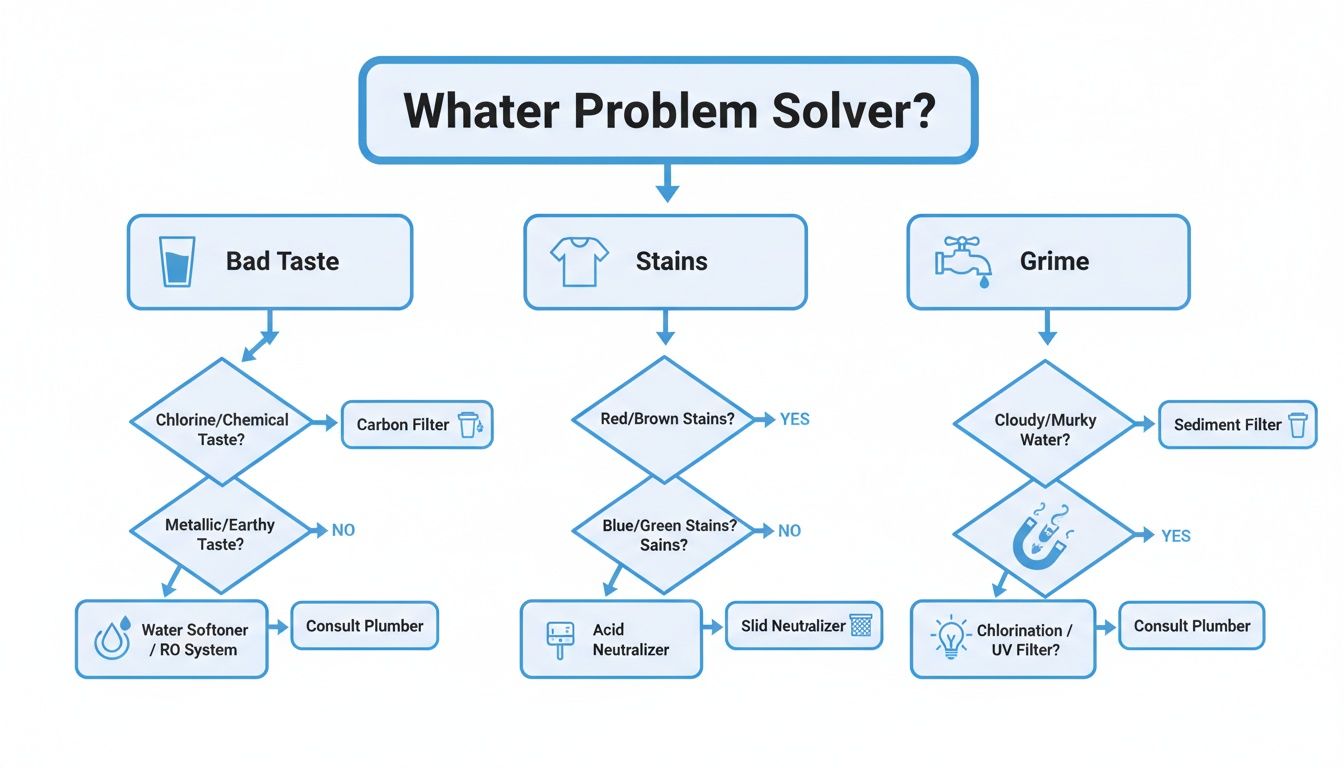
As you can see, symptoms like funky tastes or stains on your laundry point to different potential solutions, helping you decide if a filter is what you need or if it's time to call a plumber.
Understanding Your Home's Flow Rate
Once you know what to filter, the next piece of the puzzle is flow rate. It sounds technical, but it’s really simple. Flow rate is just a measure of how much water can pass through your system at any given moment, measured in gallons per minute (GPM).
Picture a typical chaotic morning in your house. The shower is running, the dishwasher is on, and someone just started a load of laundry. All of those things are demanding water simultaneously. If your filter system has too low of a flow rate, it creates a traffic jam, and your water pressure plummets. Nobody enjoys a shower that dwindles to a sad little trickle.
Getting the flow rate right is the key to a system that you never have to think about. It should be powerful enough to handle your home’s peak demand without ever slowing you down.
Here’s a good rule of thumb to follow:
Small Homes (1-2 bathrooms): A system with a 10-15 GPM flow rate usually does the trick.
Medium Homes (3-4 bathrooms): You’ll want to look for something in the 15-20 GPM range.
Large Homes (4+ bathrooms): To keep the pressure strong everywhere, you’ll probably need a system rated for 20+ GPM.
Of course, the number of people in your house and even your appliances can shift these numbers. A modern high-efficiency washing machine uses way less water than an older model, for instance. Your water heater's performance is also directly linked to the water flowing into it; our guide on how to choose a water heater has some great info that connects well here.
And if your water report shows a high mineral content, it might be a good idea to look into water softening systems as part of your overall solution.
When you're customizing a new home with us, this is the kind of stuff we can plan for from the very beginning. Using my proprietary visualization tools, we can map out the behind-the-scenes systems—not just the countertops and flooring—to make sure your home works perfectly for you. It's that hands-on approach that makes all the difference.
The Best Time for a Seamless Installation
If you're in the middle of planning a new home, your head is probably swimming with decisions about flooring, countertops, and paint colors. I get it. But some of the most important upgrades are the ones you can’t even see. When it comes to a whole house water filtration system, timing is everything, and there’s no better time to install one than during construction.
Trying to retrofit a system later on can be a real pain. It often means cutting into finished drywall and re-routing pipes. But when the walls are open and the plumbing is being mapped out, your plumber can easily carve out the perfect spot for your system. It's simpler, cleaner, and a lot easier on the wallet.
Planning for the Perfect Spot
The ideal place for a whole house filter is right where the main water line enters your home, just after the water meter and the main shut-off valve. This spot is usually tucked away in a utility closet, basement, or garage. Planning this out from the start means you can design the space with a few practical needs in mind.
You'll want to make sure there's enough room not just for the filter tanks, but for future maintenance too.
Easy Access: You’ll need enough clearance to comfortably swap out filters. For example, if the system is shoved into a tight corner behind a water heater, a simple 10-minute filter change can turn into a frustrating hour-long project.
A Nearby Drain: More advanced systems, like water softeners or backwashing filters, need a drain line to flush out all the gunk they capture.
Electrical Outlet: If you're considering a system with a UV purifier for extra protection or a fancy digital control head, you'll need a power source close by.
When you map this out with your builder from the start, these small but crucial details get handled effortlessly. This kind of forward-thinking is a key part of the rough-in plumbing stage. You can get the full scoop on how this foundational phase sets your home up for success in our guide on what rough-in plumbing is and why it matters.
The Value of a Built-In Solution
Installing a system during the build just looks and works better. The plumbing connections are clean and secure, perfectly integrated into your home's main water line. This seriously cuts down on the risk of leaks down the road. It's the difference between making the filter a natural part of your home’s anatomy versus slapping on an aftermarket part.
Integrating a whole house water filtration system during construction isn't just an upgrade; it's a foundational decision for a healthier home. It ensures that from the moment you turn the key, every drop of water is pure.
For homeowners in communities across Baltimore County and Harford County, this is a no-brainer that adds immediate value. You're protecting your brand-new plumbing and appliances from day one, stopping the damaging buildup of sediment and minerals that can shorten their lifespan.
When you work with me, we think beyond just the visible finishes. I provide hands-on service and unique visualization tools that help you see how every choice—from the tile you picked for your shower to the filter protecting it—works together. This way, you can customize a home that's not only beautiful but is also designed to support your family's well-being for years to come.
Putting The Cost And Long-Term Value In Perspective
Let's be real—when you're customizing a new home, every dollar counts. You're making big decisions on countertops, flooring, and lighting. So, when a whole house water filtration system comes up, it's easy to see it as just another expense on a long list.
But here's the thing: this isn't a "nice-to-have" cosmetic upgrade. It's a fundamental investment in the health of your home and your wallet, one that starts paying you back the day you move in.
The initial price tag can swing quite a bit. A straightforward sediment and carbon filter combo is going to be a lot friendlier on the budget than a more complex setup with a water softener or a UV purifier for well water. Installation costs are also a factor, which is exactly why getting it done during construction is the smartest, most cost-effective move you can make.
The real story, though, isn't the upfront cost. It's about what you save over the long haul.
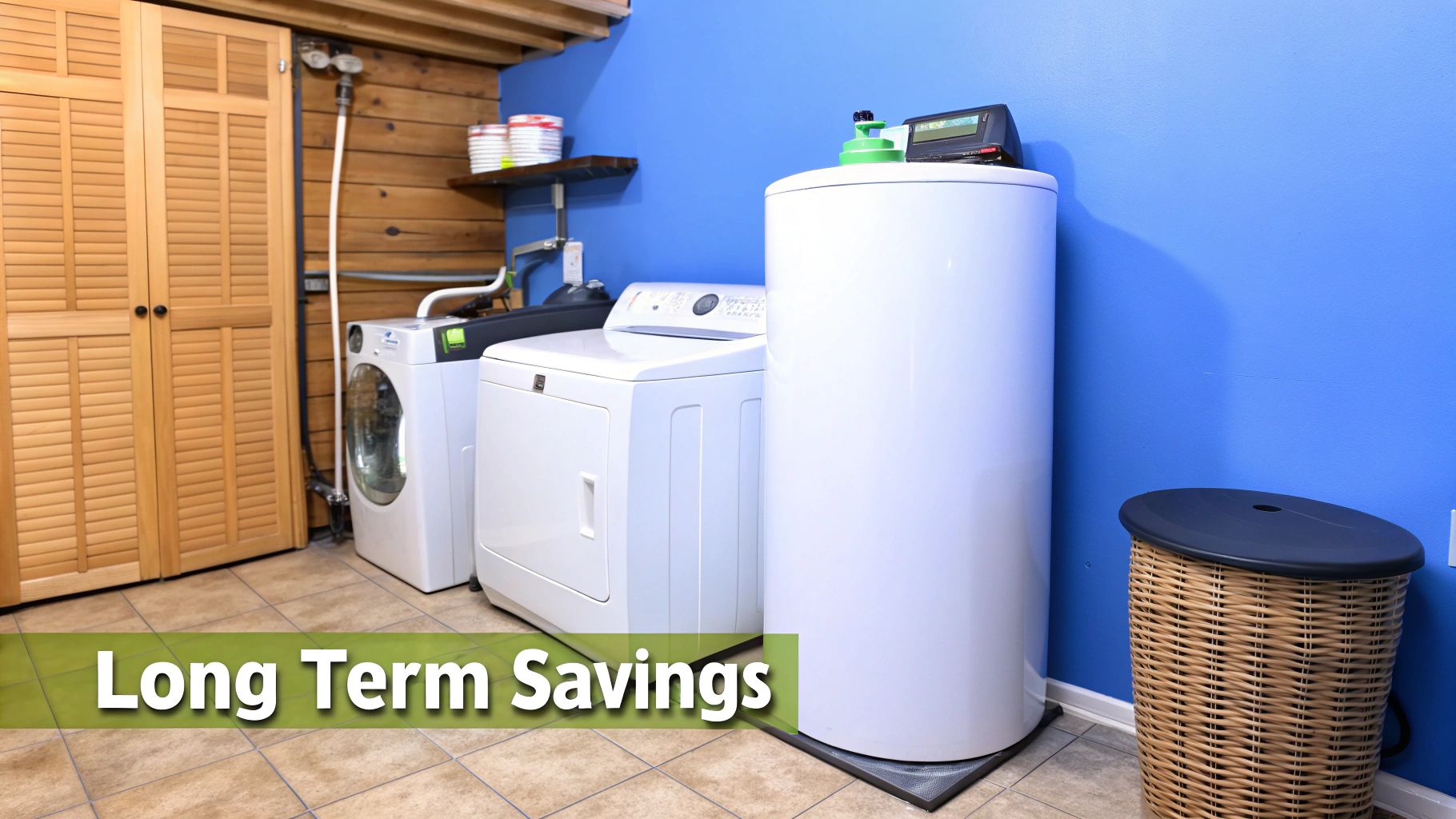
How A Filter Actually Puts Money Back In Your Pocket
Think about all the brand-new, water-guzzling appliances you just invested in. Your shiny new dishwasher, washing machine, tankless water heater, and that amazing espresso machine are all at the mercy of whatever is in your water supply.
Without a filter, hard minerals and sediment create scale buildup. This invisible gunk forces your appliances to work much harder, which quietly drives up your utility bills and leads to them breaking down way sooner than they should.
Here’s where the savings really start to add up:
Longer Appliance Life: A good filter acts like a bodyguard for your expensive appliances. For example, scale buildup is a leading cause of water heater failure. By preventing it, you can extend the life of a $1,500 appliance by years.
Fewer Repair Bills: It’s simple math. When appliances don't break down as often, you’re making fewer panicked calls to a repair technician.
Lower Energy Costs: An appliance that isn't choked with mineral buildup runs efficiently, just like it was designed to. That means it uses less electricity or gas every single time you run it.
Less Soap, Shampoo, And Detergent: This one surprises people. Soft, filtered water creates a rich lather, so you'll find you need way less soap, detergent, and shampoo to get the job done.
Protecting your home’s plumbing and major appliances from day one is one of the smartest financial decisions you can make as a new homeowner. It’s preventative maintenance that starts the moment you move in.
A Simple And Predictable Maintenance Plan
The good news is that keeping a whole house system running is surprisingly simple and predictable. Unlike a random appliance failure that can blow up your monthly budget, filter changes are scheduled events that you can plan for.
The exact timing will depend on the system you choose and your specific water quality, but the routine is generally straightforward. Staying on top of it is the key to getting clean water and protecting your investment. For more tips on keeping your new house in prime condition, you can check out our guide on creating your ultimate monthly home maintenance list.
To give you a clearer picture, here's a simplified look at typical costs and upkeep for common whole house filtration system parts.
Sample Maintenance and Cost Overview
Component Type | Typical Upfront Cost Range | Ongoing Cost (Filter Replacement) | Replacement Frequency |
|---|---|---|---|
Sediment Pre-Filter | Included with system | $20 - $50 | Every 3-6 months |
Carbon Block Filter | Included with system | $40 - $100 | Every 9-12 months |
Water Softener Salt | Varies with system | $10 - $20 per bag | Every 1-2 months |
UV Purifier Bulb | Varies with system | Varies with system | Annually |
This table just gives you a ballpark idea, but it shows how manageable the ongoing costs really are, especially when weighed against a potential $1,500 water heater replacement.
When you’re customizing a new home in White Marsh or Edgewood, we can design a system that fits your home, your water, and your budget perfectly. My hands-on approach and unique visualization tools help you look past the line-item cost and see the incredible long-term value that smart, practical upgrades like this bring to your home. Let's build a house that works for you, from the inside out.
A great home is about more than just the walls and the roof—it's about how it feels. It’s that sense of comfort and well-being you get when you know you’ve created a genuinely healthy space for your family. This feeling comes from getting the details just right, from the perfect countertops in your kitchen to the clean, refreshing water that comes out of every single tap.
As an expert who helps people in communities like White Marsh and Edgewood customize their homes, I know it's about more than just the surface-level finishes. Using my proprietary visualization tools, we can walk through every option, from flooring and cabinets to smart upgrades like whole house water filtration systems. It’s these choices, working together, that build a home that truly supports your family's lifestyle from the moment you move in.
Designing a Healthier Future
Building well-being into your home's DNA is what modern design is all about. Thinking through your home's air quality, water purity, and overall energy efficiency doesn't just make it a better place to live; it makes it a smarter long-term investment. For anyone interested in taking a bigger-picture approach, our guide on sustainable construction practices for greener homes is a great place to start.
When you’re ready to design a home in Baltimore County or Harford County that feels healthy, comfortable, and is uniquely yours, let’s talk. My hands-on approach is all about making sure we build a home that brings your vision to life.
Got Questions? We've Got Answers
Still have a few things you're wondering about when it comes to whole-house water filtration? You're definitely not alone. Let's tackle some of the most common questions homeowners ask when they're getting started.
Will a Whole-House Filter Kill My Water Pressure?
This is the big one, and I get it. The short answer is no—if it’s the right size for your house. A professionally selected system is matched to your home's flow rate (measured in gallons per minute), so it can easily keep up with your family's daily demand.
Think of it this way: your home's plumbing is like a four-lane highway. You wouldn't want to squeeze all that traffic through a single toll booth, right? An undersized filter does just that, creating a bottleneck that drops your pressure. A properly sized system ensures you'll never even notice it’s there when you're running the dishwasher and showering at the same time.
How Do I Figure Out What's Actually in My Water?
Excellent question. Your best starting point is your local utility’s annual Water Quality Report, often called a Consumer Confidence Report (CCR). This is basically a report card for your tap water.
It breaks down exactly what's been tested for and at what levels. If you live in Baltimore County or Harford County, these reports are usually posted right on your municipal supplier's website. Just search for "[Your Town] Water Quality Report," and you should find it easily. This little document is your treasure map for choosing the right filter.
Your local CCR is the single most valuable tool for understanding your water. It takes the guesswork out of the equation and helps you target the specific issues that matter most for your home.
Isn't a Water Filter the Same as a Water Softener?
They're different players, but they're on the same team. A water filter is all about removing a wide range of contaminants—think sediment, chlorine, pesticides, and other stuff that messes with the taste and smell of your water.
A water softener, on the other hand, has one very specific mission: to get rid of the "hard" minerals like calcium and magnesium. These are the culprits behind that crusty white scale buildup on your faucets and inside your appliances. That's why a lot of homeowners install both: a filter for purity and a softener for protection.
Can I Just Install This Thing Myself?
While it might seem like a manageable DIY project on a Saturday afternoon, installing a whole-house water filtration system means cutting into your home's main water supply line. This isn't just a simple pipe connection; it demands real plumbing expertise to make sure it's leak-proof and up to local building codes.
For a home you are having built, going with a professional is the only way to go. It keeps all your warranties intact and guarantees the job is done right from day one, giving you complete peace of mind.
Ready to explore how the right details can create a healthier, more comfortable home? While the builder provides high-quality homes, I go a step further—offering my clients unique proprietary visualization tools, hands-on service, and access to visualizers that help you bring your dream space to life. Let's talk about customizing everything from your flooring and countertops to smart upgrades like water filtration. Visit my site at Customize Your Home to learn more.
Comments