

What Is a Breaker Box? A Homeowner's Essential Guide

Ever wonder about that mysterious gray metal box in your garage, basement, or utility closet? That's your home's breaker box, and it’s basically the command center for your entire electrical system. It’s a friendly but firm gatekeeper for all the electricity flowing into your home.
It takes the main power feed coming into your house from the utility company and splits it up, sending electricity safely to all the different rooms and appliances. Think of it as the heart of your home's electrical system, pumping power exactly where it needs to go.
Your Home's Electrical Command Center
The breaker box is your first line of defense against electrical problems. It's packed with a bunch of switches called circuit breakers, and each one is a dedicated safety guard for a specific part of your house—like the kitchen outlets or the bedroom lights.
Its most important job is preventing electrical overloads. If you've ever run the microwave and the toaster at the same time and suddenly the power cuts out, that's your breaker box doing its job! That little switch "tripped" to shut off the power, stopping the wires in your walls from getting dangerously hot and potentially starting a fire. It's a simple, brilliant safety feature that keeps your home and family safe.
Let's take a quick look at the core functions of a breaker box.
Breaker Box Quick Facts
Component/Function | What It Does for You |
|---|---|
Main Breaker | The master switch. It can shut off power to your entire house in an emergency. |
Branch Circuit Breakers | Individual switches that protect specific circuits (e.g., kitchen, bedrooms, A/C). |
Power Distribution | Divides the main power feed into smaller, manageable circuits for different areas. |
Overload Protection | Automatically trips and cuts power if a circuit draws too much electricity. |
Short Circuit Protection | Instantly cuts power if a "short circuit" occurs, preventing fires and shocks. |
This table gives you a snapshot, but seeing how it all comes together is what really matters for keeping your home safe and functional.
From Fuses to Flipping a Switch
When you're looking for a new home in places like White Marsh or Edgewood, Maryland, the breaker box—or electrical panel, as it's also called—is a critical piece of the puzzle. We’ve come a long way from the old-school fuse boxes. The concept of a circuit breaker actually dates back to 1879, when Thomas Edison first came up with a way to protect lighting circuits. But back then, you still had to replace a blown fuse.
Now, we have these brilliant little resettable switches. It's a huge leap in safety and convenience. You can read more about the evolution of the modern electrical panel.
Understanding your breaker box is a true homeowner superpower. It demystifies your home's electrical system, giving you the confidence to handle minor issues like a tripped breaker without having to call for help every time a circuit overloads.
Once you get a handle on the main panel, you can explore other cool electrical setups, like power bridge installations for clean, wall-mounted TV setups. My whole goal is to empower my clients with this kind of knowledge.
I offer my clients a hands-on service and even provide unique proprietary visualization tools that help you see your dream space come to life, from picking your flooring and countertops to planning the electrical layout. It’s about helping you create a space perfectly tailored to how you live. Dive deeper into our resources on modern electrical systems to learn even more.
A Simple Tour Inside Your Electrical Panel
Popping open the door to your breaker box for the first time can feel a bit intimidating, a lot like looking under the hood of a car. It seems complex, but once you know what you're looking at, the basics are actually pretty simple. You don't need any tools to just take a peek, and understanding the key players inside will give you a ton of confidence as a homeowner.
The first thing you’ll probably notice is one large switch sitting at the top, separate from all the others. That's the main breaker. Think of it as the master shut-off valve for your entire home's electricity. If you ever have a major electrical emergency, that one switch will cut power to everything.
Below the main breaker, you'll see neat rows of smaller switches. These are the branch circuit breakers. Each one acts as a dedicated bodyguard for a specific part of your home or a major appliance. They should be labeled with descriptions like "Kitchen Outlets," "Master Bedroom," or "Dishwasher." This is the genius of the system—it keeps a problem in one area from knocking out power to the whole house.
This diagram shows you exactly how that works, with power flowing from the street, into the breaker box, and then branching out to all the different parts of your home.
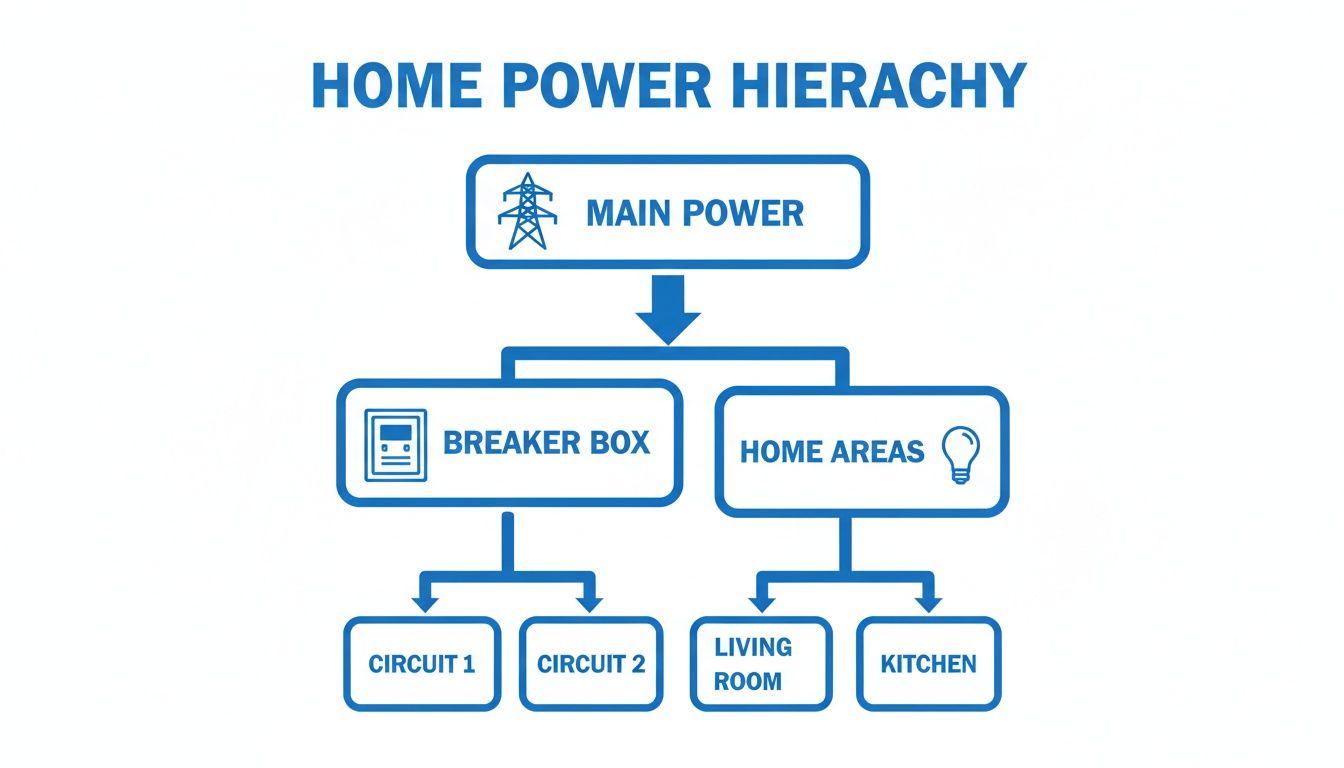
As you can see, the breaker box is really the command center, organizing and protecting your home's entire electrical system.
Specialty Breakers for Added Safety
Now, you might spot a few breakers that look a little different—they’ll have small "Test" buttons on them. These are specialty breakers that provide an extra layer of protection against specific dangers.
GFCI Breakers (Ground Fault Circuit Interrupter): These are all about shock prevention. You'll find them protecting circuits in areas where electricity and water might mix, like bathrooms, kitchens, laundry rooms, and outdoor outlets. A GFCI constantly monitors the flow of electricity, and if it senses even a tiny imbalance—like what would happen if a hairdryer fell into a sink—it shuts the power off in a fraction of a second.
AFCI Breakers (Arc Fault Circuit Interrupter): These are your fire prevention specialists. They're designed to listen for a very specific electrical problem: a dangerous arc fault. This is a tiny spark that can happen from things like a frayed cord, a wire getting pinched in the wall, or a loose connection. An AFCI breaker detects that dangerous spark and kills the power before it can ignite a fire.
At its core, the [MCB Breaker](https://yasutrading.com/products/MCB Breaker 20A to 63A ( 1 to 4pole)) is the heart of your panel. It's the device that automatically trips when a circuit gets overloaded or shorts out. That simple, crucial function is what keeps your home, your expensive electronics, and most importantly, your family safe.
Knowing what these components do really helps you understand your home on a deeper level. When I work with buyers in Baltimore County and Harford County, I go a step further. We use unique visualization tools to map out the entire electrical plan, right alongside selections for flooring and cabinets. This way, we make sure the home’s electrical system is perfectly designed for how you actually live, right from the start.
How To Find and Map Your Circuit Breakers
Trust me, you want to know where your breaker box is before the power goes out. The last thing you need is a frantic, flashlight-fueled scavenger hunt in the middle of a storm. Do yourself a favor and find your home's electrical command center now.
You’ll usually find it tucked away in a garage, basement, utility closet, or sometimes even a hallway. Look for a plain gray metal box set into the wall. If you’re stumped, pull out your home inspection report—its location should be noted there.
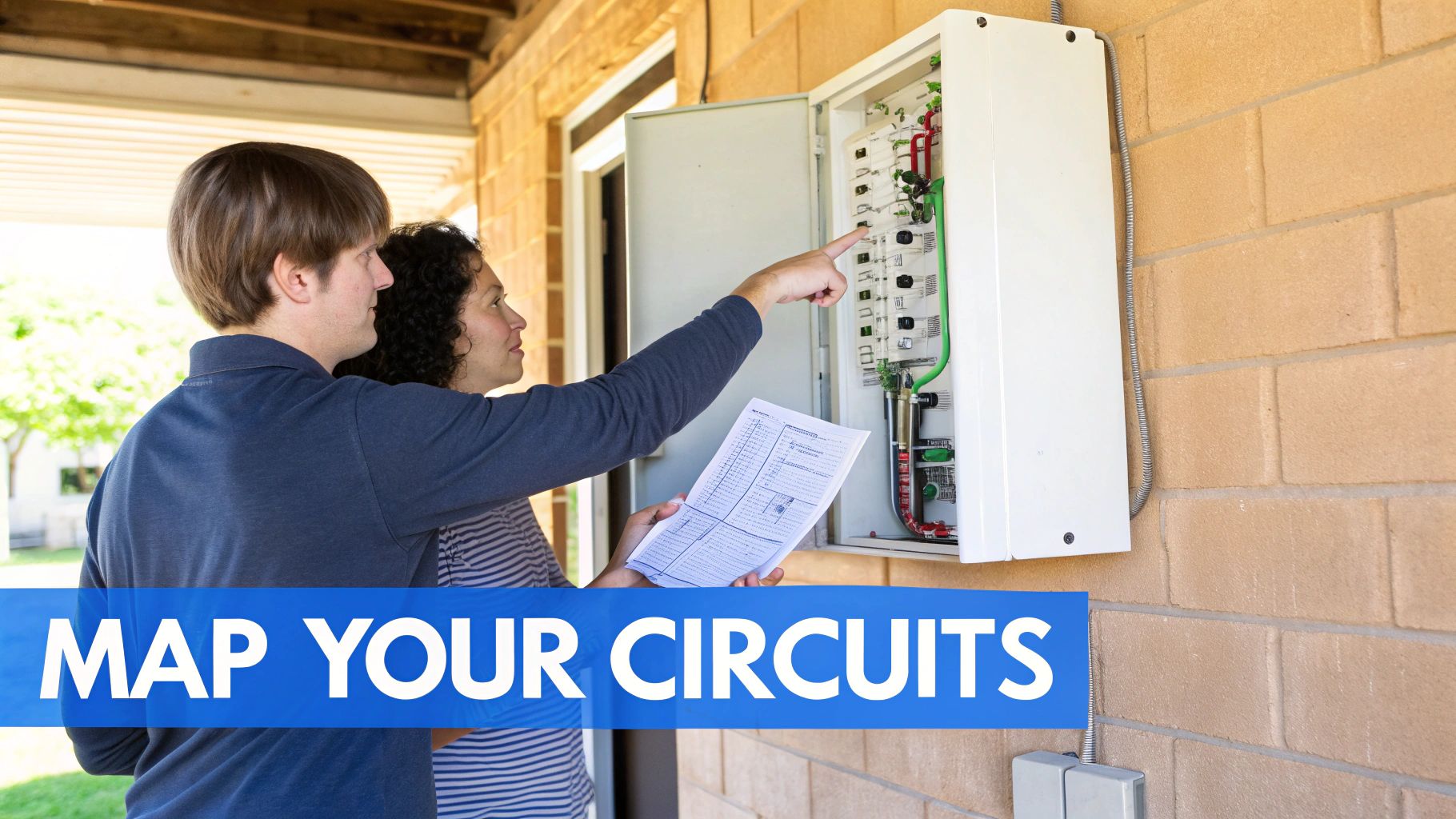
Creating Your Circuit Map
When you open that little metal door, don't be surprised if the labels inside are a mess. Vague scribbles, outdated info, or—worst of all—no labels at all. This is incredibly common, but you can fix it yourself and save a ton of future headaches. Mapping your circuits is a simple and safe job, but it definitely requires two people.
Here’s the easiest way to get it done:
Grab a Partner: One person needs to be at the breaker box, and the other will be the "tester," walking around the house with something easy to plug in, like a small lamp or a phone charger.
Flip and Find: The person at the panel flips one branch breaker off. Never touch the main breaker for this!
Report Back: The tester roams the house, checking which outlets and lights just went dead. They might shout, "Okay, the living room outlets on the south wall are out!"
Label Like You Mean It: Back at the panel, write a clear, specific label for that breaker. Think "Living Room - South Wall" or "Kitchen - Dishwasher." The more detail, the better.
Rinse and Repeat: Turn that breaker back on and move down the line until every single switch has a proper label.
This one simple task is a game-changer, especially for new homeowners in communities like White Marsh and Edgewood. It turns an intimidating metal box into a tool you actually understand and control. Keeping your panel neat is a big part of staying on top of your home's needs. For more great tips, check out your ultimate monthly home maintenance list for 2025.
I take this a step further with my clients. We use proprietary visualization tools during the design phase so clients can map out exactly where every outlet goes. This way, your home’s electrical system is built around your life from the very beginning.
Solving Common Breaker Problems Safely
Sooner or later, even the most reliable breaker box is going to ask for a little attention. Think of it as your home’s way of tapping you on the shoulder and letting you know something isn't quite right.
A breaker that keeps tripping, a weird buzzing sound, or a bit of rust—these are all messages you definitely shouldn't ignore. Knowing what these little signals mean can help you figure out what's going on and how to handle it safely.
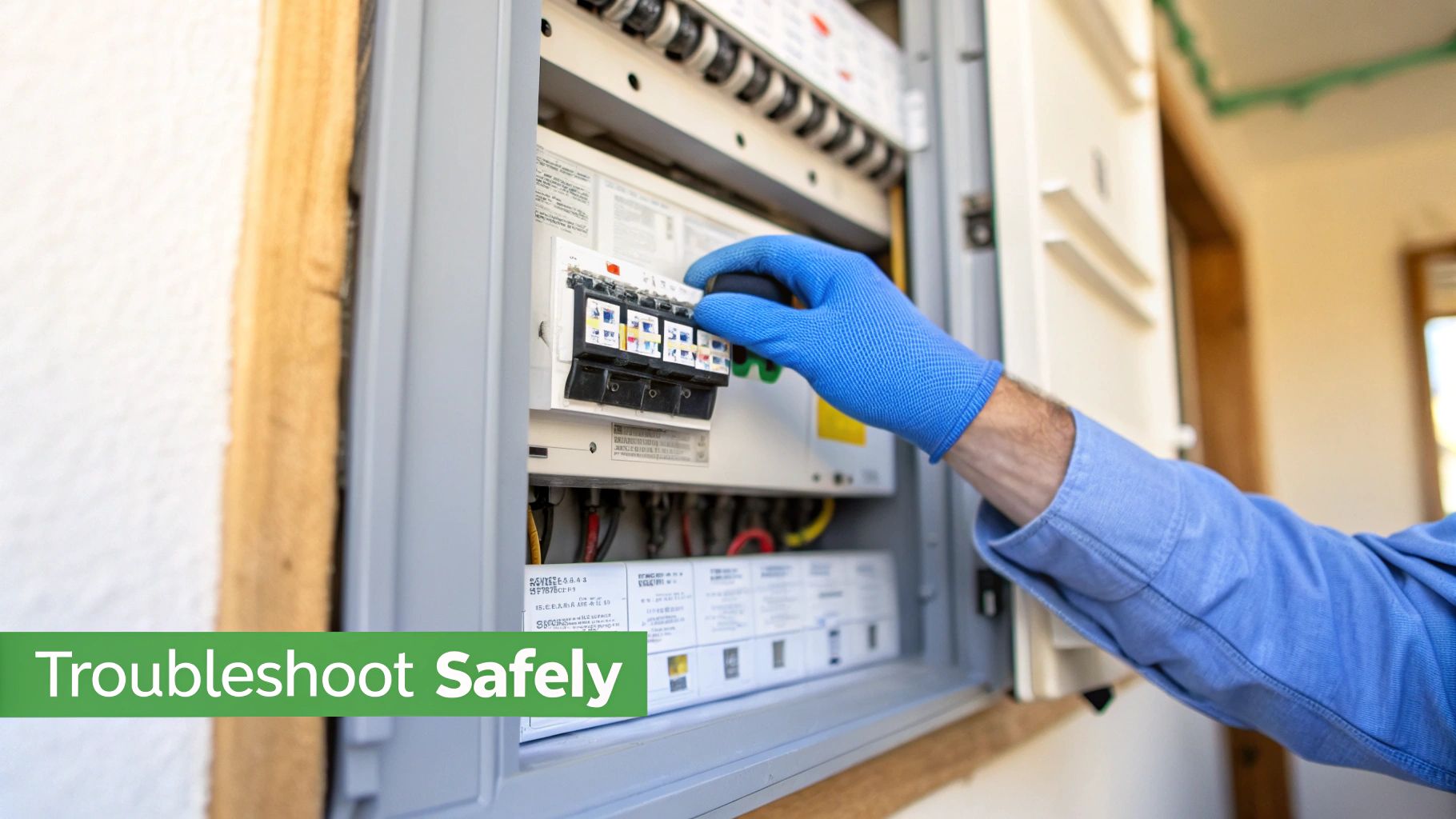
Sometimes, the fix is super simple. For example, if you're running the microwave, the air fryer, and the coffee maker all at the same time, you've likely just overloaded that one kitchen circuit. In that case, the breaker tripping is a good thing! It's doing its job to prevent a bigger problem. But other signs can point to deeper issues that need a professional's touch.
Recognizing The Warning Signs
Knowing what to look for is the first step in keeping your whole electrical system happy and healthy. Some issues are more urgent than others, but you should never just brush any of them off. Keep an eye (and an ear) out for these common red flags.
Breakers That Trip Constantly: Look, a breaker that trips once in a blue moon is no big deal. But one that trips every day or even every week? That's its way of screaming that the circuit is always overloaded, or worse, there's a short circuit somewhere in the wiring.
A Burning Smell or Scorch Marks: If you smell something like burning plastic near your panel or see dark, scorched marks around a breaker, this is a serious fire hazard. Stop what you're doing and call an electrician. It could be a bad breaker or a loose wire that's dangerously overheating.
Buzzing or Hissing Sounds: Your electrical panel should be completely silent. Any buzzing, humming, or hissing sounds are a major red flag, usually pointing to a faulty breaker or a serious wiring problem.
Think of these symptoms as your home's early warning system. For more ways to protect your home, check out our full collection of home safety tips over on the blog.
Why We Should Be Thankful for Modern Breakers
It's easy to take them for granted, but modern circuit breakers are a huge leap forward from the old days. By the 1940s-1960s, circuit breakers had totally changed the game for residential panels. They became the standard as homes started filling up with new gadgets like TVs and washing machines.
They were a massive upgrade from old-school fuse boxes, which needed 20-30% more maintenance time whenever a fuse blew. In fact, data from the U.S. Consumer Product Safety Commission shows that homes built with modern breaker panels (after 1960) have 40% fewer electrical incidents than homes from the fuse-box era. If you're a history buff, you can learn more about the evolution of circuit breakers on circuitbreaker.com.
Knowing what to do—and what not to do—is everything when you're dealing with your breaker box. A little knowledge goes a long way in keeping you and your home safe.
Breaker Box Troubleshooting Guide
When something goes wrong with your breaker box, it can be a little intimidating. This simple table can help you diagnose what might be happening and decide if it's a DIY fix or time to call in a pro.
Symptom | Potential Cause | What You Should Do |
|---|---|---|
A single breaker trips repeatedly | Circuit overload (too many devices) or a short circuit in an appliance or wiring. | Unplug devices from that circuit and reset the breaker once. If it trips again, call an electrician. |
The main breaker trips | Major overload on your whole system or a serious fault in the panel itself. | This is rare and serious. Do not attempt to fix it yourself. Call a licensed electrician immediately. |
Flickering lights across the house | A poor connection at the main breaker or on the bus bar. | This indicates a problem inside the panel. This is not a DIY job—contact an electrician for a panel inspection. |
Burning smell or visible scorch marks | Overheating wire, a loose connection, or a failing breaker. A significant fire risk. | Turn off the main breaker if it is safe to do so and call an electrician for emergency service. |
Buzzing or humming noises | A breaker isn't seated correctly, a wire is loose, or a breaker is about to fail. | This is an urgent warning sign. Avoid touching the panel and call a professional right away. |
Remember, your safety is the top priority. When in doubt, always make the call to a certified electrician.
Safety Dos and Don'ts
When a problem pops up, the key is to stay calm and act safely. Here’s a quick guide to help you make the right moves.
What You SHOULD Do:
DO try a simple reset one time. If a breaker trips, unplug a few things from that circuit, then firmly flip the breaker switch all the way off and then back to the "On" position.
DO keep the area around your panel clear. You need at least three feet of open space in front of it to get to it safely in an emergency. No shelves, no boxes, no junk.
DO call a professional if you're even a little unsure. When it comes to electricity, it is always, always better to be safe than sorry.
What You SHOULD NOT Do:
DON'T keep resetting a breaker that trips over and over. You're ignoring a clear warning sign and could be making a dangerous situation much worse.
DON'T ever touch your breaker box if you see any signs of water, moisture, or rust. Water and electricity are a deadly mix.
DON'T even think about opening the panel cover to "fix" something yourself. The components behind that cover are live with high-voltage electricity that can be lethal.
I always tell my clients here in Baltimore and Harford County that while designing your dream space is the fun part, knowing how to operate your home safely is just as important.
Matching Your Panel to Your Modern Lifestyle
Let's be real—the way we live has completely changed. A breaker box that was more than enough twenty years ago is probably gasping for air trying to keep up with today's demands. Just think about what's plugged in right now: a home office with a couple of monitors, a whole family of smart gadgets, high-powered appliances, and maybe even an EV charger humming away in the garage.
All these new additions are thirsty for electricity, and they draw way more power than homes of the past were ever designed for. That's exactly why a 200-amp panel has become the gold standard for most new homes. It gives you the electrical horsepower to run everything at once without the nuisance of constantly tripping breakers. If you're still rocking an older 100-amp or 150-amp panel, it might be struggling to keep up, especially if you have any upgrades on your wish list.
Is Your Current Panel Up to the Task?
When you’re designing a new space, you absolutely have to think about your electrical needs from the get-go. For instance, if you're planning a big kitchen remodel in your Baltimore County home, you'll need separate, dedicated circuits for that new double oven, the built-in microwave, and the refrigerator just to keep things from getting overloaded. A little bit of planning here saves a lot of headaches later.
This is especially true for modern homes here in Maryland. A standard 200-amp panel can handle 40-50 kW loads, which gives you plenty of juice for an EV charger (which can pull 7.2 kW all by itself) and a house full of smart devices. With the number of IoT devices in our homes tripling since 2015, having that extra capacity isn't a luxury anymore; it’s a flat-out necessity.
Thinking ahead also helps future-proof your home against inevitable code updates, like the recent mandates for arc-fault protection that are designed to prevent thousands of fires every year. For a deeper dive into how we got here, you can learn about the journey from fuses to smart breakers on sincede.com.
A powerful, well-planned breaker box is the invisible foundation of a functional modern home. It ensures that your space can grow with your technological needs, providing safe and reliable power for years to come.
Feeling like it might be time for an upgrade? We’ve got you covered. Check out our detailed walkthrough on how to upgrade your electrical panel in our homeowner's guide.
As part of the hands-on service I provide to my clients in communities like White Marsh and Edgewood, I use unique visualization tools to see the entire electrical plan before the first wire is run. We can map out every outlet, plan for that future hot tub, and make sure your breaker box is sized perfectly for your life—all while you're picking out your new countertops and flooring. My goal is to make sure your dream space isn't just beautiful, but brilliantly functional, too.
Answering Your Breaker Box Questions
Alright, let's wrap this up by hitting some of the most common questions I get from homeowners. Think of this as the quick-and-dirty FAQ to clear up any final confusion. Whether you're a first-time buyer in Harford County or you've owned your home for years, my goal is to make you feel confident when you look at that metal box on the wall.
Even after explaining all the parts and pieces, a few specific questions always seem to pop up. Let's tackle them head-on.
What's the Difference Between a Fuse Box and a Breaker Box?
You've probably heard people talk about older homes having a "fuse box." The real difference is how they stop a power surge.
A fuse box is old-school tech. It uses little glass or ceramic fuses with a tiny wire inside that’s designed to melt and break the connection when too much power flows through. When a fuse blows, it's toast. You have to physically unscrew the dead fuse and pop in a brand new one.
A modern breaker box, on the other hand, is all about reusability. It uses switches. When a circuit gets overloaded, the switch automatically "trips" to the off position, cutting the power. To get things running again, you just find the tripped switch and flip it back on (after figuring out what caused the problem, of course).
The bottom line? Breaker boxes are worlds safer, way more convenient, and built for the power demands of modern life. It's why they are the non-negotiable standard in all quality homes today, including those in communities across Baltimore County and Harford County.
Why Does a Specific Breaker Keep Tripping?
A breaker that keeps tripping is your home's way of waving a red flag. It’s telling you something isn't right, and it's almost always one of three culprits:
Circuit Overload: This is the most common reason, by far. It just means you’re asking for more power than the circuit can safely deliver. The classic example? You plug a space heater into the same bedroom outlet as your vacuum cleaner and—click—the lights go out.
Short Circuit: This one is more serious. It happens when a "hot" wire accidentally touches a "neutral" wire, which can be caused by damaged wiring or a faulty appliance.
Ground Fault: This is a safety risk where a hot wire touches a ground wire or the metal casing of an appliance. It’s a major shock hazard, which is what GFCI outlets are designed to prevent.
If a breaker won't stay on, it's time to call a licensed electrician. They can quickly figure out if you're just plugging in too much stuff or if there's a deeper wiring issue that needs to be fixed.
Is It Safe to Reset a Tripped Breaker?
Absolutely. In most situations, it's perfectly safe to reset a tripped breaker yourself. You just need to do it the right way and know when to stop trying.
First, go to the room where the power went out and unplug anything big you just turned on. Then, head to your breaker box and find the one switch that’s not lined up with the others—it'll be in the "off" or a middle position. To reset it, you have to push the switch firmly all the way to the "Off" position first. Then you can flip it back to "On."
Now, here's the important part: if the breaker trips again right away, do not reset it again. That means there's a persistent problem. Forcing it back on repeatedly can cause wires to overheat and create a serious fire risk. If the breaker feels warm or you smell anything like burning plastic, it’s a "call an electrician now" situation.
Do I Need to Upgrade My Breaker Box for a Remodel?
There's a very good chance you will, especially if you're working on an older house or adding anything that draws a lot of power.
A kitchen remodel is the perfect example. Let's say you're adding a beautiful new double oven, an induction cooktop, and a high-efficiency dishwasher. Your current panel might not have enough amperage—or even enough physical slots—for the new dedicated circuits these appliances demand.
The same logic applies to adding central air, a hot tub, an EV charger, or a whole new addition to your home. An electrical assessment should be one of the very first things you do in your planning phase. This is where thinking ahead pays off big time. My unique approach includes using proprietary visualization tools to help you map out every electrical need during the design process, ensuring your gorgeous new space is powered safely from day one.
While the builder I represent provides high-quality homes, I go a step further—offering my clients unique proprietary visualization tools, hands-on service, and access to visualizers that help you bring your dream space to life. If you're ready to create a home that's a perfect fit for your life in White Marsh, Edgewood, or anywhere in Maryland, I'm here to help. Explore your options and start your journey today at https://www.customizeyourhome.com.
Comments