

What Is a Model Home and How Does It Work?

Ever driven past a new housing development and wondered, "What is a model home?" Think of it as the builder's masterpiece—a fully furnished, professionally decorated, and often upgraded example of a floor plan they offer. It’s like test-driving a car before you buy it; this is your chance to physically walk through the layout, get a feel for the room sizes, and see the builder's craftsmanship firsthand.
Your First Look at a New Community
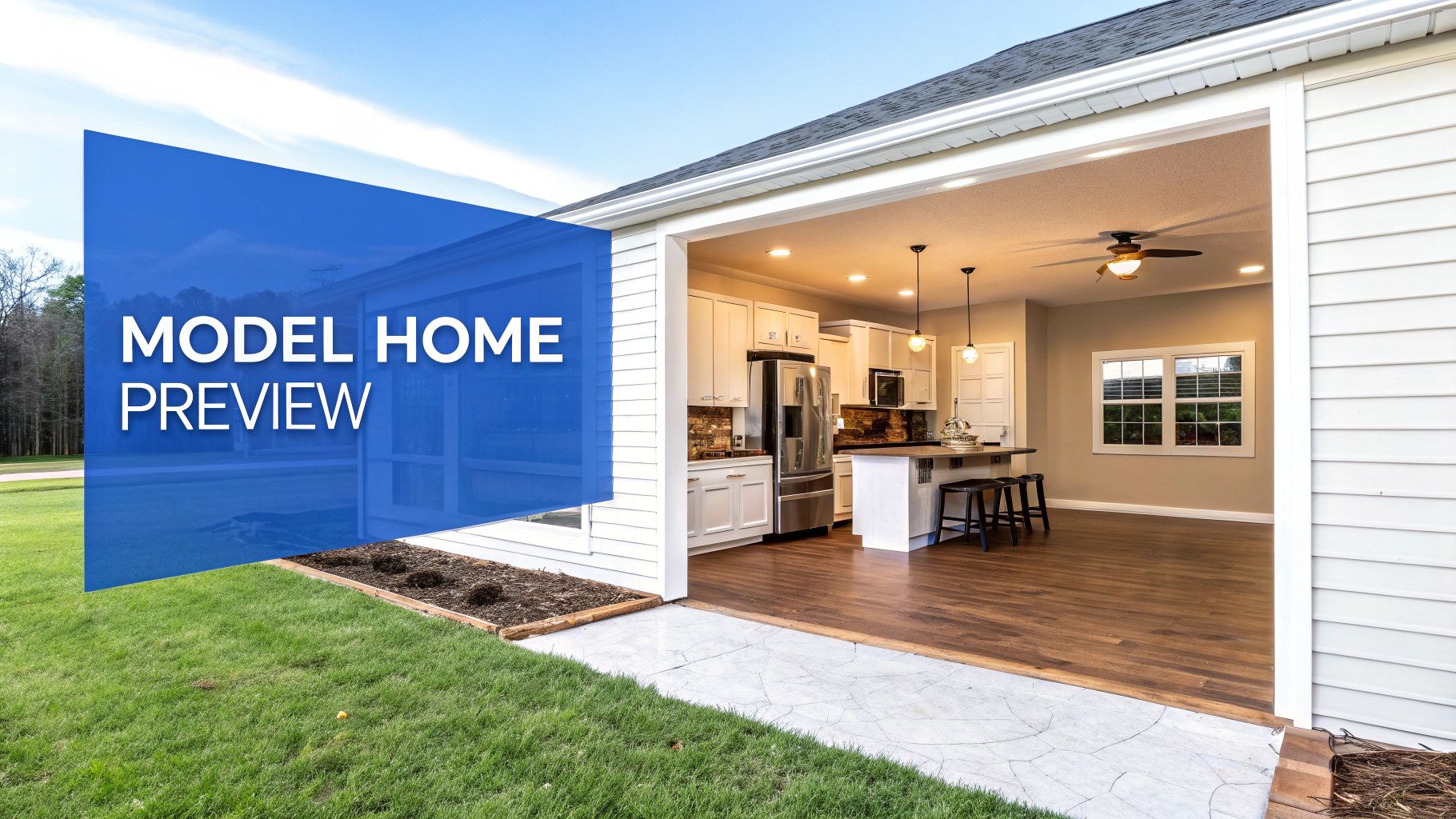
A model home is built with one goal in mind: to help you imagine your life there. Builders pour a lot of resources into professional interior design, immaculate landscaping, and high-end finishes to show their homes in the absolute best light. It’s a real, tangible experience that a blueprint or online gallery just can’t replicate. You actually get to open the doors, feel the flooring under your feet, and understand the natural flow from room to room.
This hands-on approach really works. For example, a blueprint might show a kitchen island, but standing in the model home lets you see if you can comfortably walk around it while someone else opens the refrigerator. Studies show that over 60% of new-home buyers said walking through a model home was crucial for helping them visualize how they’d live in the space. It turns an abstract floor plan into a place you can picture your family in, which is why it plays a huge part in the buying decision for nearly half of all buyers.
What to Expect During a Tour
When you step inside a model home, you're not just seeing a house; you're seeing its absolute full potential. The builder's goal is to inspire you and show off all the incredible possibilities.
Here's what you'll almost always find:
Professional Staging: Every piece of furniture, art, and decor is strategically placed to make each room feel spacious, functional, and inviting.
Upgraded Features: Expect to see the best of the best—premium quartz countertops, top-of-the-line appliances, and beautiful hardwood flooring that likely aren't included in the base price.
A Prime Location: Builders usually put their model homes on some of the best lots in the community to make a fantastic first impression.
Knowing this ahead of time helps you look past the beautiful staging and focus on the home's core structure and what comes standard. To get a better handle on the entire process, take a look at our guide to buying a new construction home in Maryland.
Whether you’re exploring communities in White Marsh, Maryland; Edgewood, Maryland, or anywhere in Baltimore County, Maryland; and Harford County, Maryland, touring a model home is an excellent starting point. But it’s just that—a start. I go a step further, offering my clients unique proprietary visualization tools and hands-on service. These visualizers help you bring your dream space to life, letting you see your specific choices—from the cabinet finish to the flooring stain—in your future home before it's even built. Let's connect and start making your vision a reality.
The Pros and Cons of a Model Home Visit
Walking through a beautifully staged model home is one of the most exciting parts of the home-buying process. It’s the moment a floor plan jumps off the page and becomes real, but it's smart to go in with a clear head. You need to understand both the perks and the potential pitfalls before that perfect decor sweeps you off your feet.
Knowing both sides of the coin helps you stay focused on what really matters: finding the right home for your family.
A model home tour gives you something a blueprint or an online gallery just can't: a true feel for the space. You can walk the hallways, get a real sense of room sizes, and see the builder's quality and craftsmanship up close. For example, you can see if the laundry room is conveniently located near the bedrooms or if the open-concept living area feels as spacious as you'd hoped. It's the best way to know for sure if a layout will actually work for your life.
Think of a model home tour as a fantastic source of design inspiration. You get to see the latest trends in finishes, fixtures, and colors, which can spark some great ideas for personalizing your own space.
The Advantages of Touring a Model
Seeing the home in person really does make the decision-making process a whole lot easier. Here’s why.
Visualize Your Life: This is your chance to see exactly how your furniture might fit, how much natural light fills the rooms, and how the home flows. It helps you truly picture your daily routines unfolding there.
Inspect the Craftsmanship: Get up close and personal with the builder's work. Look at the trim, the paint job, and the sturdiness of the fixtures. It’s a golden opportunity to judge the quality for yourself.
Potential to Purchase the Model: Every now and then, builders will sell the fully furnished model home. This can be an amazing deal because it often comes loaded with all the high-end upgrades, professional landscaping, and sometimes even the furniture.
Things to Keep in Mind
While the benefits are huge, it’s critical to tour with a practical mindset. The "wow" factor is completely intentional, but you have to look past the sparkle to make a smart decision.
That stunning kitchen with the waterfall countertops and professional-grade appliances? Chances are, it’s packed with upgrades that aren't included in the home's base price. Builders do this to show off the absolute best they can build.
Make sure you ask the sales agent for a list of standard features so you know exactly what comes with the home from the start.
Also, remember that model homes are usually built on prime corner lots to grab attention, which could mean more traffic and noise than other spots in the neighborhood. And if you end up buying the actual model, keep in mind it’s had a lot of foot traffic. It's wise to check for any minor wear and tear.
For more helpful pointers on what to look for, check out our guide on the do's and don'ts for new homes in Maryland.
How to Tour a Model Home Like a Pro
Walking into a model home is exciting, but it's also a sales pitch in 3D. Your job is to play detective. You need to look past the perfect furniture and decorator touches to see the home's "bones"—the stuff that really matters and can't be changed easily. Think of this as your game plan for getting the real story.
Your main goal here is to picture your life and your stuff in this space, not the life of the imaginary family who lives in the staged version. How does the layout actually flow? Imagine yourself hauling groceries from the car to the kitchen. Think about the morning rush hour in your house—will this layout cause a traffic jam?
Next, pay close attention to light and sound. If you can, try to visit at different times of the day to see how the natural light changes from room to room. And just... listen. Is it quiet? Can you hear traffic from the main bedroom? Little things like that make a huge difference once you're living there.
Your Essential Touring Checklist
To really get the most out of your visit, you can't just wander through. Go in with a plan and don't be afraid to take your time and really poke around.
Bring a Tape Measure: Sure, that massive sectional looks amazing in the model's living room, but will your couch even fit? Measure the key spots where your furniture will go—the living room, bedrooms, and that potential home office nook.
Open Everything: Seriously, don't be shy. Open the kitchen cabinets and drawers. Check out the pantry space. Peek inside every single closet. It's the only way to get a true feel for how much storage you’re actually getting.
Use Your Phone: Snap photos and take videos of everything—the good and the bad. I always tell my clients to record a video and talk through what they're seeing. It’s a huge help later when all the different floor plans start to blend together.
Key Questions to Ask the Sales Agent
The sales agent is your best source of information, so come armed with questions. Their answers are what separate the sticker price from the real price.
Remember, a model home is a builder's ultimate sales tool, decked out to make you fall in love. Builders know that the base price you see often leaves out 10–30% of what people end up spending on design and structural options. The model is loaded with these higher-end features so you can see and touch them. It's where you'll pick everything from fancy kitchen packages to upgraded flooring. If you want to dive deeper into how this works, check out the market trends for smart homes and upgrades on technavio.com.
With that in mind, here are the non-negotiable questions to ask:
"Can you give me a list of the standard features included in the base price?" This is the most important question you will ask all day. It gives you a baseline for what the home costs before a single dollar is spent on extras.
Once you have that list, start pointing. Point to things you like and ask, "Is this countertop standard or an upgrade?" Do the same for the flooring, the appliances, the light fixtures, and the bathroom tiles.
Finally, wrap it up with, "Could you provide a price list for the most common upgrades?" This lets you start building a realistic budget right from the get-go, with no painful surprises later.
Touring a model in a community like White Marsh, Maryland or Edgewood, Maryland is a fantastic way to start. But I go a step further for my clients. My proprietary visualization tools are a game-changer. Instead of just trying to imagine what your choices will look like, you can actually see how your preferred flooring, cabinets, and countertops will come together in your new home. It completely takes the guesswork out of the equation.
Understanding What's Standard and What's an Upgrade
It’s incredibly easy to get swept away when you walk through a model home for the first time. That gleaming hardwood flooring, the spa-like bathroom with gorgeous custom tile, the gourmet kitchen with its stunning quartz countertops—it's all designed to make you fall in love on the spot. But it’s so important to remember that what you’re seeing is the builder’s showpiece, and not everything is included in that base price.
Builders use model homes to show off the full potential of their designs. That means they're often loaded with upgrades. Think of the base price as the starting point, the blank canvas for your future home. It typically covers the essential structure, standard-grade carpeting, basic paint, and simple laminate countertops. Pretty much anything beyond that is usually considered an upgrade.
This is where the fun really begins, though. It's your chance to personalize your space. We let buyers customize their homes by getting to pick their flooring, countertops, cabinets, tile, and more. While the builder I represent provides high-quality homes, I go a step further—offering my clients unique proprietary visualization tools, hands-on service, and access to visualizers that help you bring your dream space to life.
To keep your head on straight and your budget in check during a tour, it helps to have a game plan. Knowing what to look for, what questions to ask, and what to write down makes all the difference.
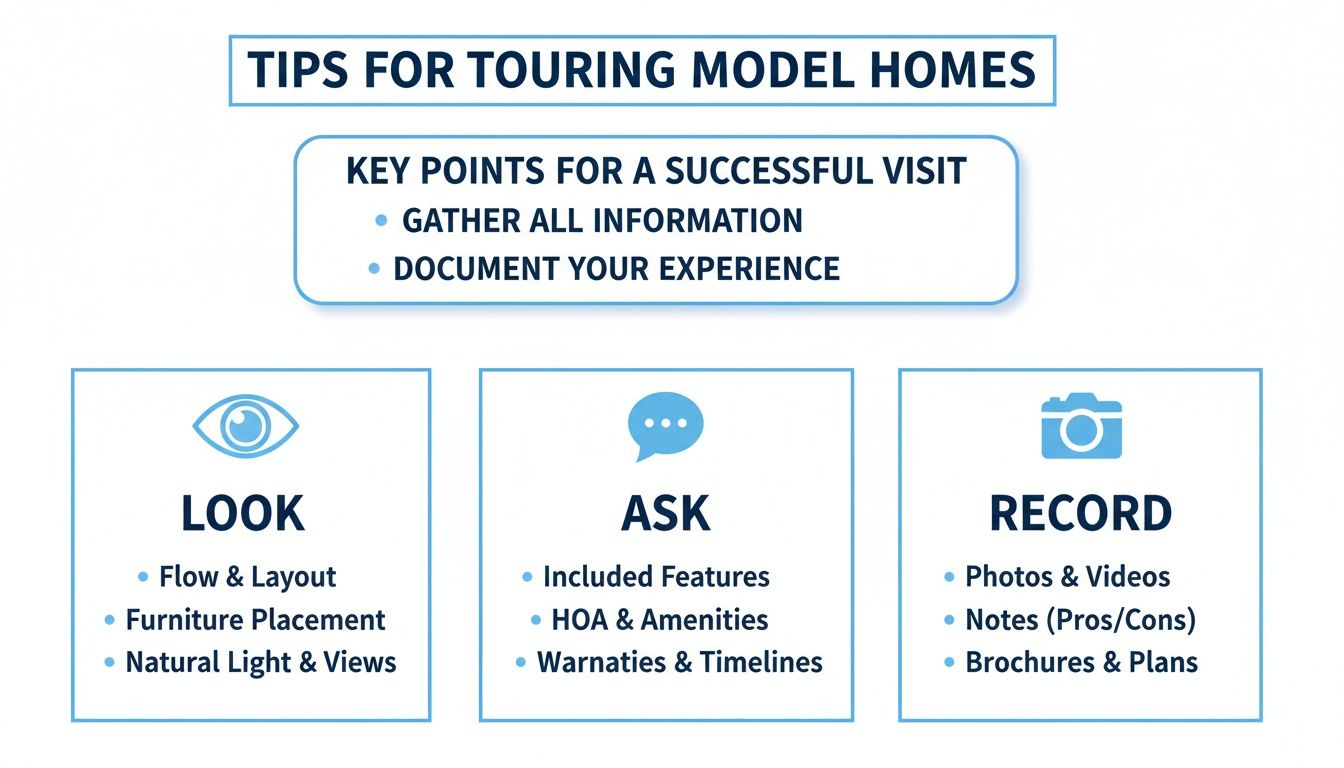
This little guide is a great cheat sheet, breaking down the three key actions—Look, Ask, and Record—to help you gather all the information you need to make smart, confident decisions.
Distinguishing Between Standard and Upgraded Features
The absolute best way to avoid budget shock later on is to get a crystal-clear understanding of what’s included from day one. Any good sales consultant should have a "standard features" sheet ready for you, which lists everything that comes with the base price. Keep that list in your hand as you walk through the model. When you see something you love, point to it and ask, "Is this standard?"
To give you a better idea, here’s a helpful table that breaks down some of the most common features.
Standard Features vs Common Upgrades
Feature Category | Typically Standard | Typically an Upgrade |
|---|---|---|
Flooring | Builder-grade carpet in bedrooms and living areas; vinyl or linoleum in kitchens and baths. | Wood Laminate (standard for us), luxury vinyl plank (LVP)(standard for us), upgraded carpet with thicker padding, or ceramic tile. |
Kitchen | Laminate countertops, basic cabinet hardware, and standard appliance package (e.g., black or white). | Granite (standard for us) or quartz (standard for us) countertops, custom tile backsplash, under-cabinet lighting, and stainless steel (standard for us) or smart appliances. |
Lighting | Basic overhead light fixtures in each room. | Recessed lighting (standard for us), pendant lights over an island (standard for us), dimmer switches, or ceiling fans (standard for us in owner's suite). |
Technology | Standard wiring for cable and internet. | Integrated smart home systems (standard for us), security cameras, or built-in speakers. Learn more about the amazing possibilities by checking out our standard smart home features. |
The key takeaway here is pretty simple: never assume something is included. Always, always ask for clarification. This puts you in the driver's seat, empowering you to decide which upgrades are truly worth the investment for your family and your lifestyle.
Whether you're exploring new communities in White Marsh, Maryland; Edgewood, Maryland, or anywhere across Baltimore County, Maryland; and Harford County, Maryland, my goal is to make this whole process transparent and enjoyable. I provide my clients with unique visualization tools that let you see exactly how your chosen finishes will look together. It completely removes the guesswork so you can design your dream home with total confidence.
The Smart Home Tech You'll See
Step inside a new model home today, and you might feel like you’ve jumped a few years into the future. It's about more than just the gorgeous staging and perfect paint colors. Builders are now using model homes to show you what a fully connected lifestyle actually feels like.
This isn't just about cool gadgets for the sake of it. We're talking about real, practical tools that simplify your day. Imagine a smart thermostat that learns your routine to cut down on energy bills, or lighting you can control with your voice when your hands are full carrying in groceries. These are the details that turn a house into a home that works for you.
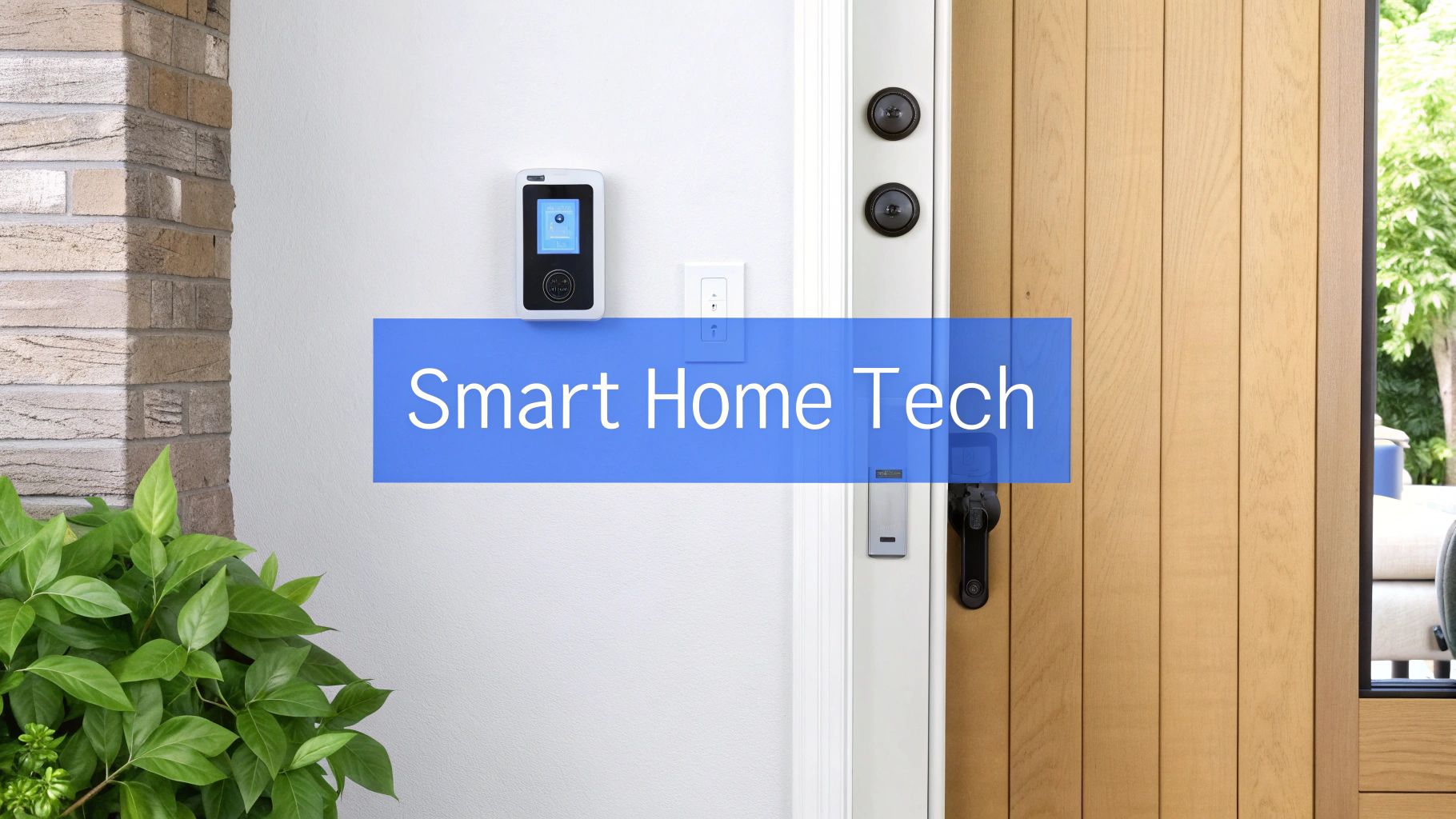
This trend isn't a fad; it's a fundamental shift in what buyers expect. The global smart home market ballooned to an estimated $127.8 billion in 2024, and it's still growing. Builders know this, which is why they’re packing their models with the latest tech. You can read about the rapid growth in the smart home market to see just how big this is getting.
What to Look for During Your Tour
As you walk through the model, keep your eyes peeled for the tech that’s seamlessly blended into the home. You’ll probably spot a few key systems that offer some serious perks.
Smart Security: Check for things like video doorbells, keyless smart locks, and security cameras you can peek at from your phone.
Climate Control: Play around with the smart thermostat. Is the interface easy to use?
Convenient Lighting: See if there are smart switches on the walls or if the lighting can be controlled with an app or your voice.
Integrated Hubs: Is there a central command center? Look for a smart speaker (like an Alexa or Google Home) that pulls all the different devices together.
When you're touring homes in White Marsh, Maryland or Harford County, Maryland, don't just notice these features—ask how they all connect. A bunch of separate gadgets isn't a smart home; a unified system is. For a deeper dive, check out your guide to home smart tech in a new build.
The best part of a new construction home is that you can decide which tech is important to you. It's about building a home that's not just beautiful but also works smarter for your family.
Bring Your Own Vision to Life
Touring a model home is a fantastic way to get the wheels turning, but what happens when you’re ready to take that inspiration and run with it? This is where we can really have some fun.
Builders give you the canvas, but I help you paint the masterpiece. My clients get a much more hands-on experience because I bring powerful visualization tools to the table. We can plug in your actual selections—the exact flooring, countertops, and cabinets you love—and see them come to life in your floor plan before a single nail is hammered. Think of it as your own personal design studio.
It’s all about taking the guesswork out of the equation. You get to see how it all comes together, making sure the home you walk into is the one you’ve been dreaming of.
If you're gathering ideas and trying to nail down your style, a great place to get inspired is an AI Interior Designs Gallery. It's a cool way to explore different looks and see what resonates with you.
Let's Build Your Vision Together
This is your chance to create a space that feels like you. We’ll work together to customize everything from the big-ticket items like flooring and countertops down to the tile and cabinet hardware.
If you’re thinking about building a new home in Maryland areas like White Marsh, Maryland; Edgewood, Maryland; Baltimore County, Maryland; or Harford County, Maryland, I'd love to chat. Let's start designing a home you'll be excited to come home to for years.
Got Questions? We’ve Got Answers.
It’s totally normal to have a few questions buzzing around your head when you start looking at model homes. In fact, most people do! Let's clear up some of the most common ones so you can walk into your next tour feeling like a pro.
So, Can I Actually Buy the Model Home Itself?
You bet (after the end of selling our communities)! Builders almost always sell the model home, usually when the community is close to being finished. It's a hugely popular choice because it’s already packed with all the bells and whistles—think top-of-the-line finishes, gorgeous landscaping, and sometimes even the designer furniture.
The only real catch? It's been the star of the show, so it’s had plenty of visitors. Plus, what you see is what you get; there’s no opportunity to put your own spin on the design choices.
Does the Furniture Come with My New House?
In a word, no. The stunning furniture you see is just for show, helping you imagine how you might live in the space. It’s staging, pure and simple.
When you build a new home, you're getting an incredible blank canvas that’s all yours to decorate. The one exception is if you buy the actual model home itself—in that case, the builder might sell it "as-is," decor and all.
Think of the model's decor as your personal lookbook. It's there for inspiration, helping you lock in a layout you love. The real fun begins when you start picking finishes that truly reflect your style.
How Do I Know What's Standard and What's an Upgrade?
This is the big one, and the answer is simple: just ask!
When you arrive, ask the sales consultant for the “standard features” sheet. This is your cheat sheet, listing everything that comes with the base price of the home.
As you walk through, point at things you like—the backsplash, the light fixtures, the carpet—and ask, "Is this standard or an upgrade?" It’s the single best way to keep your budget in check and avoid any unwelcome surprises down the line.
Here at Customize Your Home, we believe building a home should be clear and exciting, not confusing. If you’re looking for a new home in Maryland areas like White Marsh, Maryland; Edgewood, Maryland; Baltimore County, Maryland; or Harford County, Maryland, I can personally walk you through the process. My hands-on approach and unique visualization tools will help you see exactly what your dream home will look like.
Ready to get started? Let's connect and start building your vision.
Comments