

What Is Debt to Income Ratio and Why It Matters for Homebuyers

Before you even start dreaming about quartz countertops or the perfect hardwood floors, there's a key number you need to get friendly with: your Debt-to-Income (DTI) ratio.
Think of it less as a scary financial test and more as a quick snapshot of your financial health. It's a simple percentage that tells lenders how much of your monthly income is already spoken for by debt payments.
In short, it helps them see if you can comfortably handle a new mortgage payment on top of everything else. The lower your DTI, the better you look to a lender—it signals you're a lower-risk borrower, which can seriously boost your chances of getting approved.
Why DTI is Such a Big Deal for Homebuyers
So, why all the fuss over one little number? It all comes down to risk. Lenders need to feel confident you won't be stretched too thin once you have a mortgage. A low DTI shows them you have a good handle on your finances and enough breathing room in your budget.
But this isn't just about the lender. Knowing your DTI is incredibly empowering for you. It grounds your home search in reality and helps you figure out what you can genuinely afford before you get attached to a house that's out of reach. It’s the first step toward a stress-free homeownership journey, whether you're looking for a new home in White Marsh, Maryland, or anywhere in Baltimore County.
A strong DTI doesn't just get you approved; it can also unlock better interest rates, which saves you a ton of money over the life of your loan. For a deeper dive into how all your financial pieces fit together, exploring comprehensive financial planning can provide a much clearer picture.
Your DTI is more than just a number for a loan application; it’s a tool that helps you create a sustainable budget for your future home. It clarifies your financial position, ensuring you can enjoy your new home in Baltimore County or Harford County without worry.
Understanding your DTI is a crucial part of figuring out your true buying power. Before you go any further, check out our guide on how much house you can comfortably afford to get a complete picture.
A Quick Guide to DTI Levels
To make it even clearer, here's a simple breakdown of what different DTI ratios typically mean to a mortgage lender.
DTI Ratio | What It Means for Lenders | Loan Prospects |
|---|---|---|
36% or Less | Ideal. You have plenty of room in your budget. | Excellent. You'll likely qualify for the best rates and terms. |
37% to 43% | Manageable. This is an acceptable range for many lenders. | Good. You should qualify for most conventional loans. |
44% to 50% | Caution Zone. Your budget is getting tight. | Possible, but options may be limited (e.g., FHA, VA loans). |
Over 50% | High Risk. Lenders see very little room for a new payment. | Very challenging. Loan approval is unlikely without major changes. |
As you can see, the goal is to keep that number as low as possible to make your homebuying process smooth and successful.
How to Calculate Your DTI Step by Step
Ready to crunch the numbers and figure out your DTI? It might feel like you need a finance degree, but I promise, it's just some simple arithmetic. Let's walk through it together, step-by-step, so you can get a clear picture of where you stand.
Knowing your DTI is a huge advantage, especially if you're thinking about buying a new home in Maryland. It directly impacts your budget for the fun stuff, like picking out new flooring, countertops, and cabinets for the home you'll get to customize.
Step 1: Round Up All Your Monthly Debts
First, you need to get a handle on every single monthly debt payment you have. We're not talking about your Netflix subscription or your grocery bill here. We're focused on the fixed, recurring payments you’re committed to making on money you've borrowed.
Grab a piece of paper or open up a spreadsheet. It's time to list everything out.
What Counts Towards Your DTI Calculation?
To make sure you don't miss anything, here’s a quick rundown of the common debts lenders look at when calculating your back-end DTI. It's a handy checklist to follow.
Debt Category | Include in DTI? (Yes/No) | Example |
|---|---|---|
Rent or Mortgage | Yes | Your current monthly housing payment. |
Auto Loans | Yes | The minimum payment on your car loan. |
Student Loans | Yes | Your required monthly payment, even if deferred. |
Credit Card Balances | Yes | The minimum monthly payments on all cards. |
Personal Loans | Yes | Payments for any personal or signature loans. |
Other Installment Loans | Yes | Payments for furniture, electronics, etc. |
Alimony/Child Support | Yes | Any court-ordered monthly payments you make. |
Once you've got all these figures written down, add them all up. That final number is your total monthly debt. Simple as that.
Step 2: Figure Out Your Gross Monthly Income
Next up is your gross monthly income. This is the key number lenders care about—it's your total income before a single penny is taken out for taxes, health insurance, or anything else. It's the bigger number on your pay stub, not your take-home pay.
If you're self-employed or your income fluctuates (think sales commissions or freelance work), lenders will typically want to see an average of your income over the last couple of years to confirm it's stable.
Don't forget to include all your income sources:
Wages and salary
Bonuses and commissions
Tips
Alimony or child support you receive
Pension or Social Security benefits
Add everything together to get your grand total for gross monthly income. This handy diagram shows exactly how these two pieces—debt and income—fit together.
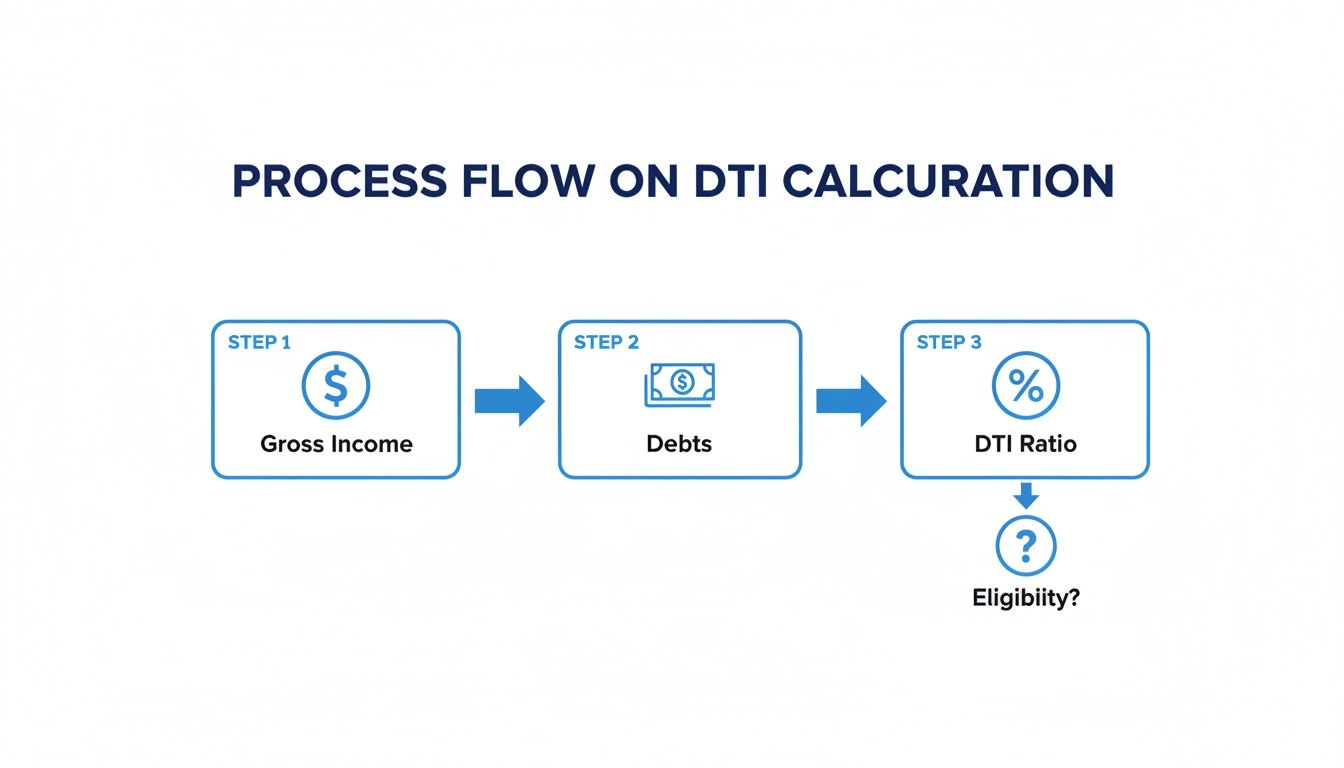
As you can see, it's really just a simple division problem that gives you a powerful snapshot of your financial health.
Step 3: Do the Math
Alright, this is the moment of truth! You have your two numbers: total monthly debt and gross monthly income.
The formula is straightforward:
(Total Monthly Debt / Gross Monthly Income) x 100 = DTI Ratio (%)
Let’s run through a practical example. Imagine a couple in Harford County, Maryland, getting their finances in order to buy a new home.
Gross Monthly Income: $8,000
Monthly Debts: * Rent: $1,600 * Car Payment: $450 * Student Loans: $300 * Credit Card Minimums: $150
Total Monthly Debt: $1,600 + $450 + $300 + $150 = $2,500
Now, we just plug those numbers into our formula:
($2,500 / $8,000) = 0.3125
To turn that into a percentage, just multiply by 100, which gives us 31.25%. We can round that to 31.3%. For a lender, this DTI is fantastic. For a more detailed look at the math, you can check out this guide on how to calculate your debt-to-income ratio.
Getting a solid grasp on your DTI is non-negotiable for anyone dreaming of a customizable home. This single number—your total monthly debt divided by your gross monthly income—is what determines your mortgage eligibility and how much you can truly afford for those personal touches. History has shown us why it matters; during the 2008 financial crisis, countless households had DTIs creep above 40%, a major factor in the foreclosure wave that followed. These days, lenders see a DTI under 36% as the gold standard, putting you in the driver's seat to get a great loan and still have the budget for those dream kitchen upgrades.
Wondering how this all fits into the bigger picture of getting a loan? Our guide on how to get pre-approved for a mortgage in Maryland breaks down the entire pre-approval process.
Why Lenders Care So Much About Your DTI
Alright, you’ve run the numbers and have your DTI figured out. But what does that percentage actually mean to a mortgage lender? Why do they fixate on it?
Think about it from their side of the table for a moment. They're about to hand you a huge chunk of money, and they need some assurance you can handle the payments for the long haul. Your DTI ratio is one of their go-to tools for gauging exactly that.
It’s not about judging your spending habits. It's pure risk assessment. A low DTI tells a lender you have plenty of cash flow after paying your monthly bills. That signals you can comfortably take on a mortgage without stretching your finances to the breaking point. You look like a reliable borrower.
On the flip side, a high DTI is a red flag. It suggests your budget is already tight. Adding a hefty house payment on top of everything else could be a recipe for financial stress, increasing the risk you might miss payments. In a way, they're looking out for you just as much as for themselves.
It's More Than Just Getting a "Yes"
Securing an approval is just the first step. Your DTI has a much bigger job—it directly influences the interest rate you'll get.
Lenders see a borrower with a low DTI as a safer bet. To compete for your business, they'll often reward that lower risk with a lower interest rate. A small difference here can be a game-changer, potentially saving you tens of thousands of dollars over the life of your mortgage. Think of what that extra money could do for your new place—that dream kitchen island or the finished basement you've always wanted.
A strong DTI doesn't just open the door to homeownership; it unlocks better financial terms that give you more freedom to personalize your space.
Of course, DTI is just one piece of the puzzle. It works alongside your credit history. To get the full picture, you'll also want to understand what credit score is needed for a home loan.
Lender DTI Thresholds: Knowing the Magic Numbers
Not all loans are created equal, and each has its own rules for DTI. Lenders follow specific guidelines for different loan programs, so knowing these benchmarks helps you understand where you need to be.
Typical DTI Limits by Mortgage Type
This table shows the general DTI ratio requirements for popular home loan programs, helping you see where you stand.
Loan Type | Ideal Back-End DTI | Maximum Back-End DTI (with compensating factors) |
|---|---|---|
Conventional Loan | 36% or Lower | Typically capped at 43%, but can sometimes go up to 50%. |
FHA Loan | 43% or Lower | Can go up to 50% or even higher in some cases. |
VA Loan | 41% or Lower | No official maximum DTI, but lenders often use 41% as a guideline. |
USDA Loan | 41% or Lower | Generally a firm cap at 41% for both housing and total debt. |
A quick note on that "maximum" DTI: Lenders can sometimes stretch the rules if you have "compensating factors," like a stellar credit score, a large down payment, or significant cash reserves.
Having these numbers laid out gives you a concrete target. If a Conventional loan is your goal, you now know that getting your DTI under 36% puts you in the driver's seat. It makes you a top-tier candidate and gives you the best shot at securing a great loan to start customizing your dream home.
Practical Strategies to Lower Your DTI Ratio
If your DTI ratio is a little higher than you’d like, don't sweat it—this is where you can actually take control. Getting that number down is one of the most powerful moves you can make before you even think about applying for a mortgage. It doesn't just improve your chances of getting approved; it can also land you a much better interest rate, saving you a small fortune over the life of your loan.
Think of it as getting your finances in shape for the homebuying marathon. A little work now makes a huge difference later, freeing up cash for the fun stuff, like picking out those perfect kitchen cabinets or upgraded flooring for your new home in White Marsh or Edgewood. Let’s get into some real-world strategies to bring that number down.
Prioritize and Attack Your Debts
The most direct way to lower your DTI is to shrink the "debt" side of the equation. But simply chipping away at everything at once isn't the best plan. To see real results, you need to be strategic. We're talking about more than just skipping a few lattes; we're talking about moves that make a serious dent.
First, make a list of everything you owe, from the smallest credit card balance to that big student loan. Then, you can focus your efforts where they'll have the biggest impact.
Here's my go-to game plan:
Pay Down High-Interest Credit Cards: Lenders look at your minimum monthly payments, but aggressively paying down revolving debt like credit cards is a double win. It lowers those required payments and makes your whole financial profile look healthier. For example, paying off a $5,000 credit card balance could eliminate a $150 monthly payment from your DTI calculation entirely.
Target Loans with High Monthly Payments: Got a car loan or personal loan with a monster monthly payment that’s close to being paid off? Throwing extra cash at it can completely wipe that obligation off your DTI calculation. If you have 8 months left on a $400 car payment, paying it off now removes that $400 from your monthly debt.
Consider Debt Consolidation: If you're juggling multiple high-interest debts, a consolidation loan could roll them into one, hopefully with a lower interest rate and a smaller total monthly payment. Just be careful and make sure the new loan's terms and rate are genuinely better for you in the long run.
Homebuyer Pro Tip: Dropping your DTI by just 5 points could free up enough room in your monthly budget to afford that luxury flooring you've been eyeing! Every percentage point you shave off can be directly translated into more personalization for your new space.
Boost Your Income
While tackling debt is crucial, don't forget the other side of the DTI formula: your income. Bringing in more money is an equally powerful way to improve your ratio. Even a temporary boost can make all the difference when you're gearing up to apply for a loan.
Think creatively about how you can bump up your earnings.
Ask for a Raise: If you’ve been crushing it at work, now could be the perfect time to sit down with your boss and negotiate a pay increase.
Take on a Side Hustle: Even short-term freelance projects, a part-time gig, or driving for a rideshare app can provide a documented income stream that lenders can factor in.
Document All Income Sources: Make sure you’re counting everything. That includes bonuses, commissions, regular overtime, or any consistent freelance income. Don’t leave any money on the table.
Increasing your income doesn't just help with what is debt to income ratio; it strengthens your entire financial position, making you a much more appealing borrower in the eyes of a lender.
Timing is Everything
When it comes to lowering your DTI for a mortgage, when you make your moves is just as important as what you do.
First off, put a freeze on any new debt in the months leading up to your mortgage application. A brand-new car loan or maxing out a credit card for furniture can send your DTI through the roof at the worst possible moment. Lenders want to see stability, and new debt is a red flag.
It’s also smart to start working on your DTI at least six months before you plan to buy. This gives your debt-paydown efforts enough time to hit your credit report and make a real impact. A little forethought here can make for a much smoother, less stressful experience when you're ready to start visualizing your dream home with my unique design tools.
For anyone planning to buy a customizable new home, a strong DTI ratio under 36% is a total game-changer. It helps secure better rates and gives you the financial breathing room for special upgrades like premium flooring or smart home features. Post-pandemic inflation and rising rates have definitely pushed DTI ratios higher for many, especially here in Maryland, but recent wage growth is helping to offset that. In fact, one study found that buyers with a DTI under 28% got interest rates that were 0.25% lower—a difference that could save you over $40,000 on a $500,000 loan over 30 years.
Finally, getting your DTI in shape goes hand-in-hand with saving for a down payment. For more ideas on that, check out our guide with tips for saving for your new home's down payment.
Design Your Dream Home with Financial Confidence

You’ve put in the work. You get what a debt-to-income ratio is, you know how to run the numbers, and you've got a game plan to make it even better. Now for the fun part: connecting all that financial prep to creating a home that is uniquely, unapologetically you.
Getting a handle on your DTI is about so much more than just getting a "yes" from a lender. It's about walking into the homebuying process with your eyes wide open. When you know exactly what you can comfortably afford, the whole vibe shifts from stressful to exciting. You're not just guessing anymore; you're making smart decisions that line up with your life and your goals.
This kind of financial confidence lays the groundwork for a truly enjoyable homebuying experience. It means you can actually focus on the details that make a house a home—the kitchen layout, the feel of the flooring, the color of the cabinets—without a dark cloud of financial worry hanging over your head.
From Financial Clarity to Creative Freedom
Think of your DTI as the solid foundation for your budget. Once that foundation is poured and set, you can start building your vision right on top of it. This is where my hands-on approach really makes a difference, bridging the gap between the numbers on a spreadsheet and the real, tangible home you're about to create.
Instead of just trying to imagine how different finishes might look together, you can actually see them come to life. I go a step further than the average builder—offering my clients unique proprietary visualization tools and access to visualizers that take all the guesswork out of the design process. With just a few clicks, you can mix and match different options for your flooring, countertops, cabinets, and tile until it feels just right.
Here’s how that financial confidence translates directly into design freedom:
Decisive Upgrades: You’ll know right away if those gorgeous quartz countertops are a go or if a beautiful, high-quality laminate is the smarter play for your budget.
Smart Selections: You can confidently pick out the perfect hardwood flooring, knowing it fits comfortably within the mortgage amount you were approved for.
Personalized Spaces: You get to decide where your money makes the biggest impact—whether that’s creating a spa-like master bath or a chef-inspired kitchen.
This whole process is about removing the fear of overspending so you can genuinely enjoy personalizing your home.
Bringing Your Vision to Life in Maryland
With a clear picture of your finances, you’re ready to start exploring the possibilities. The builder I represent provides high-quality homes in fantastic communities across Harford County and Baltimore County, including in sought-after areas like Edgewood and White Marsh. Every community has its own unique feel, and my job is to help you find the perfect place to build your life.
When you know your numbers, the design process becomes an adventure, not a chore. You can experiment with styles and select finishes with the assurance that you're creating a home that is both beautiful and affordable.
My background isn't just in helping buyers find homes; I spent years in the mortgage industry, too. That unique combination means I can guide you through every single step, from locking in the right financing to picking out the final tile for your backsplash. It’s a level of hands-on, expert service that you just won't find with a typical builder.
Ready to turn your financial homework into a beautifully designed reality? Let's talk. Together, we can navigate both the mortgage maze and the design details, making sure the home you create is a perfect reflection of your dreams and your budget. Contact me today to start exploring the possibilities and see how my unique visualization tools can bring your vision to life.
A Few More DTI Questions Answered
Even with all the calculations laid out, it's totally normal to have a few more questions rattling around in your head. DTI can feel a bit abstract until you start applying it to your own life. Think of this as the "what if" section where we tackle some of the most common curveballs homebuyers face.
Let's clear up any lingering confusion so you can get back to the exciting part—finding a great home in a place like Baltimore County or Harford County.
Can I Actually Get a Mortgage with a High DTI?
This is the big one, right? The short answer is: maybe! While a low DTI is always your golden ticket to the best loan terms, a higher number doesn't automatically slam the door shut.
It really comes down to the type of loan and the rest of your financial picture. For example, government-backed loans like FHA loans are built to be more forgiving and often have higher DTI limits than conventional loans.
Lenders also look for what they call “compensating factors.” These are strong points in your profile that help balance out the risk of a high DTI.
A few common compensating factors include:
A killer credit score (think 720 or higher).
A down payment that's larger than the minimum requirement.
Plenty of cash left in savings after you close on the house.
So, if your DTI is creeping up to 45%, but you’ve got a fat savings account and a pristine credit history, a lender is much more likely to see you as a solid bet. They’re looking at your whole story, not just one number.
How Do Lenders Check My Income and Debts, Anyway?
Lenders definitely do their homework here—they don't just take your application at face value. This verification process is a standard and crucial part of underwriting to make sure all the numbers are legit.
To confirm your income, they'll ask for documents like:
Your most recent pay stubs (usually the last 30 days).
W-2 forms from the past two years.
Federal tax returns, which are especially important if you're self-employed or your income fluctuates.
For your debts, they pull your full credit report from the three major bureaus. This report is a detailed list of almost every loan and credit card you have, along with the minimum payments. They'll also comb through your bank statements, looking for any regular payments that might point to a debt you forgot to list.
Does My Spouse’s Debt Matter if They Aren’t on the Loan?
Great question. Generally, if you're applying for the mortgage by yourself, the lender will only consider your income and your debts for the DTI calculation. Your spouse's finances are kept separate if they aren't a co-borrower.
But there's a key exception you should know about: community property states. In those states, assets and debts acquired during a marriage are often considered joint property. Luckily, Maryland is not a community property state, so this is less of a headache here. Still, it never hurts to talk this through with your loan officer to avoid any last-minute surprises.
Getting a handle on these details makes the whole mortgage process feel a lot less intimidating. When you know where you stand, you can confidently move forward and focus on the fun stuff—like designing a home that’s 100% you.
At Customize Your Home, my background in both mortgages and real estate means I can help you see the whole picture. I'll help you get your finances squared away, so you can dive into the creative process of designing your dream space using my unique proprietary visualization tools. Let's find you a home in White Marsh, Edgewood, or another great Maryland community that’s not just stunning, but a perfect financial fit.
Ready to see what you can create? Visit https://www.customizeyourhome.com to get started.
Comments