

What Is an Earnest Money Deposit? A Homebuyer's Friendly Guide

So, you've found a home you love, and you're ready to make an offer. What's next? This is where the earnest money deposit, or EMD, comes into play.
Think of it as the ultimate financial handshake. It's a good-faith payment you make to show the seller you're serious about buying their property. Don't worry, this isn't some extra fee tacked on at the last minute; it's actually an upfront portion of your purchase price.
The Financial Handshake of Home Buying
When you’re house hunting in a community like White Marsh or Edgewood, Maryland, you need to prove you’re a serious buyer, not just a casual browser. That's exactly what an earnest money deposit accomplishes. It sends a clear signal that you’re committed, giving the seller the confidence to take their home off the market while you handle things like inspections and loan approval.
But don't worry, your money isn't just handed over to the seller directly. It's kept safe and sound in a neutral third-party escrow account until closing day, which protects everyone involved.
What Is the Core Purpose of Earnest Money?
At its heart, the EMD builds trust and security into the whole home-buying adventure. It's a standard part of the process that benefits both sides of the deal.
Here’s what it really does:
Shows You're a Serious Buyer: It proves you’re ready to move forward, which is a huge advantage in competitive markets across Baltimore and Harford Counties.
Gives the Seller Peace of Mind: The deposit acts as a safety net for the seller. If you walk away for a reason not covered by your contract, it compensates them for the time their house was off the market.
Locks in Your Claim: It essentially reserves the home for you, stopping the seller from entertaining other offers while your contract is in motion.
Think of it this way: The seller is taking a risk by pulling their home from the market. Your earnest money deposit shows you have "skin in the game" and are just as motivated to get to the closing table as they are.
For a quick overview, here's a simple breakdown of what an earnest money deposit is all about.
Earnest Money Deposit At a Glance
Aspect | Quick Explanation |
|---|---|
What It Is | A good-faith payment made after an offer is accepted. |
Purpose | Shows the seller you are a serious and committed buyer. |
How It's Held | Securely in a neutral third-party escrow account. |
Is It an Extra Fee? | No, it's credited toward your down payment or closing costs. |
When It's at Risk | If you back out of the deal for reasons not covered by a contingency. |
This table should help clarify the most important points, making the concept a bit less intimidating.
How Your Deposit Becomes Part of Your Purchase
One of the biggest myths about earnest money is that it's an extra cost you'll never see again. That's just not true! When you successfully close on your new home, that deposit is applied directly to what you owe.
Let's use a practical example. Imagine you put down a $5,000 earnest money deposit on a home in Prince George's County. If your total down payment and closing costs add up to $20,000, that $5,000 gets credited right back to you. That means you'd only need to bring $15,000 on closing day. It’s an early investment in your future home, not an extra expense.
If you want to get into the nitty-gritty of this crucial first payment, check out our essential guide to earnest money deposits.
When you work with me, I make sure you get this stuff. My hands-on approach, paired with unique visualization tools, doesn't just help you find a house; it helps you start making it your own. Imagine picking out your floors, cabinets, and countertops from day one, turning a stressful transaction into a creative journey toward your dream home.
How Much Earnest Money Should You Offer?
Trying to land on the right amount for your earnest money deposit can feel a bit like a tightrope walk. You need to show the seller you mean business, but you don't want to put any more of your hard-earned cash on the line than you have to. So, what's the magic number?
Well, there’s no single, perfect answer, but there are definitely some solid guidelines to follow.
The simplest rule of thumb is that your earnest money deposit will usually be between 1% and 3% of the home's final sale price. For example, let's say you're looking at a $400,000 home in a great community like White Marsh, Maryland. In that case, you’d be looking at an earnest money deposit somewhere between $4,000 and $12,000. That gives you a great starting point. When buying a townhome with us, we collect 1% of the purchase price. When buying a single family home or Villa with us, we collect $10,000.
But, like with most things in real estate, it's not always that straightforward. A few key factors can nudge that number up or down, and knowing what they are will help you craft a seriously competitive offer.
Factors That Influence Your Deposit Amount
The perfect earnest money offer isn't just about hitting a certain percentage; it’s all about reading the room. What’s happening in the local market? What’s the seller thinking? It all plays a part.
Here’s what you really need to think about:
Local Market Conditions: In a super-hot market, where multiple offers are the norm—think bustling parts of Harford County or Prince George's County—a bigger deposit can make your offer scream "I'm the one!" It tells the seller you're serious and financially solid, which can be the tie-breaker in a bidding war.
The Seller's Motivation: Is the seller in a rush to move? They might be a bit more flexible. On the flip side, if they're drowning in offers, they’ll probably expect a more substantial deposit to feel confident taking their home off the market for you.
The Price of the Home: This one's simple math. Since the deposit is a percentage, a more expensive home naturally requires a larger deposit. It’s all proportional.
Your Own Financial Situation: This is huge. Never offer an amount that makes you break into a cold sweat. It's so important to have a firm grip on your budget before you start making offers. If you're not sure how an EMD fits into your bigger financial picture, it's a great time to check out our guide on how much house you can afford.
Finding the Sweet Spot for Your Offer
While that 1-3% range is a reliable standard, you'll see it shift depending on how competitive things get. For most homes, it holds true. On a $300,000 house, for instance, a deposit between $3,000 and $9,000 is pretty common.
But in those really intense markets, buyers trying to win the seller's favor might push their deposits up to 5%, 10%, or even higher. It’s all about gaining an edge. However, since I represent a local builder, we try to make buying a home as easy as possible.
Here's a Pro Tip: Sometimes, offering a slightly higher-than-average EMD can give you a leg up without actually increasing your purchase price. If a seller is looking at two identical offers, they’ll often lean toward the one with the stronger deposit. It just feels safer.
With new construction homes, things can be a little different. Builders often have their own set EMD requirements, which actually simplifies things for you since the number is usually a fixed percentage they've already decided on.
At the end of the day, the goal is to find that sweet spot—an offer that's both competitive in the market and comfortable for your wallet. With my hands-on service, I'll help you get a feel for the local landscape, whether you're looking in Baltimore County or beyond. We'll analyze the market together to make sure you look like the strongest buyer in the bunch. Plus, with my unique visualization tools, you can actually see your future home take shape, from picking out the perfect kitchen cabinets to your ideal flooring. It turns the whole process into an exciting and collaborative journey.
The Journey of Your Deposit From Offer to Closing
So, you’ve written that check for your earnest money. What happens to it now? It doesn't just get cashed by the seller and spent. Your deposit actually goes on a secure, carefully planned journey to protect both you and the seller all the way to closing day.
Once your offer is accepted, that money is handed over to a neutral third party. Here in Maryland, that’s usually a title company, an escrow agent, or sometimes an attorney. They hold onto your funds in a special, restricted account known as an escrow account.
Your Money in a Secure "Lockbox"
Think of the escrow account as a safe deposit box that requires two keys to open—yours and the seller's. Neither of you can touch the money on your own. It just sits there, safe and sound, while all the important stuff happens in the background, like the home inspection, appraisal, and your final loan approval. This setup is brilliant because it prevents the seller from running off with your deposit and stops you from backing out without a good reason. It creates a stable, fair playing field.
That deposit will chill out in escrow for the whole contract period, which is typically 30 to 60 days. During that time, you'll be ticking off all the boxes on your home-buying checklist, confident that your initial investment is protected.
The best part? On closing day, that money comes right back to you. It’s not some extra fee you forfeit; it's a credit on your final settlement statement.
The earnest money deposit is really just the first installment of your down payment. It’s not an additional cost, but rather a core part of your investment that lowers the amount of cash you need to bring to the closing table.
This flow chart gives you a good visual of how your deposit fits into the whole process.
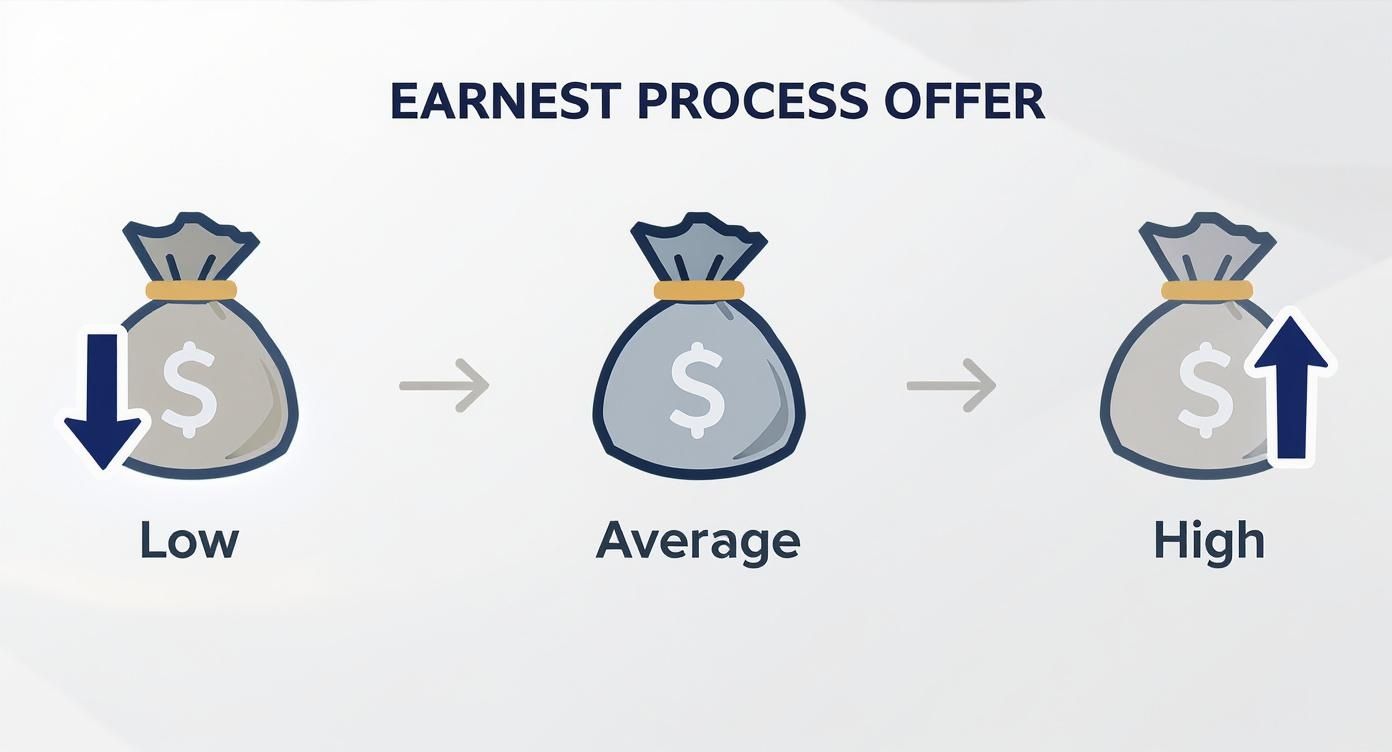
As you can see, your earnest money is a crucial step that locks in your offer and keeps things moving toward a successful close.
How It Reduces Your Final Bill
Let’s break it down with another practical example. Say you're buying a home in Baltimore County for $450,000, and you've put down a $9,000 earnest money deposit (a solid 2%).
Fast forward to closing. Your total cash-to-close—which covers your down payment plus all those other closing costs—comes out to $30,000. But wait! You've already paid that $9,000. That amount gets credited directly to your final bill. So, instead of bringing $30,000 to the table, you only need to come up with the remaining $21,000. Your deposit did its job, and now it’s making your final step that much easier.
It’s really helpful to understand how this all works, since it directly affects your out-of-pocket expenses. To get a handle on all the costs you can expect, check out our handy guide to closing costs on a new home.
Seeing the big picture is always a good idea, too. To see how this one piece fits into the grand scheme of things, it’s worth reviewing the complete steps to buying your first home.
When you work with me, we're not just finding a house; we’re creating your home. I use proprietary visualization tools that let you start customizing everything from day one in our communities in Edgewood or White Marsh. You'll get to pick your flooring, cabinets, countertops—all the fun stuff—turning what can be a stressful process into an exciting, creative journey.
How Contingencies Protect Your Earnest Money
Think of your purchase contract as the playbook for buying a home. The rules that protect you—and, most importantly, your earnest money deposit—are called contingencies. These are basically conditions written into your offer that have to be met for the deal to go through. If one of them isn't satisfied, you can legally and gracefully walk away from the contract with your deposit safely back in your pocket.
These clauses are your contractual safety net. They give you designated "exit ramps" during the home buying process, so you don't lose thousands of dollars if something unexpected crops up. Honestly, going into a deal without them is a massive, unnecessary risk.
The Big Three Contingencies Every Buyer Should Know
While you can write all sorts of conditions into an offer, there are three that are incredibly common and act as a powerful shield for your earnest money. Understanding how they work is the key to buying a home with confidence, whether you're looking in White Marsh or anywhere else in Maryland.
Here are the essential protections you absolutely need to know:
The Home Inspection Contingency on a Resale Home: This gives you the right to have a professional inspector comb through the home from top to bottom. If they find a big problem—like a cracked foundation or a mess of a plumbing system—this contingency lets you renegotiate the price, ask the seller to make repairs, or just walk away completely, deposit in hand. With a new home, this contingency does not apply.
The Appraisal Contingency: Your mortgage lender is going to order an appraisal to make sure the house is actually worth the price you've agreed to pay. If the appraisal comes in lower than the sales price, this contingency protects you. It gives you the power to go back to the seller and renegotiate, or you can cancel the contract without penalty if you can't strike a new deal.
The Financing Contingency (or Mortgage Contingency): This one is huge. It basically says that your offer is dependent on you actually getting the mortgage. If, for whatever reason, your financing falls through and you can't get the loan, this clause allows you to back out of the deal and get your earnest money back.
These safeguards didn't just appear out of nowhere; they've been shaped by a long history of real estate practice. Earnest money itself came about as a way to reduce risk in property deals. Over time, legal frameworks evolved around it—for instance, some states put a cap on how much a seller can keep if a buyer defaults, which naturally influences how much buyers put down. This tradition is all about creating balance and trust in the market.
How a Contingency Works in Real Life
Let's walk through a real-world scenario. Imagine you've found a gorgeous resale home in Edgewood, Maryland, and your offer was just accepted. You've handed over a $7,000 earnest money deposit, and your contract includes a home inspection contingency.
The inspector goes through the property and uncovers some serious, previously undisclosed water damage in the basement. These types of issues are why many people like buying a new home to avoid issues like these. The estimate to fix it? A whopping $15,000. Because you have that contingency in place, you have options. You aren't trapped.
A contingency clause transforms a potential home buying disaster into a manageable negotiation. It's your contractual right to pause, re-evaluate, and make sure you're making a sound investment before it's too late.
You could ask the seller to either fix the damage before closing or knock $15,000 off the price. If they refuse and you're no longer comfortable with the purchase, you can legally terminate the contract and get your $7,000 deposit back, no questions asked. Without that simple clause, you could have been stuck buying a home with a major issue or kissing your deposit goodbye. These protections are just as crucial for new construction, and it’s important to know what they cover. To get a better handle on that, you can check out our guide on construction contingencies.
When you work with me, my hands-on approach means we navigate these contractual details together. And while we’re securing your investment, we can have some fun with my proprietary visualization tools, letting you pick out everything from countertops to flooring for your future home in Baltimore County or Prince George's County. It’s all about making the process secure, clear, and genuinely exciting.
When You Could Lose Your Earnest Money Deposit
Contingencies are your best friend in a real estate deal, acting as a crucial safety net. But it’s just as important to understand how you could lose that deposit. I'm not saying this to scare you, but to make you a smarter, more prepared buyer. Honestly, knowing the potential traps is the single best way to sidestep them.
Let's break down the real-world situations where a buyer might have to kiss their earnest money goodbye. In almost every case, it comes down to breaking the rules of the purchase agreement without a contingency to back you up.
Waiving Your Contingencies
In a hot market—and we see this a lot in places like Baltimore County and Harford County—it's tempting to make your offer shine by waiving contingencies. Be careful, though. This is a high-stakes gamble.
For example, say you waive the financing contingency to outbid another buyer. If your mortgage falls through, you've broken the contract. The seller took their home off the market believing you were a sure thing, so they have a strong case to keep your deposit. The same logic applies if you waive the inspection. If you find a cracked foundation later and decide to bail, that deposit is almost certainly staying with the seller.
Missing The Deadlines in Your Contract
A purchase agreement is basically a timeline packed with critical dates. These aren't just friendly suggestions—they're contractual obligations.
Inspection Window: You get a specific number of days to get inspections done for a resale. If you opt to have one on a new home, this is usually done at your walk through.
Loan Application: There's a hard deadline for formally applying for your mortgage.
Closing Date: This is the big one, the finish line.
If you blow past one of these dates without getting a formal extension, you could be in default. And if your delay torpedoes the whole deal, the seller will likely have a right to your earnest money. This is why staying organized and keeping in constant touch with your agent and lender is so important.
Just Getting Cold Feet
This is probably the most clear-cut way to forfeit your deposit. A signed purchase agreement is a legally binding commitment. If you simply wake up one morning and change your mind for a reason that isn't covered by a contingency—maybe you saw another house you liked more, or the reality of a mortgage just hit you—you can’t just walk away without consequences.
Backing out of a deal because of "buyer's remorse" is the textbook reason earnest money exists. It’s there to protect the seller from this exact scenario, compensating them for the time and other potential offers they lost while their home was tied up with you.
Getting a handle on these risks is a huge part of becoming a confident homebuyer. Real estate market data consistently shows that a buyer's serious commitment, backed by their deposit, is directly linked to a successful closing. On the flip side, missteps like missing deadlines or backing out on a whim are the fastest way to lose that money. You can learn more by exploring the real-world impacts of earnest money deposits.
Avoiding these issues really boils down to being prepared and knowing what you're signing. For a closer look at what to watch out for, take a look at our guide on 7 first-time home buyer mistakes to avoid in 2025. When you work with me, I make sure you're protected. My hands-on approach means we go through every contract detail together, letting you focus on the fun part—using my proprietary visualizers to start designing the floors, cabinets, and finishes for your dream home.
Bringing Your New Home Vision to Life

When you're shopping for an existing home, your earnest money deposit is often about beating out other buyers for a house someone else designed. But what if that deposit could be the first step toward creating a home that's uniquely yours?
That’s the incredible difference when you choose to buy a new construction home that you can personalize. Instead of jumping into a bidding war, your deposit reserves your opportunity to build a home where you get to make the calls on all the details that matter. It completely flips the script from a stressful competition to an exciting, creative process.
From Deposit to Design
This is where the real fun begins and where my hands-on service truly shines. Once your home site is secured, we don't just sit around and wait. We dive right into designing your home’s interior. I bring out my proprietary visualization tools—they're a total game-changer—to help you see your ideas come to life before construction even begins.
Whether you're building in Edgewood or Prince George's County, we can sit down together and map out all the finishes for your future home.
Here’s a little taste of what you get to decide:
Kitchen Countertops: Will it be timeless granite, sleek quartz, or something totally different? We’ll look at samples and see how they play with your cabinet choices.
Cabinet Styles and Colors: From modern flat-panel doors to traditional Shaker-style, we'll find the look and color that fits your personal taste.
Flooring Throughout: Picture the perfect hardwood for your living room or a stylish, durable tile for the kitchen and bathrooms. You pick it.
Bathroom Tile and Cabinet Hardware: This is your chance to create a personal spa. We'll select the shower tiles, vanity, and cabinet hardware that make you feel relaxed just looking at them.
This process ensures the home you walk into on day one is a true reflection of you.
The Customization Advantage
Building a new, personalized home gives you a level of control and satisfaction you simply can't find in the resale market. Most builders don't allow customizations, I only represent builders that do allow customizations. I believe when you buy a new home, you should be able to customize it. While other buyers in competitive spots like Baltimore County or Harford County are stressing over inspection surprises and appraisal gaps, you’re enjoying a far more predictable and genuinely fun experience.
With a new construction home, your earnest money isn't just a bid—it's the down payment on your creativity. It secures your opportunity to build a home that's perfectly tailored to your tastes from day one, without any of the compromises that come with buying a used house.
This approach strips away so much of the usual home-buying anxiety. You won’t be inheriting old plumbing, a leaky roof, or a 15-year-old HVAC system on its last legs. Everything is brand new, under warranty, and chosen by you. That’s peace of mind you can’t put a price on.
Let's Create Your Dream Home Together
The journey to a new home should feel just as good as the moment you get the keys. If you’re tired of the resale market's limitations and ready to explore a more personal path to homeownership, I’m here to guide you. With my unique visualization tools and dedicated service, we can turn your ideas into a stunning reality.
Ready to stop competing and start creating? Let's connect and talk about building your dream home in one of our beautiful Maryland communities.
Still Have Questions About Earnest Money? Let's Clear Them Up.
We’ve walked through the ins and outs of earnest money, but it's totally normal to still have a few questions buzzing around. Let's tackle some of the most common ones I hear from homebuyers, so you can feel 100% ready for the next step.
Is Earnest Money the Same Thing as a Down Payment?
Great question. They're definitely not the same, but they are related. Think of it as a down payment on your down payment.
Your earnest money deposit is the initial "I'm serious" money you put down when your offer is accepted, typically just 1-3% of the home's price. Your down payment, on the other hand, is the much larger sum you pay at the closing table, which is a percentage of your total mortgage loan.
So, how do they connect? At closing, your earnest money deposit is credited directly toward your down payment and closing costs. It becomes part of that larger final payment, which means less cash you have to bring on the big day.
What if I Just Get Cold Feet and Want to Back Out?
This is precisely why those contract contingencies we talked about are so critical. If you need to walk away for a reason that's covered by a contingency—say, the home inspection reveals a major issue or your financing unexpectedly falls through—you'll get your deposit back.
But if you just change your mind for a personal reason not covered in the contract, that’s considered a "breach of contract." In that case, the seller is usually legally entitled to keep your earnest money as compensation for their trouble and for taking their home off the market for you.
At Customize Your Home, I believe that buying a new home should be an exciting creative process, not a confusing financial one. Our builder partner crafts incredible homes, and I bring a hands-on service to the table, helping you personalize every single detail. Using unique visualization tools, we can mix and match flooring, cabinets, and countertops right before your eyes. Ready to build a home in White Marsh, Edgewood, or another fantastic Maryland community that’s a true reflection of you? Visit Customize Your Home to get started!
Comments