

What Is R Value In Insulation And Why It Actually Matters

Ever see that "R-Value" number on a package of insulation and wonder what it really means? The easiest way to think about it is like the SPF rating on your sunscreen. A high SPF means better protection from the sun, and a higher R-Value means better protection for your home from the heat and cold. It’s your ticket to staying comfortable and keeping those energy bills in check.
Understanding R-Value And Why It Matters

So, let's break it down. What is R-value? In simple, friendly terms, it’s a measurement of how well a material resists heat flow. That's it. The "R" literally stands for resistance.
The higher the number, the better the material is at stopping heat from moving through it. This is crucial for keeping your home warm in the winter and cool in the summer. Think of it as a universal yardstick. It doesn't matter if you're comparing fluffy fiberglass batts, spray foam, or rigid boards—the R-value gives you an apples-to-apples way to judge insulating power.
What’s The Point Of Good Insulation, Anyway?
At the end of the day, the goal is simple: create a home that’s comfortable and doesn't waste energy. Proper insulation is the bedrock of that goal, especially here in Maryland where we get a taste of all four seasons. From frosty winters in Baltimore County to sticky, humid summers down in Harford County, having the right R-value in your walls, attic, and floors changes everything.
A well-insulated home isn't just about feeling cozy. It's about giving your HVAC system a break. When your home holds its temperature, your furnace and air conditioner don't have to work nearly as hard, and that means real, tangible savings on your utility bills every single month.
This commitment to efficiency is a huge part of creating a modern, high-performing home. In fact, great insulation is consistently one of the top 10 energy-efficient home features for 2025 because of the immediate impact it has on both comfort and cost.
Here's a quick rundown to help solidify the concept.
R-Value at a Glance
Concept | What It Means for You |
|---|---|
Heat Resistance | The R-value is a direct measure of how well insulation stops heat from passing through. |
Higher is Better | A higher number means more insulating power, which translates to better temperature control. |
Energy Savings | Proper R-value reduces the workload on your HVAC system, leading to lower energy bills. |
Year-Round Comfort | It helps keep your home warmer in the winter and cooler in the summer. |
Getting this right from the start is one of the smartest investments you can make in your home.
While the builder I represent provides high-quality homes, I go a step further—offering my clients unique proprietary visualization tools, hands-on service, and access to visualizers that help you bring your dream space to life. My goal is always to empower you with the knowledge to make confident choices for your home. If you really want to get into the weeds, this a complete guide to R-value roofing and smart insulation is a fantastic resource.
How Experts Actually Measure R-Value
So, where does that R-value number actually come from? It's not just some marketing guess. It’s the result of a standardized, scientific process that gives everyone—from builders to homeowners—a reliable way to compare insulation products.
At its core, the test is all about measuring how well a material resists heat flow.
Think about it: before we had this standard, things were a mess. People often just went by thickness, assuming that "thicker is better." But that’s a shaky assumption, since a thin layer of one material can insulate far better than a thick layer of another. For example, a thin foam board can have a much higher R-value than a thick wool blanket.
The Birth of a Standard
To clear up the confusion, the industry created a standardized test. This ensures that when you see an R-value on a package of fiberglass and another on a can of spray foam, you’re actually comparing apples to apples.
The test itself is pretty straightforward in principle. Scientists measure the temperature difference between the two sides of an insulation sample and track how much energy it takes to maintain that difference. It’s a controlled lab experiment that gives us a clear, simple grade for thermal performance.
This universal standard is what gives you confidence when you're picking materials for your home. It’s a guarantee that the insulation performance promised for new homes, whether in communities from White Marsh to Edgewood, is backed by real, measurable data.
The R-value concept we rely on today has a long history. It was first standardized way back in 1945 by Everett Shuman, the Director of Penn State’s Building Research Institute. This was a game-changer, shifting the industry from vague ideas about thickness to a concrete measure of performance. You can read more about the history of insulation values and see just how far we've come.
The Key Factors in an R-Value
So, what determines that final number on the label? It really boils down to three key things. Understanding them helps you see why one product might be an R-13 while another is an R-21.
Material Type: This is the big one. The internal structure of the material is what does the heavy lifting. Materials with millions of tiny trapped air pockets, like foam and fiberglass, are fantastic insulators because still air is terrible at conducting heat.
Thickness: While it's not the only thing that matters, thickness is definitely a factor. If you take the same exact material, a thicker piece will have a higher R-value. For a practical example, a standard R-13 fiberglass batt is about 3.5 inches thick, while a higher-performing R-21 batt is about 5.5 inches thick. Doubling the thickness pretty much doubles the R-value.
Density: This one can be a little counterintuitive. For materials like blown-in fiberglass or cellulose, there’s a "Goldilocks" density—not too loose, not too tight. If it’s too fluffy, air moves through it easily. But if you pack it in too tightly, the material itself starts conducting heat, which lowers its effectiveness.
These are the variables that are carefully controlled in a lab to produce that final, trustworthy R-value you see on the packaging.
Comparing Common Insulation Types
Walking into the insulation aisle at a home improvement store can feel a little overwhelming. You're met with a sea of pink rolls, bags of fluffy stuff, and strange-looking foam boards. While they all promise to keep your house comfortable, they get the job done in very different ways—and their R-values prove it.
Let's break down the most common options you'll run into. The key is understanding the "R-value per inch" for each type, as that number tells you why one might be perfect for your attic while another is a better fit for your walls.
Fiberglass: The Familiar Favorite
This is the one most people picture: the iconic fluffy pink or yellow batts you see in rolls. Made from spun glass fibers, it’s the go-to for a reason—it's affordable and you can find it just about anywhere.
Average R-Value: R-2.9 to R-4.3 per inch
Best For: Unfinished walls, floors, and ceilings. It’s designed to fit snugly between standard-spaced studs and joists.
The Takeaway: Fiberglass is a solid, budget-friendly choice for most standard projects. Just be aware that it has to be installed carefully; any compression or gaps will seriously hurt its performance.
Blown-In or Loose-Fill Insulation
Instead of neat rolls, this stuff is made of small, loose particles of either cellulose (think recycled paper) or fiberglass. A pro uses a special hose to blow it into place, letting it fill every last nook and cranny.
Average R-Value: R-2.2 to R-3.8 per inch
Best For: Attics and tricky-to-reach spots. It's a fantastic solution for topping up old insulation or filling enclosed wall cavities without tearing down drywall.
The Takeaway: Blown-in insulation creates a seamless thermal blanket that settles perfectly around pipes, vents, and wiring, leaving no gaps for heat to escape. For example, it's perfect for filling the oddly shaped spaces around attic rafters.
This infographic really gets to the heart of what makes up an insulation's final R-value.
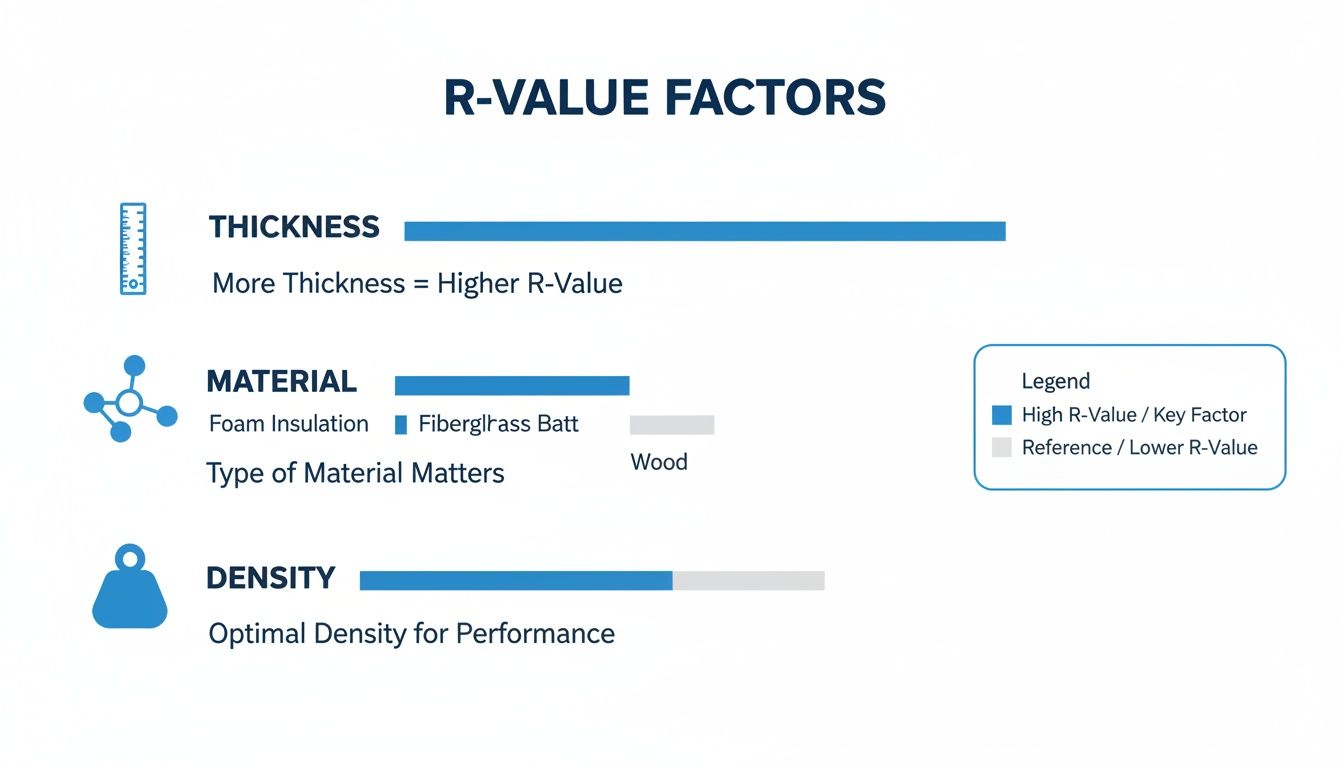
As you can see, R-value isn't just about the material. It’s a mix of the material itself, how thick it’s applied, and whether it’s installed at the right density.
Spray Foam: The High Performer
Spray foam is a different beast altogether. It's a two-part liquid that, when sprayed, expands into a solid foam, sealing every single crack and gap as it cures. It comes in two main flavors: open-cell and closed-cell.
Closed-cell spray foam is the undisputed champion of R-value. Because it’s so dense and rigid, it not only insulates but also adds structural strength to whatever you spray it on. It’s a true two-for-one.
Open-Cell R-Value: R-3.6 to R-4.5 per inch
Closed-Cell R-Value: R-6.0 to R-7.0 per inch
Best For: Anywhere you need maximum insulation in a tight space, like the rim joists in your basement. It’s also an incredible air and moisture barrier, all in one shot.
The Takeaway: Yes, it's more expensive and needs a professional to install, but spray foam delivers unmatched performance. It’s a fantastic choice for situations where sealing air leaks is just as important as insulating.
Choosing the right material is the first step toward a home that's truly comfortable and efficient. When I work with clients, I use special visualization tools to show them how these options would look and perform in their actual space. But even without that, just knowing these basics is a huge advantage. Whether you’re customizing a new home in White Marsh or renovating an older one in Baltimore County, understanding what you're putting in your walls makes all the difference.
What R-Value Do I Actually Need in Maryland?
So, you've got the basics of R-value down. Now for the million-dollar question: what does your home actually need? Insulation isn't a one-size-fits-all game. The right amount depends entirely on your climate, and here in Maryland—from White Marsh to Edgewood—we get the full experience.
Our climate zone serves up chilly winters and some seriously hot, humid summers. That means our homes need insulation that can pull double duty, keeping us warm in January and cool in July.
Thankfully, we don't have to guess. The U.S. Department of Energy gives us solid guidelines for what works best. For those of us in Baltimore County and Harford County, these recommendations are the gold standard for a home that’s both comfortable and efficient.
R-Value Targets For a Maryland Home
Think of your house as a collection of different zones, each with its own job and its own insulation needs. Your attic, for example, is the number one escape route for heat in the winter and the main entry point for it in the summer. It's the thermal "hat" for your house, so it needs the most protection.
Here's a breakdown of what to aim for in our area:
Attics: You want a hefty R-38 to R-60 up there. This creates a powerful barrier that keeps the weather outside where it belongs. A practical example would be about 16 to 22 inches of blown-in fiberglass.
Walls: For your exterior walls, shoot for R-13 to R-21. The right number depends on your wall construction—a wall built with 2x6 studs has more room for insulation than one with 2x4s.
Floors & Crawl Spaces: Any floors over an unheated garage or basement need R-25 to R-30. This simple step stops cold from creeping up through your feet on a winter morning.
Don't just focus on the attic. The foundation is just as critical. Properly insulating your foundation walls or the floor above an unconditioned space is a huge deal. That's why it's so important to understand what a crawl space is and how it impacts your home.
These numbers aren't random. They're the sweet spot where you get the biggest bang for your buck in comfort and energy savings.
When I work with my clients, we go way beyond just looking at blueprints. I use my own visualization tools to show you exactly how different insulation packages will perform over the long haul. It's all about making smart, informed decisions so you can create a home that's perfectly tuned for the Maryland climate—and a place you'll absolutely love living in.
Why Real-World Performance Can Differ From The Label
You've done your homework and picked an insulation with a stellar R-value. So, you're all set for maximum efficiency, right? Not so fast. The number on the package is a lab-tested ideal. In the real world, several factors can chip away at that performance, meaning you might not be getting the full insulating power you paid for.
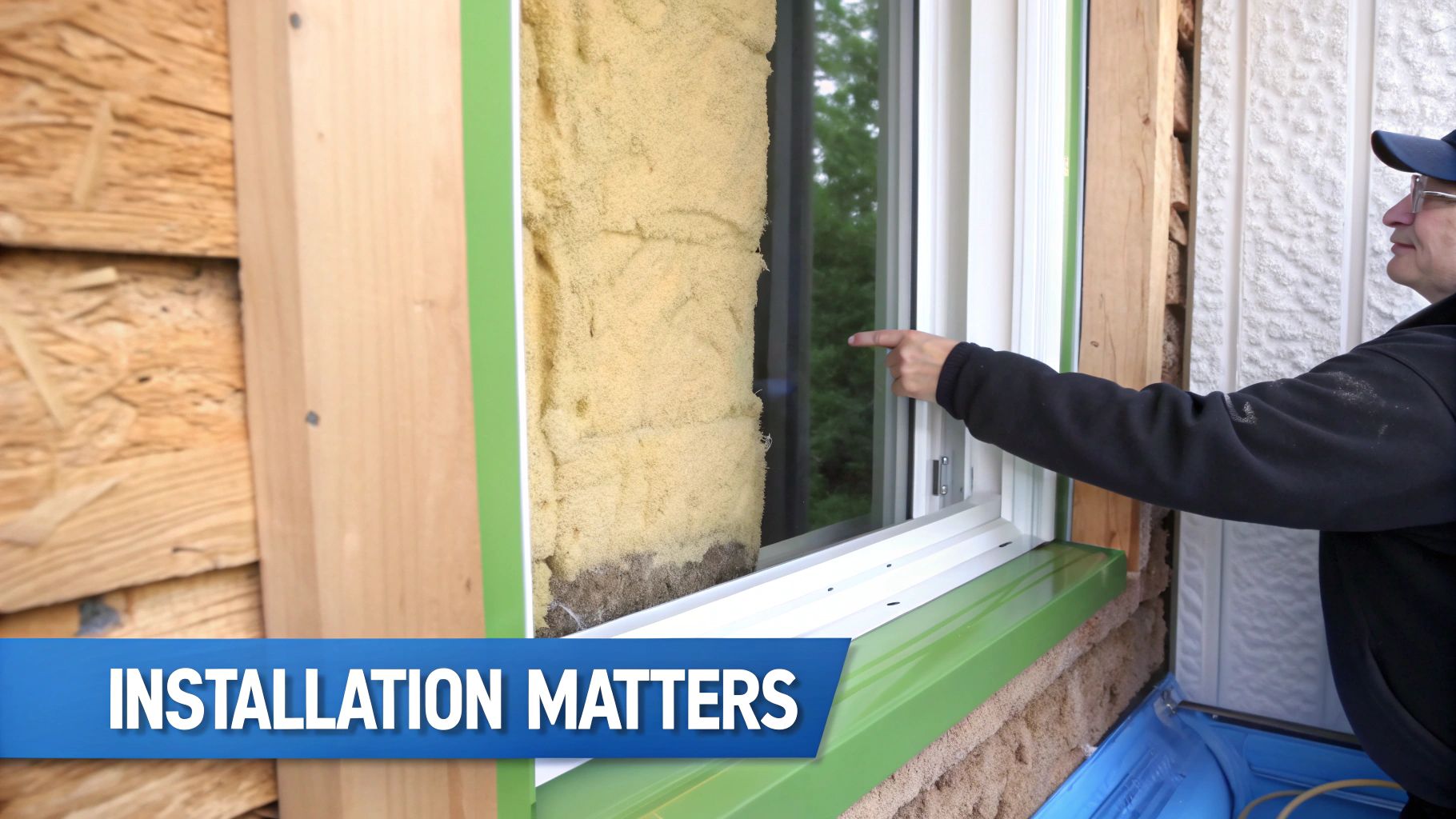
Think of it like a car's official MPG rating—that number was achieved on a perfect, flat track. Your daily commute, with all its hills and stop-and-go traffic, will almost certainly tell a different story. Insulation works the same way.
How Quality Installation Makes A Difference
The single biggest factor that separates the lab from your living room is the quality of the installation. Insulation only works its magic when it's installed meticulously, without any gaps, compression, or voids.
Imagine wearing a premium winter coat but leaving it completely unzipped. That’s precisely what happens when insulation is poorly fitted. Even tiny gaps around windows, outlets, or pipes create thermal weak spots, letting your expensive conditioned air slip right out. Compressing fiberglass batts to fit into a tight space also crushes their R-value, because it eliminates the trapped air pockets that actually do the insulating.
The Problem Of Thermal Bridging
Another sneaky energy thief is something we call thermal bridging. Your walls aren't just solid blocks of insulation; they have wooden studs running through them every 16 or 24 inches. And wood, unfortunately, has a much lower R-value than the insulation filling the space between the studs.
These studs act like mini-highways for heat, allowing it to "bridge" right past your insulation, moving from your warm interior to the cold outdoors. This common issue can drag down the overall R-value of your wall assembly by 15-20% or more compared to what the insulation label promises.
A well-built home addresses thermal bridging head-on. By creating a continuous thermal barrier, we minimize these energy leaks. This attention to detail is crucial for homes in communities like White Marsh and Edgewood, where four-season weather demands superior performance.
Understanding Thermal Drift In Foam
Certain types of rigid foam insulation can also experience a phenomenon called thermal drift. The industry's understanding of R-value took a big step forward with the development of Long Term Thermal Resistance (LTTR) testing, which accounts for how some foams lose a bit of insulating power over time. Most of this degradation, up to 20-30%, happens within the first couple of years before stabilizing. You can discover more about the history of R-value and foam insulation testing if you want to get into the weeds.
Understanding these real-world factors is the key to creating a truly efficient home. It’s not just about picking the right product—it’s about designing and installing a complete system that works. For a deeper dive, check out our 10 essential home energy efficiency tips for 2025. When you're ready to design your dream space, I offer hands-on service and proprietary visualizer tools to help you bring it all to life.
Making Smart Choices For A Comfortable Home
So, let's pull all of this together. By now, you know that R-value is a key player in keeping your home comfortable and efficient. You get that higher is usually better, and that your local climate is the ultimate guide for how much insulation you really need.
Whether you're thinking about an upgrade or you're in the middle of picking out finishes for a brand-new home, this knowledge is your secret weapon. It helps you build a home that isn’t just easy on the eyes, but one that’s genuinely comfortable and saves you money every single month.
Your Partner In Home Customization
This is where the fun really starts. While the builder I represent provides high-quality homes, I go a step further—offering my clients unique proprietary visualization tools, hands-on service, and access to visualizers that help you bring your dream space to life. We let buyers customize their homes by getting to pick their flooring, countertops, cabinets, tile, and more, making sure every choice is a true reflection of you.
Knowing what R-value is all about is a big piece of the puzzle, but it's not the whole picture. It’s about creating a home that works for you on every level, from its energy smarts to its visual style. The end goal is a home that just feels right, built for you and your family.
Knowledge is power in the home-building journey. Understanding the basics of construction and efficiency ensures you can confidently ask the right questions and make choices that will benefit you for years to come.
Making smart, comfort-focused choices touches every part of your home. For instance, knowing how to tackle insulating specific areas like a garage roof can make a surprising difference in your home's overall performance.
And if you're passionate about building a home that's as kind to the planet as it is to your bank account, taking a look at sustainable construction practices for greener homes is a fantastic next step.
If you’re looking at new homes in Maryland communities like White Marsh, Edgewood, or anywhere in Baltimore County and Harford County, I’m here to help. Let’s connect and talk about building a space that’s perfect for you.
Got More Questions About R-Value?
We’ve dug deep into the world of R-value, but a few questions always seem to pop up. Let's tackle some of the most common ones I hear from homebuyers.
Can You Overdo It With Insulation?
Technically, yes, but it's not something most people need to worry about. The real concern isn't "too much" insulation, but rather the point of diminishing returns.
For instance, bumping up your attic insulation from an already solid R-30 to a massive R-60 won't slice your energy bills in half. The cost to add that extra material far outweighs the tiny bit of extra savings you'll pocket. Your best move is to aim for the recommended R-values for your climate zone, like our local targets for Baltimore and Harford County, to get the best bang for your buck.
Does Insulation Lose Its R-Value Over Time?
For the usual suspects—fiberglass and cellulose—the R-value is remarkably stable. It'll perform as promised for decades as long as it stays dry and isn't compressed.
Some rigid foam products can lose a tiny bit of R-value in their first few years, a process called thermal drift. But don't worry, good manufacturers plan for this. They publish a Long-Term Thermal Resistance (LTTR) value, which is the number you can count on for the long haul.
What's The Bigger Deal: R-Value Or Air Sealing?
Ah, the classic debate! The truth is, you can't have one without the other. They are equally important partners in creating a comfortable, efficient home.
Think of it this way: high R-value insulation is like wearing a super warm, thick wool sweater. But if you wear it on a blustery day without a jacket, the wind cuts right through you. Air sealing is the windbreaker. It stops the drafts and lets your insulation (the sweater) actually keep you warm.
I provide hands-on service and unique visualization tools that help you bring your dream space to life, from picking out your flooring and countertops to your cabinets and tile. If you're looking to build in White Marsh, Edgewood, or the surrounding Maryland communities, let's connect and design a space that’s built for your life. Begin the conversation at https://www.customizeyourhome.com.
Comments