

Choosing a Mortgage Lender: A Friendly Guide for Homebuyers

Choosing a mortgage lender isn't just about chasing the lowest interest rate; it’s about finding the right financial partner for one of the biggest moves of your life. The secret? Get pre-approved early, shop around with different types of lenders, and don't be afraid to ask a ton of questions. You need a partner who offers a great deal and top-notch service.
Starting Your Search for the Right Mortgage Lender

Picking a mortgage lender can feel like a huge, intimidating decision. Think of it less like a transaction and more like finding a co-pilot who will help you navigate the financial journey to your dream home. Getting this choice right from the start makes everything else—from making an offer to picking out your new kitchen countertops—so much easier.
And you're definitely not alone in this process. The mortgage lending market is booming, projected to jump from $14.48 billion in 2025 to $30.15 billion by 2033. All that growth means you have more choices than ever, which is great, but it also means you need to know what you’re looking for before diving in.
Understanding Your Options
First things first, let's break down the main players in the mortgage world. Each type has its pros and cons, and the right one for you really depends on what you value most. For example, if you love the hands-on, personal service we provide when you're customizing your home, you might prefer a lender with a similar approach, like a local credit union.
Here’s a simple breakdown of the main types of mortgage lenders you’ll encounter and who they typically work best for.
A Quick Glance at Your Lender Options
Ultimately, there's no single "best" option—just the one that's best for you.
Your lender should feel like a trusted advisor. They are a key part of your homebuying team, and their guidance can make a world of difference, especially when you're looking at homes in vibrant Maryland communities like White Marsh or throughout Baltimore County. Our lender partners are not owned by the builder, which means you will get the best rate based on your credit score and you will get amazing incentives if you use them. Most builders own the lender, we don't.
The Power of Pre-Approval
Here’s a pro tip: Before you even think about touring homes and falling in love with the perfect floor plan, get pre-approved. It's your secret weapon.
A pre-approval letter does two critical things. First, it shows sellers you’re a serious, qualified buyer, which gives your offer a ton of credibility. Second, and maybe more importantly, it gives you a clear, solid budget to work with. No more guessing games—you can shop with total confidence.
While we get excited about helping you customize everything from flooring to fixtures, we know the financial piece has to be solid. You can check out our list of preferred https://www.customizeyourhome.com/lender-partners-new-homes-maryland to get started.
And if you're planning on building a new construction home, a crucial first step is Mastering Construction Loan Requirements to make sure your project flows smoothly from day one.
Banks vs. Credit Unions vs. Online Lenders: Who's Who?
Alright, you're pre-approved and ready to find a lender. This is where you’ll quickly see there isn't just one type of place to get a mortgage. Think of it less like a single store and more like a whole shopping district with different kinds of shops. Your job is to find the one that fits your style and financial situation, whether you're building a new home in White Marsh or buying your first place in Prince George's County.
You’ll mainly run into three kinds of lenders: traditional banks, credit unions, and the newer online players. Each has its own vibe and set of pros and cons, and honestly, there's no single "best" choice for everyone.
The Big Three Lender Types
Your decision will likely boil down to what you prioritize. Do you want the convenience of a bank you already use? The personal touch of a local institution? Or the speed and ease of a slick digital process?
Traditional Banks: These are the big, household names—think Chase, Bank of America, Wells Fargo. If you already have a checking account with one, there can be a certain appeal to keeping everything in one place. They offer a ton of different loan products, but sometimes you can feel like just another number.
Credit Unions: I’m a big fan of credit unions, especially for first-time buyers. They’re non-profits owned by their members, which often means better rates and lower fees. Even better, they're known for their hands-on, personalized service. They’ll actually take the time to walk you through the process, which can be a lifesaver.
Online Lenders: These are the tech-savvy newcomers like Rocket Mortgage or Better.com. Their whole model is built around speed and convenience, with slick websites and mobile apps that make applying a breeze. If you're comfortable doing everything online and want to close as fast as possible, this is definitely a route worth exploring.
It really is like standing at an intersection, trying to decide which road to take.
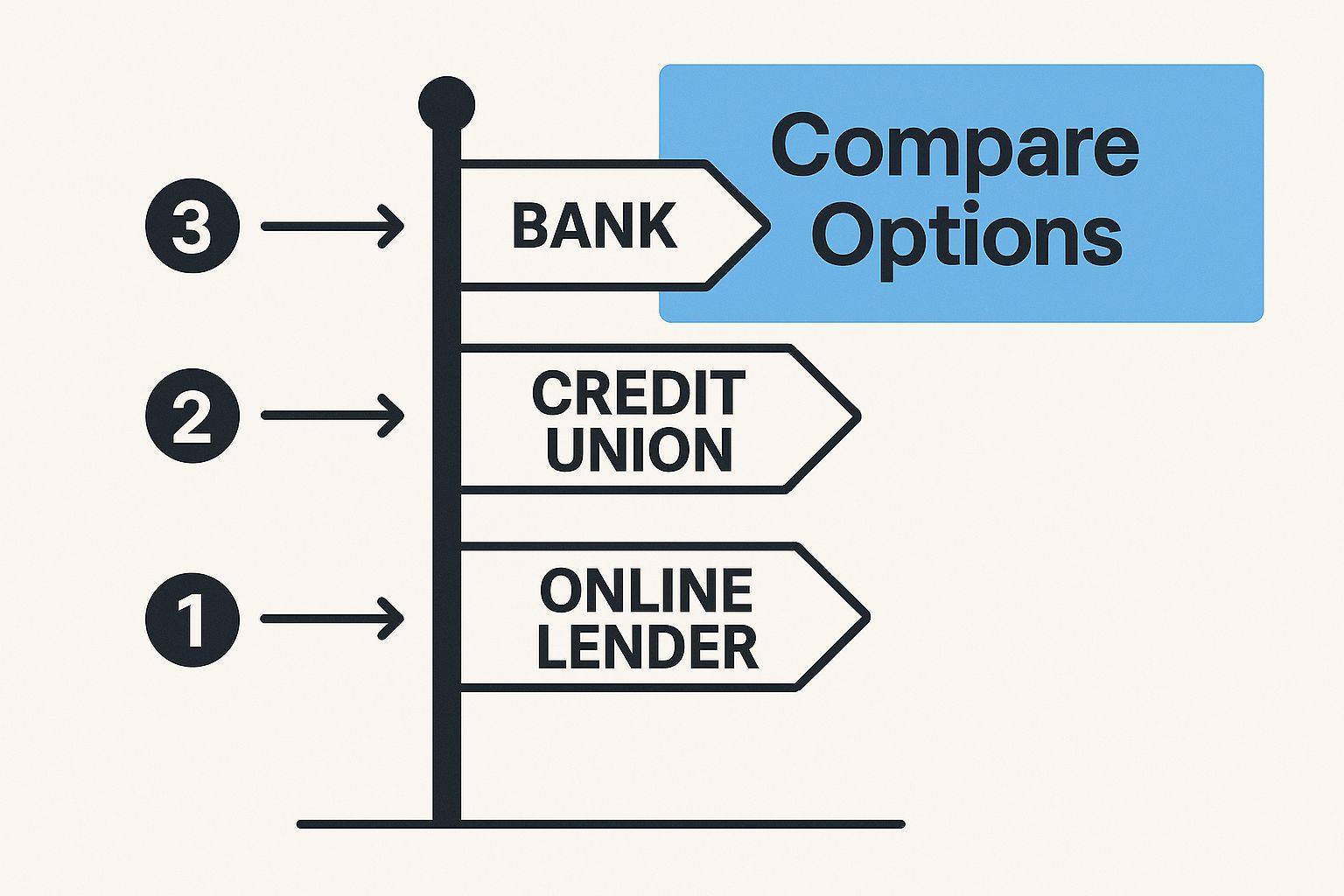
They all lead to the same destination—homeownership—but the experience you have on the journey can be wildly different.
What’s Happening in the Market?
No matter who you choose, they’re all part of the same massive financial ecosystem. For 2025, the mortgage market is expected to be huge, with experts predicting total loan originations to hit around $2.3 trillion. That’s a massive 28% jump from the year before!
What does that mean for you? It means the market is active, and lenders are competing for your business. That’s good news. If you want to dive deeper into the numbers, this global market analysis from Ginnie Mae is a fascinating read.
Finding the right lender is like finding the right partner for your home project. You want someone reliable, transparent, and communicative who understands your vision and helps you achieve it without unnecessary stress.
It’s so important to explore all your avenues. We have a lot more resources to help you compare the different mortgage options available right here in Maryland.
How to Compare Mortgage Offers Like a Pro
Alright, the loan offers are starting to roll in. It's go time.
It's tempting to immediately scan for the lowest interest rate and call it a day, but that’s a rookie mistake. That rate is only one small part of the story. To really get what you’re being offered, you need to get comfortable with the Loan Estimate form.
This is a standardized, three-page document every lender has to send you. It’s specifically designed to break everything down so you can compare offers side-by-side without any smoke and mirrors. Honestly, it’s the best tool you have for making a smart choice.
Look Beyond the Interest Rate
The single most important number on that entire form isn't the interest rate—it's the Annual Percentage Rate (APR). The APR is the true, all-in cost of your loan. It bundles the interest rate with most of the lender’s fees, giving you a much clearer picture of what you’ll actually pay year after year.
Here’s a practical example: one lender might dangle a 6.5% interest rate but load it up with high fees, pushing the APR to 6.8%. Another might offer a 6.6% interest rate with almost no fees, bringing their APR down to 6.7%. In that scenario, the loan with the slightly higher interest rate is actually the better deal.
Digging into Closing Costs
Closing costs are where things can get a little wild. They vary a ton from one lender to another. A lender with a super attractive rate might be planning to make up for it with expensive origination fees, quickly turning a "great deal" into a financial headache.
Your Loan Estimate neatly breaks these costs down for you:
Origination Charges: This is what the lender charges you for doing the work—think application fees, processing, and underwriting. These are often the most negotiable fees.
Services You Cannot Shop For: These are non-negotiable costs for required third-party services like the appraisal, flood certification, and credit report. You can't pick the provider, but you can see if one lender is charging more than another.
Services You Can Shop For: This bucket includes things like title insurance, escrow services, and a pest inspection. The lender gives you an estimate, but you have every right to shop around and find a cheaper provider on your own.
Have a pre-approval with an outside lender? Contact our lender partners, find out what their rates are and if they are higher than your outside lender, they will match or beat the rate. All you need is a detailed loan estimate from the outside lender and they will use that to get the same or better interest rate for you.
As you weigh your options, don't forget about the long-term financial picture. Figuring out how to unlock the full potential of tax deductions can significantly affect the true cost of your home loan. You can learn more about maximizing your mortgage interest deduction from tax pros who live and breathe this stuff.
And remember, your credit score is your biggest bargaining chip. A higher score gives you more leverage to negotiate better terms. If you feel like your score could use a little boost, check out our guide on the credit score for a home loan.
Essential Questions to Ask Every Potential Lender

Think of this part of the process like you're conducting a job interview. You're the one doing the hiring, and you need to find the best fit for the role. Sure, the numbers are important, but you also need to feel comfortable with your lender's communication style and trust their advice.
Their answers to a few key questions will reveal everything you need to know. It’s no different than when you ask us about customizing the kitchen countertops in a new Harford County home—you need specifics! A great lender will welcome your questions and give you clear, confident answers.
Questions About Speed and Service
In real estate, time is always of the essence. A lender who drags their feet can jeopardize your entire purchase, especially when sellers have multiple offers to choose from. You need to know exactly what to expect from their process.
Here are a few questions to get that conversation rolling:
What’s your typical closing time for a loan like mine? A 30-day close is pretty standard, but some lenders are much faster, while others can seriously lag. A slow closing in a hot market like Baltimore County could mean losing your dream home.
Who will be my main contact person through this whole process? Nothing is more frustrating than being bounced from one department to another. Having a single, dedicated loan officer to call makes a world of difference when you need a quick answer.
How do you like to communicate, and how quickly do you respond? Are they a phone person, or do they live on email? Make sure their style works for you so you’re never left wondering what’s going on.
Your lender's communication skills are a direct preview of their customer service. If they're tough to get a hold of now, just imagine what it will be like when you're under contract with a deadline breathing down your neck.
Questions About Costs and Transparency
Alright, let's talk money. A good lender should be an open book about their fees and be more than happy to explain every single line item on your loan estimate. This is where you can really tell if a lender is on your side.
Get direct and ask these questions to see the full financial picture:
Can you walk me through all the lender fees on this estimate? This forces them to justify every cost. Don't be shy about asking if any of them, like the application or underwriting fee, are negotiable.
Does this loan have any prepayment penalties? This is a huge one. You definitely don’t want to be penalized for paying off your mortgage early or refinancing for a better rate down the road.
What are the requirements for locking in my interest rate? You need to be crystal clear on when you can lock your rate, for how long, and if there's any cost to do it.
Starting this whole process on solid ground is crucial. That’s why we always suggest homebuyers check out our guide on getting prequalified for a mortgage loan before they even start looking at houses. It really sets the stage for productive conversations just like these.
Now For the Fun Part: Making the House Your Home
Getting your mortgage sorted out is a huge milestone. Pop the champagne! But now, the really exciting part begins: turning that new house into a place that feels completely, unmistakably you.
Choosing a lender handles the numbers, but your journey is far from over. This next phase is all about taking your personal style and weaving it into the very fabric of your new home. While the builder I represent provides high-quality homes, I go a step further—offering my clients unique customization tools, hands-on service, and access to visualizers that help you bring your dream space to life.
From Floor Plan to Finished Product
We're big believers that the design process should feel just as smooth as getting your financing. That's why we've put a ton of effort into creating tools that let you see your vision come to life before you commit. You’re not just flipping through a catalog; you're actively designing your future.
Here’s a peek at how we make that happen:
Real, Human Guidance: We’re with you every step of the way, offering advice and making sure your choices all come together cohesively. Our team is here to make sure you feel totally confident in every decision.
See It Before You Build It: Ever second-guess if those dark cabinets will really work with that light quartz countertop? Our visualization tools take all the guesswork out of it. You can digitally mix and match options until you find the perfect combo for your style.
Your Style, Your Choices: From the flooring you walk on to the tile in your shower, you get to hand-pick the details that matter most. This is where you get to inject your personality into the home right from the start.
Your home should tell your story. When you get to customize it from the start, you're not just moving into a house—you're creating a space that is perfectly, uniquely yours, down to the last doorknob.
This hands-on, personal approach is what we're all about in our incredible communities across Maryland. Whether you're pulled in by the energy of White Marsh, the friendly vibe in Edgewood, or the gorgeous scenery throughout Baltimore County, Harford County, and Prince George's County, we're ready to help you build a home you'll adore for years to come.
Ready to play with the possibilities? Let's chat and start designing a space that’s all you. We don't just build high-quality homes—we give you the tools and support to truly make it your own.
Got Questions? We’ve Got Answers.
Even after doing all your homework, you're bound to have a few nagging questions when you're deep in the lender-shopping trenches. It's totally normal. Getting these last few things cleared up will give you that final shot of confidence to pick a lender and move forward.
Let's dive into some of the most common questions we hear from homebuyers.
How Many Lenders Should I Actually Talk To?
This is a big one. You’re looking for a sweet spot here—enough to compare, but not so many that you're drowning in paperwork.
Aim to get quotes from at least two to three different lenders. Both of our lender partners are fantastic, or they would be a partner. Speak with me about your situation and I can help guide you with your lender selection. Everyone's financial situation and goals are different, I will give you all of the information you need to make the best decision for you and your family.
This gives you a solid basis for comparison without creating total chaos. My advice? Cast a wide net. Get a quote from a big national bank, a local Maryland credit union, and an online-only lender. This mix will give you a real feel for the different rates, fees, and service levels out there. Plus, walking into a negotiation with multiple official Loan Estimates is your best leverage. One thing to know about getting a quote from an outside lender is they will not know the tax break down and other community specific things as our lender partners. Our lender partners will quote you accurate information so you can have piece of mind.
And don't stress about your credit score. The credit bureaus expect you to shop around. All mortgage-related credit inquiries within a 14 to 45-day window are typically bundled together and treated as a single event, so the impact on your score is minimal.
What’s the Real Difference Between Pre-Qualification and Pre-Approval?
Ah, the classic question that trips up so many buyers. They sound almost the same, but in the world of real estate, they couldn't be more different.
Think of it this way: a pre-qualification is like a casual chat about your finances. A pre-approval is a verified, official green light. One gets the conversation started; the other gets your offer accepted.
A pre-qualification is really just a ballpark estimate. It’s a quick, back-of-the-napkin calculation based on financial info you provide, with no proof required. It’s a good first step, but that’s about it.
A pre-approval, now that’s the golden ticket. For this, you fill out a full application, and the lender pulls your credit and actually verifies your income, assets, and debts. When you have a pre-approval letter in hand, it tells sellers you’re a serious, credible buyer, which can be a game-changer in hot markets like Baltimore County or Harford County.
Finding the right lender is a huge first step, but the real fun begins when you start creating a home that’s uniquely yours. While the builder I represent provides high-quality homes, I go a step further—offering my clients unique customization tools, hands-on service, and access to visualizers that help you bring your dream space to life in our beautiful Maryland communities. Ready to build your dream? See what’s possible at https://www.customizeyourhome.com.
Comments