

Difference Between Builder and Contractor: Who to Hire and Why It Matters

So, you’re diving into a home project and the terms ‘builder’ and ‘contractor’ are getting thrown around. It’s a common point of confusion, but don't worry, the distinction is actually pretty simple and knowing it will save you a lot of headaches!
At its core, a home builder constructs brand-new homes from scratch, often inside entire communities they're developing. A general contractor, on the other hand, manages renovation projects on a property you already own.
Think of it this way: a builder creates the product, and a contractor helps you modify it. For example, if you want a new home in a planned community, you call a builder. If you want to update the kitchen in the house you've lived in for ten years, you call a contractor.
Understanding The Key Difference Between A Builder And A Contractor
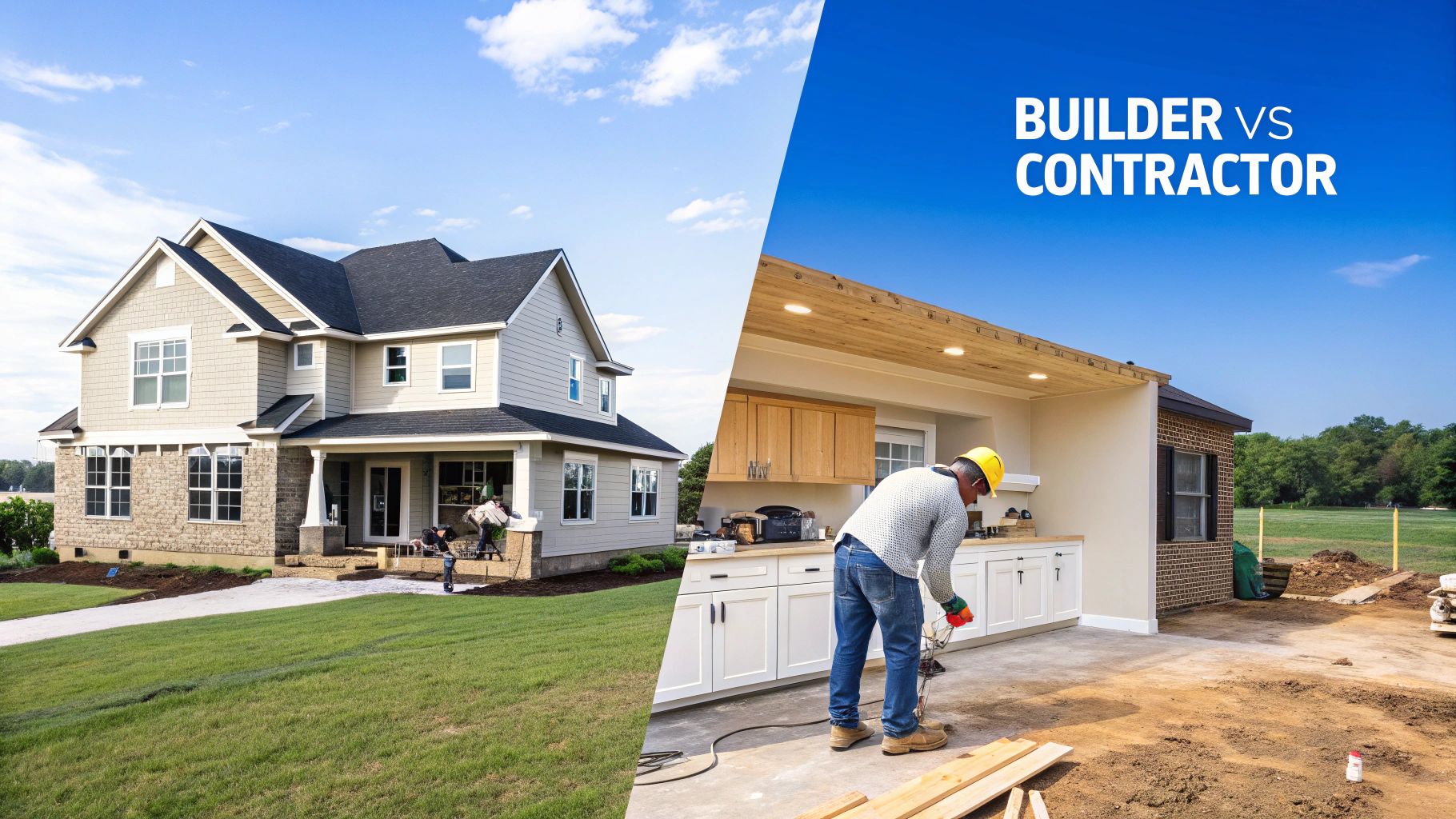
Knowing who to call is the first, and arguably most important, step in any home construction journey. While both of these pros are crucial in the housing world, they play in different sandboxes and meet very different needs. Let’s clear up the confusion and break down their roles in a friendly way.
A home builder is the company that buys a tract of land, develops it, and builds new houses based on a specific set of floor plans. Their expertise is in the A-to-Z creation process—from pouring foundations and framing walls all the way to installing the final light fixtures. When you sign on with a builder, you're buying a complete package: a new house in a new neighborhood.
Scope Of Work
The builder's scope is massive and systematic. They handle everything needed to create a residential property, including developing the site, securing permits for the entire community, and juggling the construction schedules for dozens of homes at once. It’s this large-scale operation that makes their process so efficient and predictable.
A general contractor, however, is your go-to pro for a specific project inside your existing home. Their scope is laser-focused and completely tailored to your property. Dreaming of a kitchen remodel, a finished basement, or a brand-new deck? You hire a contractor. They’re the project manager who wrangles all the subcontractors—plumbers, electricians, painters—to bring your vision to life. A practical example would be hiring a contractor to knock down the wall between your kitchen and dining room to create an open-concept living space.
If you want to dig deeper into what a GC does, check out our guide on what a general contractor is and why you need one.
Key Takeaway: A builder creates a brand-new home for you to buy. A contractor modifies the home you already own.
To put it all in perspective, here’s a quick side-by-side comparison of what each professional really does.
Quick Look Builder vs Contractor Roles
Key Aspect | Home Builder | General Contractor |
|---|---|---|
Project Type | Constructs new homes on land they own and develop into communities. | Manages renovation or addition projects on a client's existing property. |
Primary Goal | To build and sell a completed, brand-new residential property. | To execute a specific construction project according to the homeowner's plans. |
Scale of Work | Large-scale; often builds multiple homes simultaneously in a development. | Project-specific; focuses on one renovation or addition at a time for a client. |
Client Relationship | The client is a home buyer purchasing a finished product. | The client is a homeowner hiring a service to improve their property. |
This table really highlights the fundamental difference: builders sell you a product, while contractors provide you a service. Understanding that distinction is the key to hiring the right expert for your specific needs.
What Does a Day in the Life Look Like?
To really get a feel for the difference between a builder and a contractor, it helps to imagine what their typical day looks like. They both manage construction sites, sure, but their focus, the scale they work on, and the problems they solve are completely different. Think of it like a movie director versus a stage manager—both are crucial to the production, but they operate from entirely different perspectives.
A builder’s job starts way before any dirt gets moved. Their day is all about the big picture and long-term vision. They’re juggling things like buying huge tracts of land, getting entire communities zoned correctly, and managing the master plan for dozens, sometimes hundreds, of homes at once.
The Builder’s 30,000-Foot View
A builder's daily to-do list is filled with macro-level tasks that shape a whole neighborhood.
Laying the Groundwork: They’re in charge of making sure roads, sewers, and utilities are installed to serve every single home in the development.
Juggling Multiple Timelines: A builder is the master of coordinating schedules for a whole fleet of homes. You can see just how complex this is in our post explaining the new home construction timeline.
Navigating Permits at Scale: Instead of pulling a permit for one house, they’re dealing with approvals for the entire project, from environmental studies to master building plans.
For instance, a builder creating a new community in White Marsh, Maryland, isn't just thinking about one house; they're crafting a whole environment where families will live for decades.
The Contractor’s On-the-Ground Focus
A contractor, on the other hand, lives in the world of a single project for a specific client. Their day is a hands-on whirlwind of managing the details for one job on one property. They’re the ones who come to your house, figure out the best way to tackle your renovation, give you a detailed bid, and then bring in all the right tradespeople to make it happen.
A contractor's Tuesday might look like this:
Meeting a homeowner in Edgewood, Maryland, to help them pick the perfect tile for their bathroom remodel.
Coordinating with the plumber and electrician for a kitchen gut-job in Baltimore County.
Personally checking the drywall progress on a basement finishing project over in Harford County.
This difference in scale isn't just local; it's a global trend. Large-scale general contractors, who often function as builders, take on the lion's share of major, high-value projects where economies of scale are everything. At the same time, smaller, specialized contractors thrive in the residential renovation space because that’s where direct, personal service really counts. You can dig deeper into construction market trends and segmentation here.
When you boil it down, a builder is creating a brand-new product from scratch. A contractor is an expert at taking an existing product—your home—and making it better. This fundamental difference in their daily grind is what really defines their roles and helps you figure out exactly who you need to call.
Breaking Down Costs, Warranties, and Customization
When you're weighing your options between a builder and a contractor, the conversation inevitably boils down to three make-or-break factors: the final cost, the warranty protecting your investment, and how much you can truly make the space your own. These are the areas where the path you choose really starts to diverge, and understanding them is key to a successful project.
The Financial Picture: Predictable vs. Flexible Pricing
Let's talk money first. Home builders usually offer a much more predictable, fixed-price model. Because we’re constructing multiple homes, we buy materials in bulk and have established processes, which creates efficiencies. This means we can often give you a solid, all-in price right from the start, taking a lot of the guesswork and budget anxiety off the table.
On the other hand, a general contractor's pricing is typically more dynamic. When they're tackling a renovation, they often don't know what's lurking behind the walls. For instance, they might start a bathroom remodel and discover old, leaky pipes that need a complete replacement. These unforeseen problems can pop up, leading to change orders that add to your final bill.
Protecting Your Investment for the Long Haul
Warranties are another area where the two paths diverge significantly. A new home builder almost always provides a comprehensive, long-term structural warranty. This is a huge benefit, offering you peace of mind that covers the very bones of your house for years. To get a better handle on this, check out our guide on what home warranty coverage includes.
A contractor’s guarantee is usually much shorter and is tied directly to the specific work they performed. If they renovated your bathroom, their warranty covers their craftsmanship on that job—not the plumbing in the next room or the roof overhead.
When you look at the business side of things, builders typically operate with higher margins, averaging 8-12%, while contractors are often in the 4-6% range. This difference isn't just about profit; it's what allows a builder to fund those robust, long-term warranties and manage the complexities of large-scale development.
This visual breakdown really highlights the difference in scale and scope between the two.
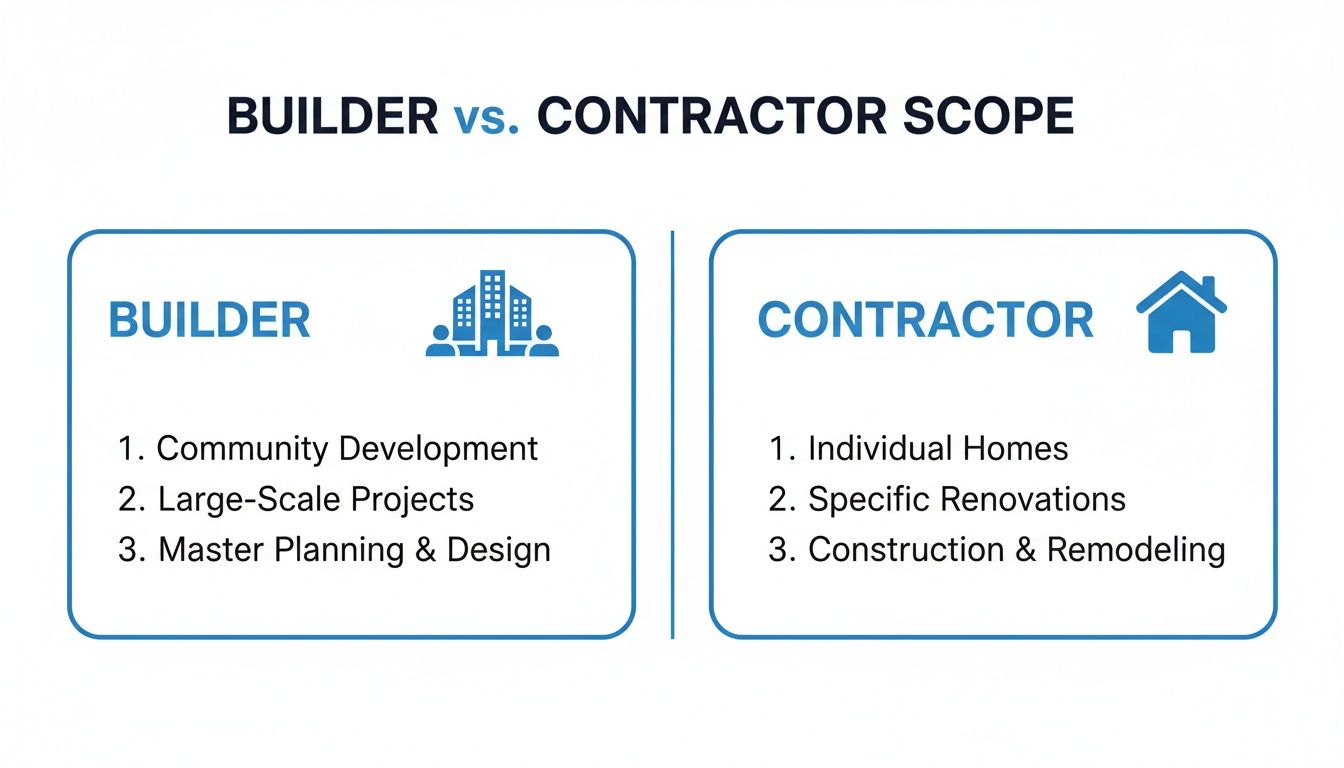
As you can see, a builder is thinking about an entire community, while a contractor is focused on specific tasks within a single home. This fundamental difference shapes everything from their pricing to their warranties.
Making the Space Uniquely Yours
Now for the fun part: customization! This is where working with a builder on a new home is such a great experience. You get to put your personal stamp on a fresh canvas, choosing everything from the flooring and countertops to the cabinets and tile. It’s about creating a home that reflects your style from day one.
While the builder I represent provides high-quality homes, I go a step further—offering my clients unique proprietary visualization tools, hands-on service, and access to visualizers that help you bring your dream space to life. Picking out samples is one thing, but it’s tough to visualize how it will all come together. Our tools let you digitally experiment with different finishes, seeing exactly how your kitchen will look with that granite countertop or how the bathroom feels with a specific tile. It removes all the "what ifs" and helps you make decisions with confidence for your new home, whether you're building in White Marsh, Edgewood, or anywhere in the greater Baltimore and Harford counties.
To make these differences even clearer, let's break them down side-by-side.
Feature Breakdown: Cost, Customization, and Warranty
Feature | Home Builder | General Contractor |
|---|---|---|
Cost Structure | Typically a fixed price based on pre-set plans and bulk material purchasing. Less risk of budget overruns. | Often an estimate-based model (cost-plus or fixed fee). Prone to change orders due to unforeseen issues in existing structures. |
Customization | High level of personalization with finishes, fixtures, and cosmetic details from a curated selection. | Customization is focused on altering an existing space. The scope is defined by the renovation or addition project. |
Warranty | Offers a comprehensive structural warranty (often up to 10 years) plus shorter warranties on systems and workmanship. | Provides a limited workmanship guarantee on their specific project, typically lasting for about one year. |
In short, a builder gives you a brand-new product with a clear price and a strong warranty, while a contractor modifies an existing one with more cost variability and a project-specific guarantee. Neither is "better"—it's about which model aligns with your specific goals for your home.
When to Hire a Builder Versus a Contractor
So, after digging into the roles, costs, and everything in between, we land on the big question: who do you call? The choice between a builder and a contractor really boils down to what you want to accomplish.
Are you starting a brand-new chapter from scratch, or are you just revising the one you’re already in? That’s the core difference.
The Best Time to Choose a Builder
Going with a builder is the clear choice when you’re dreaming of a brand-new, move-in-ready home but don't want the stress of managing a massive ground-up construction project yourself. It's for anyone who wants to be the very first person to turn the key in the lock.
This path is probably for you if:
You’re drawn to a new, planned community in a great spot like White Marsh or Edgewood, Maryland.
You love the idea of customizing a clean slate—getting to pick your flooring, countertops, cabinets, tile, etc. with some expert guidance.
You want predictable costs and the security that comes with a comprehensive new-home warranty.
When you work with a builder, you're buying the whole package: the lot, the house, and a guided process to make it feel like yours.
When a Contractor Is Your Go-To Pro
On the flip side, you hire a contractor when you already love your neighborhood and your home's "bones" but want to improve, update, or add on to it. A contractor is the pro you call to tackle a specific renovation on the property you already own.
This is the way to go if:
You're planning a full kitchen or bathroom gut job.
You want to finally finish that basement to get more usable living space.
You’re hoping to add a deck out back for summer barbecues.
If you’re upgrading what you’ve already got, a contractor is the person you need. The decision often just comes down to whether your project is a remodel vs new construction.
To make it dead simple, just ask yourself: "Am I starting from scratch or improving what I already have?" If it's a fresh start, you want a builder. If it's an upgrade, you need a contractor.
The market backs this up, too. In 2023, out of roughly 919,000 construction businesses in the U.S., the overwhelming majority were smaller contractors who specialize in renovations and specialty projects. It just goes to show how central they are to helping people update the homes they're already in.
At the end of the day, picking the right professional for your vision—whether you're in Baltimore County or Harford County—is the most important first step you can take.
Finding Your Perfect New Home in Maryland

So, you’ve sorted through the differences between a builder and a contractor and landed on the idea of a brand-new home. This is where things get really exciting. Choosing a builder isn't just about the bricks and mortar; it’s about finding a community that feels right and a lifestyle you'll love.
Instead of navigating the surprises that come with a renovation, you get the confidence of new construction plus the fun of personalizing your space from the start.
The New Home Experience in Maryland
My focus is on building beautiful homes in thoughtfully planned communities across Maryland. I’m committed to making the home-buying journey as smooth and enjoyable as possible, whether you’re looking in White Marsh, Edgewood, or other great spots in Baltimore County and Harford County.
These areas offer a fantastic blend of easy living and strong community vibes, making them the perfect backdrop for a new home. If you're ready to see what's out there, you can discover Maryland new construction homes and get a feel for the possibilities.
As you start your search, it's smart to get a handle on property values. A real estate comparative market analysis is a great tool for this. It helps you see how different neighborhoods and home styles fit into your budget and long-term investment plans.
Beyond the Build: Hands-On Service and Visualization
What really makes a home-buying experience stand out is the personal service and the tools that help you feel confident in your choices. While the builder I represent provides high-quality homes, I go a step further—offering my clients unique proprietary visualization tools, hands-on service, and access to visualizers that help you bring your dream space to life.
Imagine you're standing in what will be your kitchen, trying to decide between two different countertops. A tiny sample square doesn't really help, does it? Now, picture seeing a full digital rendering of your kitchen with each option installed. That's how you can confidently pick the one you truly love.
This is exactly what my unique visualization tools deliver. You get to see how your selections for flooring, cabinets, tile, and countertops all come together before a single nail is hammered. It takes all the guesswork out of the design process and ensures the finished space is exactly what you dreamed of.
This is about more than just building a house; it's about bringing your vision to life with excitement, not anxiety. If you’re ready to see what a personalized, transparent home-buying process feels like, I invite you to browse the communities I build in. Let’s start the conversation about creating your perfect new home in Maryland.
Frequently Asked Questions
After digging into the differences between builders and contractors, a few questions always seem to pop up. Let's clear the air on these common points so you can move forward feeling confident you're making the right choice for your project.
Can A Builder Also Be A Contractor?
Absolutely. In fact, a home builder is a general contractor for the new homes they're building. They're the ones managing the entire show, from pouring the foundation to installing the last light fixture, coordinating all the electricians, plumbers, and painters along the way.
But it usually doesn't work the other way around. The person you hire to renovate your kitchen is a general contractor, but they aren't considered a "builder" in this context because they aren't creating a brand-new house on a piece of land. The real dividing line is the creation of a new home from the ground up.
Who Is Generally More Expensive, A Builder Or A Contractor?
This is a bit of an apples-to-oranges comparison since they deliver completely different things. A new home from a builder is obviously a much larger investment than, say, hiring a contractor to finish your basement.
When you look at it from a value perspective, though, builders often offer more cost certainty. They buy materials in massive quantities and have their construction process down to a science, which helps keep costs predictable. A contractor's final bill for a remodel can be a moving target—you never know what surprises might be hiding behind an old wall that can add to the budget.
Do I Need An Architect If I Work With A Builder?
Nope, you typically don't need to bring your own architect to the party. Builders work from a portfolio of professionally designed and engineered home plans that have already been vetted. Their team has already done all the heavy lifting on the structural and design side.
Your job is to bring your personal style to that proven blueprint. You get to have fun with the selections—picking out the floors, cabinets, and countertops that make the house feel like your home, all without the headache of managing the architectural design yourself. For example, you get to choose between hardwood or luxury vinyl plank flooring, quartz or granite countertops, and shaker or flat-panel cabinets to match your taste.
Important Takeaway: The builder provides the architectural blueprint; you provide the personal style. This approach streamlines the process, making it faster and more cost-effective.
How Do I Verify Credentials In Maryland?
Doing your homework is non-negotiable, no matter who you're hiring. Thankfully, Maryland makes it pretty straightforward to check a professional's credentials and protect yourself as a homeowner.
For General Contractors: Make sure they have an active license with the Maryland Home Improvement Commission (MHIC). This is legally required for most home remodeling projects.
For New Home Builders: You can check their registration with the Maryland Home Builder Registration Unit. This confirms they're authorized to build new homes in the state.
Beyond the official licenses, always ask for references and look through a portfolio of their recent work. A true pro will be proud to show you what they've done.
Feeling confident that a new, personalized home is your next step? At Customize Your Home, I go beyond just building high-quality homes in beautiful Maryland communities like White Marsh and Edgewood. With hands-on service and proprietary visualization tools, I help you see and perfect your dream space before construction even begins. Explore our communities and discover a better way to buy a new home.
Comments