

How to Purchase a Home in Another State: A Simple Guide

So, you're thinking about buying a home in another state? It might seem like a huge challenge, but with a friendly guide and the right strategy, it's totally achievable. It really comes down to three key things: doing your homework on the new location, putting together a solid local team, and using technology to bridge the physical gap.
When you break it down, buying from afar is more than doable.
Your Roadmap for Buying a Home Out of State
Dreaming of a fresh start in a new state? You've come to the right place. Pulling off a home purchase from hundreds of miles away feels like a massive project, but with the right game plan, it’s completely manageable. Let's walk through it.
First, get crystal clear on your "why." Are you relocating for a killer job offer, searching for a better lifestyle, or maybe buying a vacation property? Knowing your motivation is everything—it sharpens your focus. For instance, if you're picturing a quiet weekend spot, a community like Vista Reserve or Trimble Meadows in Harford County, Maryland, could be the perfect serene escape.
Nailing Down Your Budget and Location
Alright, let's talk money. When you're moving states, your budget has to cover more than just the sticker price of the house. You need to factor in different property tax rates, homeowners insurance costs, and the overall cost of living. A home in Baltimore County will have a completely different financial footprint than one in another part of the country.
Once your budget is set, it's time to become a digital detective. You can learn a surprising amount about a neighborhood right from your couch.
Here’s where to start:
Go for a Virtual Drive: Use tools like Google Street View to "drive" around potential neighborhoods. You can get a genuine feel for how well homes are maintained, how close the parks are, and the general vibe of the block.
Tap into Local Communities: Jump on Facebook and look for community groups in areas you're considering, like White Marsh or Edgewood, Maryland. This is where you can ask real residents about everything from the best local pizza joint to the reputation of the schools.
Read Up on Local News: Local news sites and blogs offer an unfiltered peek into community events, new developments, and what life is actually like there.
This online groundwork is absolutely crucial. It helps you zero in on the right spots before you even think about booking a flight.
Building Your Long-Distance Dream Team
Let's be real: you can't do this alone. Putting together a local "dream team" is non-negotiable for a successful out-of-state purchase. You need a sharp real estate agent who gets the unique challenges of relocating and a lender who is licensed and experienced in your target state.
Think of your agent as your eyes and ears on the ground. They’ll be the ones doing video call walkthroughs for you and offering that priceless local perspective. A great lender, on the other hand, will make sure your financing is rock-solid and that you don't run into any state-specific lending surprises.
This simple graphic lays out the core steps to get your out-of-state home search started on the right foot.
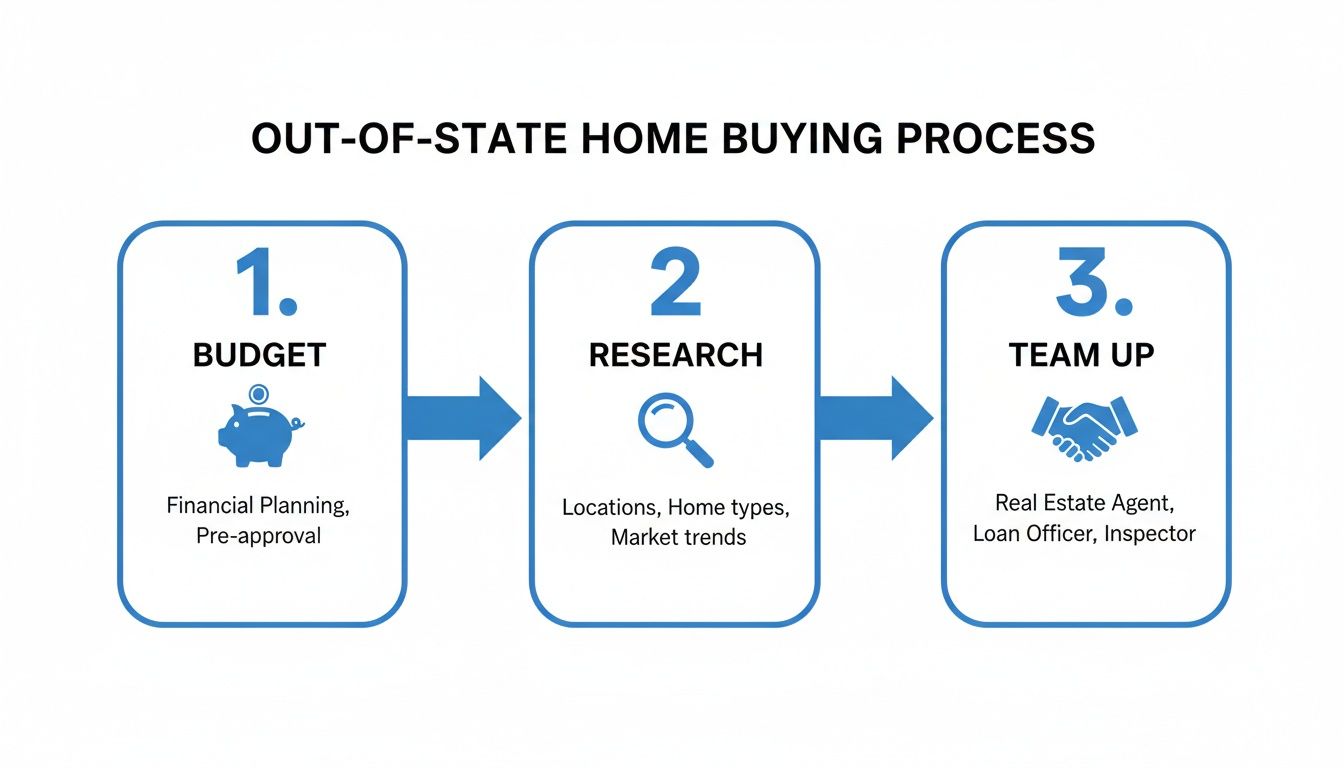
As you can see, it all begins with budgeting, researching, and teaming up. Nailing these foundational steps makes the entire process so much smoother.
Buying a home in a different state is becoming a popular move, especially for people who want a say in their home's design. Some markets are absolutely booming, with sales projected to jump by as much as 17% year-over-year—way ahead of the national average. This growth is often driven by new construction and attractive loan options.
To get a sense of how this all plays out over time, here's a rough look at the timeline you can expect.
Out-of-State Home Buying Timeline
This table breaks down the major phases of your long-distance home purchase, giving you a general idea of how long each stage might take.
Phase | Key Actions | Typical Timeframe |
|---|---|---|
Initial Research & Planning | Define goals, set budget, get pre-approved for a mortgage, research states/cities. | 1-2 Months |
Team Assembly & Search | Interview and hire a real estate agent, start virtual property tours. | 1-3 Months |
Making an Offer & Due Diligence | Submit an offer, schedule remote inspections, negotiate repairs. | 2-4 Weeks |
Closing Process | Finalize loan, review documents with an attorney, arrange for remote or mail-away closing. | 30-45 Days |
Moving & Settling In | Coordinate with movers, set up utilities, travel to your new home. | 1-2 Months |
Keep in mind, these are just estimates. Your personal timeline could be faster or slower depending on the market and your specific needs.
To keep everything straight, using an essential moving out of state checklist is a lifesaver. For an even more detailed plan, you can grab our simple home buying checklist template that's perfect for mapping out your move.
Getting the Money Right for Your Big Move
Let's talk money. When you're buying a house in another state, sorting out your finances isn't just the first step—it's the foundation for the entire process. The rules of the financial game can change the second you cross a state line, so getting a firm grip on your budget and lending options from day one will save you a world of hurt later.
Before you even start scrolling through listings, your top priority is to get pre-approved for a mortgage. Here’s the catch that trips up so many long-distance buyers: you need that pre-approval from a lender who is licensed to do business in the state you’re moving to. That pre-approval from your friendly local bank? It’s not going to work, and finding that out mid-offer can stop your home search dead in its tracks.
Finding a Loan That Works for You
Some loan types are practically made for relocators. Both FHA and VA loans, for example, are popular choices because their requirements are often more flexible, which can be a lifesaver when you're juggling a move.
And here’s another piece of good news: you don't necessarily need to have your new job lined up and started. For many lenders, a signed offer letter from your new employer is all the proof of income they need to get your financing rolling. This is a game-changer, letting you secure your new home before you’ve even started packing.
Buying a home across state lines means navigating new market dynamics. Despite some challenges for first-time buyers, the national homeownership rate has climbed to 65.2%. We've seen nearly 12 million new owners since 2013, with many finding that new construction is the perfect way to get exactly what they want in a new location. You can dive into more of these buyer trends in Zillow's latest housing report.
Your Budget Is More Than Just the House Price
The price tag on the house is just the beginning. Buying from a distance comes with its own set of "hidden" costs that you have to account for.
Imagine you're a family moving from a pricey market like California to a new life in Baltimore County, Maryland. Your budget needs to stretch way beyond the down payment.
Scouting Trips: You'll want to plan for at least one or two trips out to your new state. These aren't vacations; they're critical missions to tour homes and get the vibe of different communities, like White Marsh or Edgewood. Don't forget to budget for flights, a rental car, and a hotel.
A Place to Crash: It's rare for the sale of your old home and the closing on your new one to line up perfectly. You'll likely need a short-term rental or an extended-stay hotel for a few weeks, so build that into your numbers.
The Property Tax Surprise: Property taxes can be dramatically different from one state to the next. Moving to Harford County could mean a huge change—up or down—in what you pay annually. A little research now prevents a big shock later.
The Actual Move: Don't underestimate this one. A long-distance moving company can easily cost thousands of dollars. Get several quotes way ahead of time.
Thinking through these extra costs upfront gives you the cash reserves you need for a smooth transition, free of any last-minute financial panic. It’s all about seeing the full financial picture, and a big part of that is your debt-to-income ratio. You can learn more about why your debt-to-income ratio matters for homebuyers right here.
This kind of detailed financial planning is also perfect for anyone looking to buy a second home in Maryland. Once your budget is crystal clear, securing a gorgeous new place in a community like Vista Reserve or Trimble Meadows becomes a surprisingly simple and exciting process, even when you're managing it all from another state.
Finding the Perfect Home and Neighborhood from Afar
So, how do you actually fall in love with a house you can't just pop over to see on a Saturday afternoon? It used to involve a ton of expensive, headache-inducing flights. Not anymore.
These days, you become a master of digital house hunting. Technology puts you right in the middle of the action, even if you're thousands of miles away. It’s about more than just scrolling through pretty pictures; you’re conducting a full-blown investigation from your couch. This is the groundwork that gives you the confidence to make an offer, even sight-unseen.
Become a Virtual Tour Pro
Modern listings are so much more than a gallery of high-def photos. The real game-changers are the 3D walkthroughs and detailed video tours. These aren’t just fancy slideshows—they're immersive tools that let you digitally "walk" through a potential home.
You can glide from room to room, glance up at the ceiling height, and get a genuine sense of the layout. A floor plan gives you numbers, but a 3D tour shows you how the kitchen actually flows into the living room. That's a detail that can make or break a home’s feel for your family.
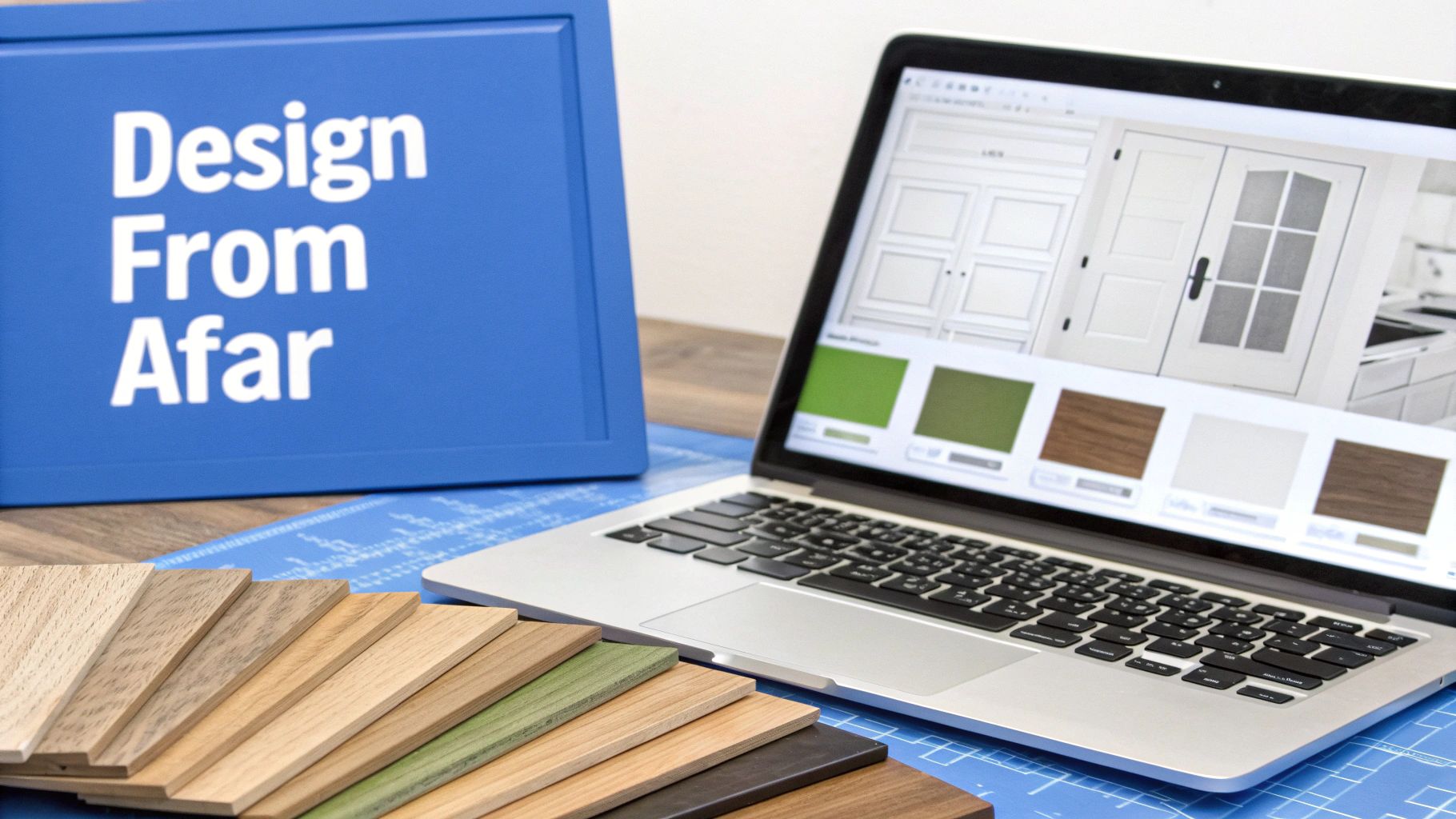
To take it a step further, I give my clients access to unique proprietary visualization tools that let them experiment with design elements. You can digitally swap out flooring, test different countertop materials, and see how various cabinet styles look in your potential new home. It brings the space to life before you’ve even packed a single box. To see what I mean, you can learn more about our virtual tours for new homes in Maryland and see this tech in action.
Directing the Live Video Showing
As great as 3D tours are, nothing replaces a real person on the ground. A live video showing with your agent is your chance to play detective and see everything the polished photos might have missed.
The key is to direct the show. Don't just be a passive observer on FaceTime. Before the call, send your agent a specific checklist of things you want them to do.
Here are a few must-haves for your list:
Engage the Senses: Ask them to describe any smells. Is that a hint of must in the basement? Are they trying to cover up a pet odor with a dozen air fresheners?
Test Everything: Have them turn on the shower to check the water pressure. Flush the toilets. Open and close a few windows.
Look High and Low: You want close-ups of the ceilings (any water stains?) and the floors (are there deep scratches hidden by a rug?).
Open All the Doors: Ask them to open kitchen cabinets, pantry doors, and closets. This gives you a real feel for storage space and the condition of the interiors.
Walk the Perimeter: The tour isn't over until they've walked the property line, pointed the camera at the roof, and shown you the siding up close.
Your agent is your stand-in. A pro move is to have them stand on the front porch and slowly pan the camera down the street in both directions. Seeing your potential neighbors’ yards and the overall vibe of the block provides crucial context you'll never get from a static photo.
Vetting the Neighborhood from Your Keyboard
Finding the right house is only half the puzzle. You also need to find the right community, and you can do some serious recon without ever leaving your current zip code.
Let's say a family is looking to move to White Marsh, Maryland. From their current home across the country, they can build a surprisingly complete picture of the area.
Do a Digital Drive-By: Fire up Google Maps and use Street View to "drive" the neighborhood. How are the homes and yards kept up? Where’s the nearest park or grocery store? Does it feel walkable, or is it a place where you'll live in your car?
Join the Local Chatter: Search on social media for community groups for White Marsh or even neighboring towns like Edgewood. These groups are absolute goldmines. You can ask residents directly about anything from the quality of the schools to typical commute times or even where to find the best pizza. The tone of these online forums often tells you a lot about the real-world community.
Read the Local News: Find local news sites or community blogs. This is how you learn about upcoming events, new businesses, and any local issues on the horizon. It’s the best way to get a feel for the pulse of the town.
By putting in this remote research, you're making sure that when you finally find that perfect house, it’s sitting in a neighborhood that already feels like home.
Making It Official: Inspections, Closing, and Logistics
Alright, you've done the digital legwork, fallen for a house from afar, and you're ready to make it official. This is where things get real. We're moving past virtual tours and into the nitty-gritty of inspections, closing paperwork, and the massive puzzle of actually moving. Doing all this from another state is totally manageable, but it demands serious organization and a whole lot of trust in your team on the ground.

First up, the home inspection. This is non-negotiable, especially when you can't just pop over to see things for yourself. Think of it as your best line of defense against discovering a money pit after you’ve already signed on the dotted line. Your real estate agent is your MVP here; they should have a list of trusted, licensed inspectors they’ve worked with and can vouch for.
Managing the Inspection from a Distance
So, how do you handle the inspection when you're hundreds of miles away? You've really got two solid options.
The best-case scenario is to fly in and be there in person. Nothing beats walking through the property with the inspector, asking questions as they come up, and seeing potential issues with your own two eyes.
But let's be realistic—that’s not always in the cards. The next best thing is to have your agent act as your stand-in. They can be there on a video call, literally walking you through the home and pointing out what the inspector finds in real-time. A top-notch inspector will also send over a ridiculously detailed report packed with high-res photos and clear, simple explanations that give you the confidence you need.
Pro Tip: When your agent attends the inspection for you, ask them to pay attention to the things a camera can't capture—like musty smells, weird drafts, or just the overall "vibe" of the home's condition. That extra layer of human insight is invaluable.
It's no surprise that more and more out-of-state buyers are leaning toward new construction. It just sidesteps so many of the typical worries. New builds often have more availability, and you get to pick out your own flooring and countertops instead of inheriting someone else's weekend DIY projects. In fact, new home sales now make up about 16% of the market, a clear sign that buyers are craving that fresh-start feel.
Navigating a Remote Closing
The idea of closing on a house from another state can sound like a logistical nightmare, but it's actually a pretty smooth process these days. The good news? You almost never have to travel just to sign the final papers.
Here are the two most common ways it gets done:
Mail-Away Closing: The title company or attorney overnights the whole closing package to you. You find a local notary, sign everything with them as a witness, and ship it right back. Simple.
Power of Attorney (POA): This is a great option if you have someone you trust implicitly. You can grant a person—usually your agent or an attorney—the legal power to sign all the closing documents on your behalf.
Your lender and agent will walk you through which approach makes the most sense for you, making sure everything is secure and legally buttoned up. This flexibility is a huge perk, especially for buyers eyeing a second home in Maryland in communities like our Vista Reserve and Trimble Meadows.
Planning Your Long-Distance Move
With the keys almost in hand, the last major hurdle is the move itself. As you're wrapping up the purchase, getting organized is everything. A great first step is to create a detailed list of everything you own; using a moving inventory list template can be a lifesaver.
I always tell clients to start researching long-distance moving companies at least two months before they plan to move. Get quotes from a minimum of three reputable companies, and don't forget to double-check their credentials and insurance coverage. Once your mover is booked, you can finally focus on your own travel plans and get ready to settle into your new home in White Marsh or Edgewood.
Making Your New Maryland Home Yours, From Anywhere
Let's be honest, one of the best parts of buying a brand-new home is making it yours. You get to pick the finishes that perfectly match your style, creating a space that feels like home the second you walk through the door. But when you’re trying to do all that from another state, the whole design process can feel like a giant, intimidating question mark.
How can you possibly pick out countertops from a thousand miles away? How do you know if that flooring you saw online will actually look good with the cabinets you chose? This is where having a hands-on, personalized design experience completely changes the game. It turns what could be a really stressful situation into one of the most exciting parts of your move.
Bringing Your Vision to Life with Modern Tools
Forget the old days of squinting at tiny samples mailed across the country. I give my clients access to some amazing visualization tools that basically let you step inside your future home—right from your current living room.
Picture this: you're sitting on your couch with your laptop, playing around with different design options in a virtual model of your exact floor plan. You can instantly see how sleek, white quartz countertops look with dark espresso cabinets. With just a click, you can swap them for a warm granite and watch the entire feel of the kitchen change. You can try out different tiles for the bathroom, experiment with hardwood flooring, and see how everything comes together in real-time.
This kind of technology takes all the guesswork out of the equation and gives you the confidence to make creative, even bold, choices. It’s about so much more than just picking colors; it’s about crafting a home you're going to love living in for years.
"Being able to see our choices in a realistic rendering was a game-changer. We could visualize the final product and make decisions with total confidence, even though we were states away. It made the entire design process fun and stress-free."
How Remote Design Works in the Real World
Let me tell you a quick story. I recently worked with a fantastic family moving from Texas to our community in White Marsh, Maryland. They were incredibly excited about the move but really anxious about designing their home remotely. They had a specific vision for their dream kitchen and master bath but were worried they couldn't nail it without being here in person.
So, we set up a series of video calls and used my interactive visualizers to walk through every single choice.
For the Kitchen: They compared dozens of countertop and cabinet combinations on the fly, immediately seeing how each choice impacted the room's brightness and style.
For the Floors: We virtually laid down different types of luxury vinyl plank throughout the main living area until they found the perfect shade to complement their furniture.
For the Bathrooms: They designed a spa-like master bath by pairing a specific floor tile with a coordinating shower wall tile, seeing the complete, cohesive look before a single thing was ordered.
Through these virtual sessions, they designed their entire home without a single ounce of stress. When they finally walked into their finished home in Baltimore County, their reaction was priceless—it looked exactly like they had imagined, down to the smallest detail. If you want to dive deeper into these tools, you can learn more by reading our guide to designing your own home online.
Perfect for Your Main Home or a Getaway
This seamless, tech-driven approach isn't just for people who are relocating full-time. It’s also the perfect solution if you're looking to buy a second property in Maryland. The process is so streamlined that managing it from another state is surprisingly simple.
Whether you're dreaming of a weekend escape or a long-term investment, communities like Vista Reserve and Trimble Meadows in beautiful Harford County offer some incredible opportunities. You can personalize your new home to be the perfect retreat, handling the entire design process from wherever you are with my hands-on help and powerful visualization tools. It’s a modern, efficient, and genuinely fun way to build your new life in Maryland.
Your Top Questions About Buying a Home Out-of-State, Answered
Let's be honest, the thought of buying a house in another state can feel overwhelming. You've probably got a dozen questions running through your mind. I've been there with countless clients, so I've put together answers to some of the most common ones to help clear things up.
Do I Really Have to Fly Out to Buy the House?
It's a great idea, but not always a deal-breaker. Thanks to modern technology, buying a home completely remotely is more possible than ever. High-definition virtual tours and a trusted agent who can be your boots on the ground can give you a surprisingly accurate feel for a property.
Plus, many states now allow for remote closings, which handles the final paperwork without you needing to be physically present. That said, I always recommend at least one in-person visit if you can swing it. There are just some things a camera can't capture, like the vibe of the neighborhood at different times of day or the actual flow of the commute.
How Do I Find a Good Real Estate Agent From So Far Away?
This is probably the single most important decision you'll make in this process. A great agent is your lifeline when you're hundreds of miles away. Start your search by looking for agents who specifically mention relocation services—they'll understand the unique challenges you're facing.
Check online reviews, but also jump into local community Facebook groups for your target city and ask for recommendations. Once you have a shortlist, schedule video calls with your top two or three picks. You're looking for someone with deep local knowledge, but just as importantly, a communication style that clicks with yours. You want to feel like they’re your partner in this, keeping you in the loop every step of the way.
What Surprise Costs Should I Be Budgeting For?
An interstate move is more than just the price of the house. A few extra costs can sneak up on you if you're not prepared.
Travel: Factor in the cost of flights and hotels for at least one or two house-hunting trips, plus a potential trip for the final inspection.
Temporary Housing: It’s almost impossible to line up your old lease ending and your new mortgage starting on the same day. You'll likely need a short-term rental or an extended-stay hotel for a couple of weeks.
Moving: Long-distance moving costs can be substantial. Get quotes from several reputable companies well in advance.
State-Specific Costs: This is a big one. Property taxes, homeowners insurance rates, and HOA fees can be drastically different from what you're used to. Do your homework here.
One of the biggest financial hurdles for families is the gap between renting and owning, which has grown in recent years. In some areas, the estimated monthly mortgage payment can be over 60% more than the typical rent for a similar property. This makes careful, all-inclusive budgeting even more crucial when planning your move.
Can I Actually Design a New Home in White Marsh or Edgewood From Another State?
You absolutely can! In fact, this is where buying new construction really shines for remote buyers. The entire process is designed to be streamlined and transparent, allowing you to make all your design choices from your current living room.
It’s an incredible way to make sure your new home in Baltimore County or Harford County feels like yours from day one. While the builder I represent provides high-quality homes, I go a step further—offering my clients unique proprietary visualization tools, hands-on service, and access to visualizers that help you bring your dream space to life. You get to pick your flooring, countertops, cabinets, tile, and more, seeing exactly how it all comes together.
This approach is also perfect for anyone looking to buy a second property in Maryland, especially in sought-after communities like Vista Reserve and Trimble Meadows. You get all the fun of customization without the stress of constant travel.
Ready to see how we can build your new Maryland home, no matter where you are now? At Customize Your Home, I specialize in giving out-of-state buyers the confidence and tools to design their perfect space. Let’s make it happen. Explore your options today at customizeyourhome.com.
Comments