

What Is an Easement on Property? A Guide for Maryland Homebuyers

Heard the term "easement" thrown around while you're house hunting and felt like you were missing something? Don't worry, you're not alone. Think of a property easement as a legal permission slip. In simple, friendly terms, it gives someone else the right to use a specific slice of your land for a very specific reason, even though you’re the owner.
It’s less of a red flag and more of a common real estate reality. Seeing one on a property shouldn't send you running for the hills.
Getting a Handle on Property Easements
As you tour beautiful new homes in Maryland communities like White Marsh or Edgewood, wrapping your head around easements is a crucial piece of the homebuying puzzle. It’s a standard legal tool that grants a person or company the right to use someone else's land for a defined purpose.
Let's get practical. Say you fall in love with a home, but the only way your new neighbor can get to their garage is by using the last five feet of your driveway. That shared access is almost certainly an easement. You own that five-foot strip, but they have the legal right to drive over it. It doesn't mean they can park there or host a BBQ on it—their use is strictly limited to getting in and out.
Who Actually Holds the Easement?
This is where you might hear a couple of legal terms, but the concept is straightforward. The person or entity who gets to use the land is called the dominant estate, and the property that has the easement on it is the servient estate.
One property gets the benefit, and the other "serves" that benefit. Simple as that.
Utility companies are a classic, everyday example. They almost always have easements to run things like power lines or water pipes across a whole neighborhood. In that scenario:
The Utility Company: They hold the easement, making them the dominant estate. They have the right to come onto your property to maintain or fix their equipment.
Your Property: It's the servient estate because it "serves" the utility company's right of access.
At its core, an easement is a non-possessory right. The holder can use the land for a narrow purpose, but they never actually own or possess it.
Why Should a Homebuyer Care?
This all becomes incredibly important when you're dreaming about your future home—picking out finishes, designing the landscaping, and planning for a new deck. An undiscovered easement could throw a real wrench in your plans.
Imagine finding out there's a drainage easement right where you wanted to build that gorgeous new patio. Suddenly, your vision for the perfect backyard is at a standstill.
That’s why getting the full story upfront is so critical. As a homebuyer in Baltimore County or Harford County, knowing about any easements ahead of time gives you power. It helps ensure the home you’re so excited to customize with your choice of flooring, countertops, and cabinets will truly be yours, without any surprise restrictions popping up down the road.
The Different Flavors of Maryland Easements
Just like there are different ways to customize a new kitchen, easements come in several "flavors." Each type serves a unique purpose, and understanding them helps you know exactly what you're dealing with when you're looking at a property.
Some easements are tied to the land itself, almost like a permanent feature. Others are more like a permission slip granted to a specific company or person. Let’s break down the most common types you’ll run into in Maryland, from White Marsh to Edgewood, so you can feel confident in your home search.
This diagram shows the basic relationship between a property, its owner, the person holding the easement, and the rights they have.
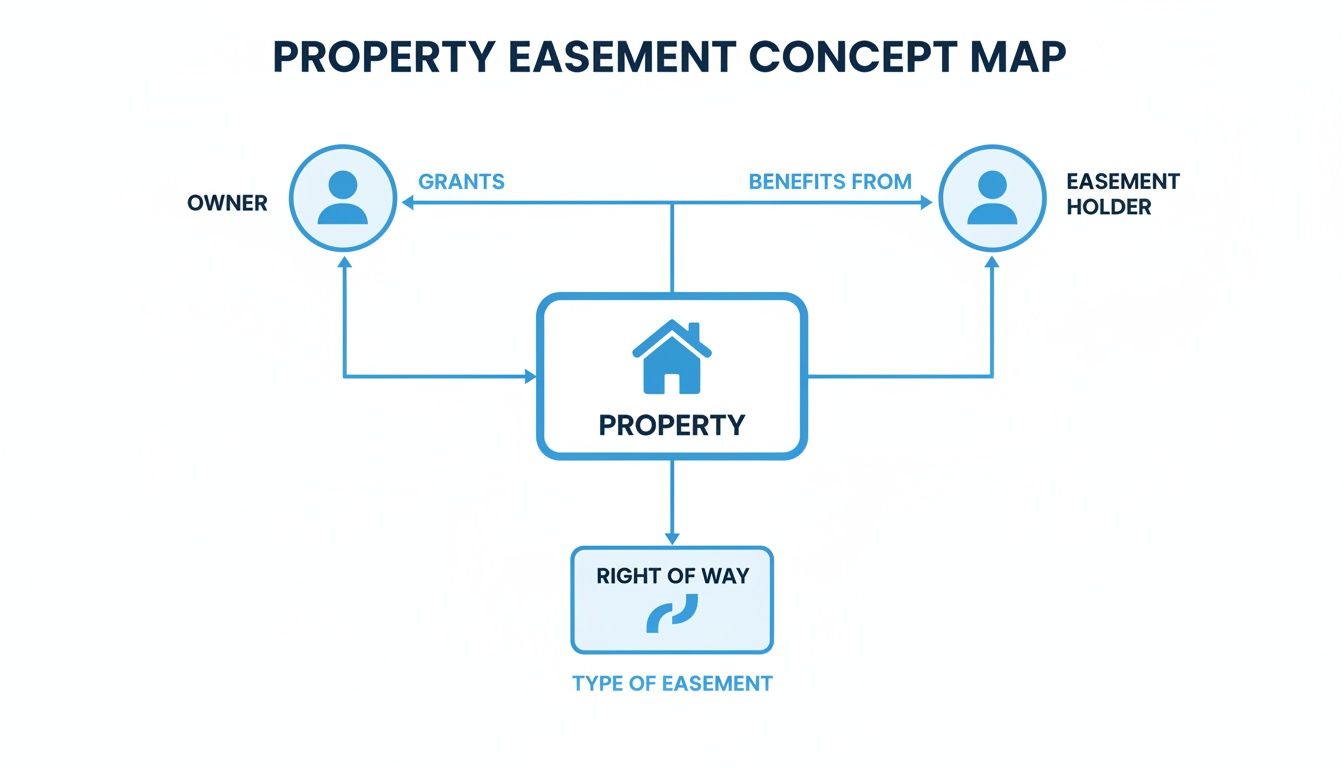
As you can see, the core idea is pretty simple: the easement holder gets the right to use part of someone else's land, but they don't get to own it.
Easement Appurtenant: The Neighborly Easement
Think of an easement appurtenant as something that’s attached to the land itself, not to a specific person. It’s all about one property (called the dominant estate) getting a benefit by using a neighboring property (the servient estate).
A practical example is a "landlocked" property. Imagine your neighbor's lot doesn't touch a public road, but yours does. An easement appurtenant would give them the legal right to use a slice of your driveway to get to their home.
This type of easement "runs with the land," which is a fancy way of saying it stays in place even if you and your neighbor both sell your homes. The new owners simply inherit the same rights and responsibilities.
Easement in Gross: The Utility Pass
Unlike the neighborly kind, an easement in gross benefits a specific person or, more commonly, a company, regardless of what property they own. This is the one you’ll see all the time with utility companies.
The local electric company has an easement in gross to run power lines across your backyard.
The city might have one for a sewer line that runs under a corner of your lot.
These easements don't involve a "dominant" property benefiting from a "servient" one. It’s just a company that needs access to do its job. They're incredibly common and usually don't cause any problems for homeowners.
Prescriptive Easements: The Footpath Story
Now for a more unusual one: the prescriptive easement. This one isn't written down in any deed. Instead, it’s created through long-term, continuous use of someone’s property without the owner's permission.
Picture a well-worn footpath across the corner of a vacant lot in Baltimore County that people have used as a shortcut to the park for over 20 years (that’s the required time in Maryland). If the use was open, obvious, and uninterrupted, a court might eventually grant a prescriptive easement, making that shortcut a legal right of way.
It’s like a right gained through sheer habit. While less common, it highlights why it's important to understand a property's history and how it's been used by the community. For a deeper dive into how property rules can be adjusted, check out our guide on what a zoning variance is and how it works.
Express vs. Implied Easements
Finally, easements can be sorted by how they were born. It’s pretty simple.
Express Easements: These are the most straightforward because they’re created intentionally and written down in a legal document, like a deed or a separate easement agreement. When you buy a home, any express easements should be clearly spelled out during your title search. No surprises here.
Implied Easements: These aren't written down but are created by circumstance and pure necessity. For instance, if a seller divides a large piece of land and sells you the back half without creating an express easement for road access, the law will likely imply that one is necessary for you to actually use your property.
Getting a handle on these different types helps you ask the right questions and truly grasp the story of any property you’re considering. It ensures that when you’re ready to start picking out countertops and flooring, you know exactly what rights come with your new home.
How Easements Can Influence Your Home Customization
So, you've found a property you love in a great Maryland spot like White Marsh or Edgewood, and your mind is already racing with ideas. But here's the big question: how does an easement actually affect the fun part—making the house your own? This is where the rubber meets the road, as an easement can directly impact your plans for everything from a backyard oasis to a future addition.
Let's use a practical example. Say you're dreaming of putting in a gorgeous in-ground swimming pool. You've even started playing with virtual design tools to picture it perfectly. But then you find out a utility easement cuts right through the middle of your backyard. This gives the local electric or water company the right to access that strip of land for their lines. As a result, you can't build any permanent structures, including that pool, right on top of it. Finding this out early saves you a world of frustration and wasted effort.

Common Customization Roadblocks
Easements can put some very real limits on your home customization dreams. Before you get too far down the road with a specific plan, it's crucial to see how an easement might get in the way. Knowing about these potential hurdles is the first step to creating a home you'll love without any nasty surprises.
Here are a few common ways an easement might throw a wrench in your plans:
Building a Fence: A right-of-way easement that lets your neighbor cross a corner of your property might mean you can't fence off that area and block their path.
Planting Large Trees: Some easements, especially for buried utilities, won't allow you to plant trees with deep roots that could damage underground pipes or cables.
Adding a Deck or Patio: That new deck you want can't be built over a drainage easement, as it needs to remain clear to manage stormwater for the neighborhood.
Constructing a Shed or Garage: Just like with the pool example, you generally can’t put permanent buildings inside an easement's boundaries.
Think of an easement as a pre-drawn "no-build zone" on your property map. My job is to help you design your dream space beautifully around those lines, not through them.
Conservation Easements: A Special Consideration
Another type you might run into, particularly in the more scenic parts of Baltimore or Harford County, is a conservation easement. This is a legal agreement that limits how you can use the land to protect its natural or historical character.
While these are fantastic for preserving green space, they could put a stop to future development. For example, a conservation easement might mean you can't clear out some woods to make your yard bigger or add a new wing to your home. They’re becoming more common, too. In 2023, state programs invested over $272 million to complete these projects—a 40% increase from the previous year.
Turning Limitations into Opportunities
Finding out your property has an easement might feel like a bummer, but it doesn't have to be a deal-breaker. In fact, this is exactly where my hands-on service and visualization tools can make a huge difference. We can map out any easements on your lot, letting you see the exact boundaries. From there, we can get creative with designing your space, ensuring your plans for new countertops, cabinets, and flooring all happen in the right places.
By understanding these restrictions from the very beginning, we can work together to bring your vision to life without hitting any snags. It's also easy to confuse these rules with the ones set by a homeowners association. To get clear on the difference, you might want to check out our guide on what a homeowners association is and how it works for Maryland buyers.
At the end of the day, knowledge is power. Knowing the score on easements empowers you to make smart, confident decisions on your journey to a new home.
How to Uncover Easements Before You Buy
When you're buying a home, the last thing you want are surprises after closing day. An undiscovered easement can be a real headache, popping up just when you thought you were in the clear. Think of this as your practical game plan for sniffing out any easements on a property in Maryland, so you can buy with total peace of mind.
This is your due diligence checklist. Follow these steps, and you’ll get a complete picture of the property, empowering you to make a smart purchase in communities from White Marsh to Edgewood.
Start with a Professional Title Search
This is non-negotiable. The single most important step in finding easements is a professional title search. Once you’re under contract, a title company gets to work digging through public records. Their goal is to make sure the seller can legally sell the property and to uncover any claims, liens, or restrictions tied to it—and that definitely includes easements.
The title company will deliver a preliminary title report that lists any recorded easements they find. This document is your first official alert about anyone else’s rights to your new land.
Get and Review the Property Survey
A property survey, also called a plat, is basically a detailed map of your land drawn by a licensed surveyor. It shows your exact property lines, where the house sits, and other features. Most importantly, it will physically map out the location of any recorded easements, often showing them with dotted or dashed lines.
Having this visual is a game-changer. It helps you see exactly where that utility line cuts across the backyard or how much of your driveway is actually shared with a neighbor. To get a better handle on this, check out our complete homebuyer guide on what a property survey is.
A property survey translates the dense legal language from the title report into a clear visual map. It’s the best way to truly understand how an easement physically impacts your lot.
Go to the Source: County Records
While the title company does the heavy lifting, you can absolutely do some digging on your own. A crucial step is performing a thorough county property records search. Every deed, plat, and easement agreement gets filed at the county recorder’s office—for homes in our area, that’s typically the Baltimore County or Harford County offices.
Here’s a quick action plan for your own investigation:
Check the Seller’s Disclosure: In Maryland, sellers have to disclose known material facts about the property, which often includes easements. Go through this document with a fine-tooth comb with your agent.
Examine the Property Deed: The current deed should mention any easements. Be on the lookout for phrases like "subject to an easement for..."
Walk the Property Lines: Never underestimate a good old-fashioned walkthrough. Keep your eyes peeled for physical clues of an easement, like utility boxes, manhole covers, overhead power lines, or even a well-worn path that hints at someone else using the property.
Taking these proactive steps means no nasty surprises when you’re ready to start the fun stuff, like picking out cabinets and countertops. It’s all about getting the full picture so you can customize your new home with confidence.
Visualize Your Dream Home, Easements and All
Finding out your dream property has an easement can feel like a major roadblock. It's easy to get discouraged, but don't let it kill the excitement of designing your perfect space.
Think of it as a creative challenge—one we can solve together. While the builder I represent provides high-quality homes, I go a step further—offering my clients unique proprietary visualization tools, hands-on service, and access to visualizers that help you bring your dream space to life.
Navigating property lines and restrictions is a huge part of buying a home. My job is to make this process not just clear, but maybe even a little fun. Using some unique visualization tools, we can bring your future home to life, easements included.
Seeing is Believing
What if you could see a digital map of any easements laid right over the property you love? My proprietary tools do just that. We can map out a utility easement cutting across the backyard or that shared driveway running along the side, showing you exactly how these things interact with your plans.
This visual-first approach removes all the guesswork. You’ll see in real time how an easement might clash with your idea for a new kitchen addition, that big outdoor deck you’ve been dreaming of, or even where you plan to install new flooring. It transforms an abstract legal term from a property survey into something you can actually see and plan around.
By mapping out easements visually from the start, we transform potential challenges into a part of the creative process, ensuring every inch of your property is used to its fullest potential.
Designing Around the Lines
Once we know exactly where the boundaries and no-go zones are, the fun really begins. We can work together to pick out the perfect cabinets, countertops, and tiles that not only fit your style but also make the most of every square foot you have.
For example, if a drainage easement means you can't build a permanent patio in one spot, we can design a gorgeous non-permanent seating area or a stunning garden that respects the easement while still giving you that outdoor escape you want. It’s all about smart design that works with the land, not against it.
This hands-on process makes every choice intentional. From picking the right tile that flows perfectly around a utility access point to choosing a cabinet layout that makes your kitchen feel bigger and more functional, we’ll make sure no detail gets missed. I’m here to help you create a home in communities across White Marsh, Maryland; Edgewood, Maryland; Baltimore County, Maryland; and Harford County, Maryland that is both beautiful and perfectly practical for you.
Let's team up to bring your vision to life here in Maryland. We'll turn those potential hurdles into a beautifully designed reality, ensuring the home you customize is the one you’ve always dreamed of—no surprises attached.
Common Questions About Property Easements
We’ve waded through a lot of legal details, from the different flavors of easements to how they can throw a wrench in your home customization plans. To bring it all home, let's go through some of the most common questions I hear from homebuyers here in Maryland. Getting a straight answer on these can really boost your confidence as you move forward.
Can an Easement Be Removed from a Property?
Yes, but it's rarely as simple as just deciding you don't want it anymore. Think of an easement as a permanent note written in ink on your property's official record. Erasing it requires a formal, legal process.
Here are the usual ways an easement gets terminated:
Mutual Agreement: This is the cleanest route. If you and the person who holds the easement rights both agree it's no longer needed, you can sign a legal document called a release agreement to officially kill it.
Merger: Let's say you buy the neighboring lot that was using your property for access. Since you can't have an easement on your own land, the two property titles "merge," and the easement just dissolves.
The Original Purpose Disappears: Sometimes, an easement just becomes obsolete. Imagine an easement was created so your neighbor could get to a main road. If the county builds a brand new public road that gives them direct access, a court might agree the old easement is no longer necessary.
Abandonment: This one is tough to prove. It takes more than just the person not using the easement for a few years. You’d have to show clear, undeniable proof that they intended to permanently give up their rights.
Because this involves altering official property records, you’ll almost certainly need a real estate attorney to navigate the paperwork and make sure it’s done right.
Does an Easement Mean Strangers Can Be on My Property?
This is a huge worry for a lot of people, but the reality is much more limited. An easement doesn't give someone a free-for-all pass to your land. Their rights are strictly confined to the specific purpose and specific area laid out in the legal document.
It’s like having a ticket for a specific seat at a concert, not a backstage pass to the whole venue.
A utility worker can come into that 10-foot strip at the back of your yard to work on a power line, but they can't decide to have a picnic on your patio. Their rights are limited to doing their job in that specific corridor.
Similarly, if your neighbor has an easement to use the last 20 feet of your driveway to get to their garage, that’s all they can do. They can’t start parking their boat there or using it as a storage area. If you feel like someone is overstepping, the first step is always to pull out the easement document and see exactly what it says.
Who Is Responsible for Maintaining the Easement Area?
Great question. This is where neighborly disputes often start if things aren't clear from the get-go. The best-case scenario is an easement agreement that spells out exactly who handles maintenance. A practical example for a shared driveway might say both owners split the cost of snow removal and pothole repairs 50/50.
But many older easements are completely silent on the issue. When the paperwork doesn't say, the general rule of thumb is that the party who benefits from the easement (the dominant estate) is responsible for keeping it up.
Utility Easements: The utility company is on the hook for maintaining its own equipment and making sure the area is safe.
Shared Driveways: If the agreement is silent, the neighbor using the driveway to get to their house is generally responsible for its upkeep so it doesn't cause damage to your property.
To head off any future arguments, especially in places like Baltimore County or Harford County where a bad snowstorm can make a shared driveway a real headache, it's smart to clarify these roles before you buy.
Does Title Insurance Protect Me from Easement Problems?
Absolutely. This is one of the most important reasons to get an owner's title insurance policy. It acts as a financial safety net against hidden problems with your property's title that were missed before you closed. This includes certain easement issues. For a deeper dive, check out our simple guide on what title insurance is in our detailed guide.
Here’s how it works:
Before you close, the title company does a deep search for any recorded easements. These known easements are then listed as "exceptions" on your policy. This just means the policy won't cover future fights over these specific, disclosed easements.
The real value comes when an unknown easement crawls out of the woodwork after you own the home. If some long-lost, unrecorded easement suddenly appears and messes with your property value or your right to use your land, your title insurance policy is there to cover legal fees and financial losses.
It’s a one-time fee you pay at closing that gives you peace of mind for as long as you own your home. It’s protection from the unknown. For tricky situations where you’re trying to balance your dream home vision with property right complexities, talking to a dedicated real estate property land use attorney can be a game-changer.
I know easements can seem like a dense, legal maze. But with the right info and helpful content for everyday home living, you can handle them like a pro. My hands-on service and unique proprietary visualization tools help you truly see your dream home on your chosen lot, easements and all. We'll work together to pick out the perfect flooring, countertops, cabinets, and tile, making sure every detail fits your vision.
Ready to start designing your perfect space in White Marsh, Edgewood, or anywhere in Maryland? Let's talk. Visit https://www.customizeyourhome.com to see how we can bring your dream home to life, together.
Comments