

How to Read Construction Drawings A Practical Guide for Homeowners

Getting your hands on the construction drawings for your new home is a genuinely exciting moment. But let's be honest, they can look like a foreign language at first. The best way to think about them is as the definitive roadmap to your future home—the single source of truth for you, me, and every single person who will work on it.
Learning how to read construction drawings is like gaining a superpower. It’s what allows you to ensure the home you’ve been dreaming of, down to the very last light switch, is exactly what gets built.
Why These Drawings Are So Important
Don't let the technical look of construction drawings intimidate you. They're not just for builders and architects; they're the detailed story of your home, and they are your most powerful tool for getting things right before the first shovel hits the ground.
When you know your way around a set of plans, you can:
Truly visualize your space. You'll see how rooms connect and get a gut feeling for the scale and flow. For example, you can trace the path from the kitchen to the family room to see if it feels open and connected.
Confirm all your personal touches. This is where you double-check that your choices for flooring, cabinets, and tile are all noted correctly.
Catch potential quirks early. You can spot small things that might drive you crazy later, like a door that swings the wrong way or an outlet hidden behind where the bed will go.
Talk to your builder with confidence. When you can point to something specific on the plans, you can ask clear, informed questions and get the answers you need.
Why Plan-Reading Skills Matter More Than Ever
You're not the only one staring at these sheets. The entire industry relies on them, and the market for creating these drawings was a massive USD 9.2 billion in 2023 and is still growing. This trend means plans are packed with more detail than ever before, which makes it even more important for you to feel comfortable with them.
While the builder I represent provides high-quality homes, I go a step further—offering my clients unique proprietary visualization tools, hands-on service, and access to visualizers that help you bring your dream space to life. Nothing beats the confidence you'll feel from understanding the core documents yourself.
Whether you're building a new home with us in White Marsh, Edgewood, or anywhere across Baltimore County and Harford County, Maryland, getting comfortable with your blueprints is the first real step. It turns what could be a confusing process into a fun and creative collaboration. This is how we make sure that kitchen you designed with your choice of countertops and cabinets is absolutely perfect, just like you pictured it.
So, let's start decoding those plans together.
Decoding the Language of Blueprints
Jumping into a set of construction drawings without knowing the lingo is like trying to read a book in a foreign language. Before you can really get a feel for the space, you need to understand the basic vocabulary—the symbols, lines, and notes that make up the language of your new home.
Every set of plans comes with a legend, or key. This is your decoder ring. It tells you what all those little squares, circles, and dashed lines actually mean. For instance, you'll see a small circle with a "S" for a light switch or a rectangle with arcs showing which way a door swings. This visual shorthand is what keeps the drawings clean and easy to read while packing in a ton of information.
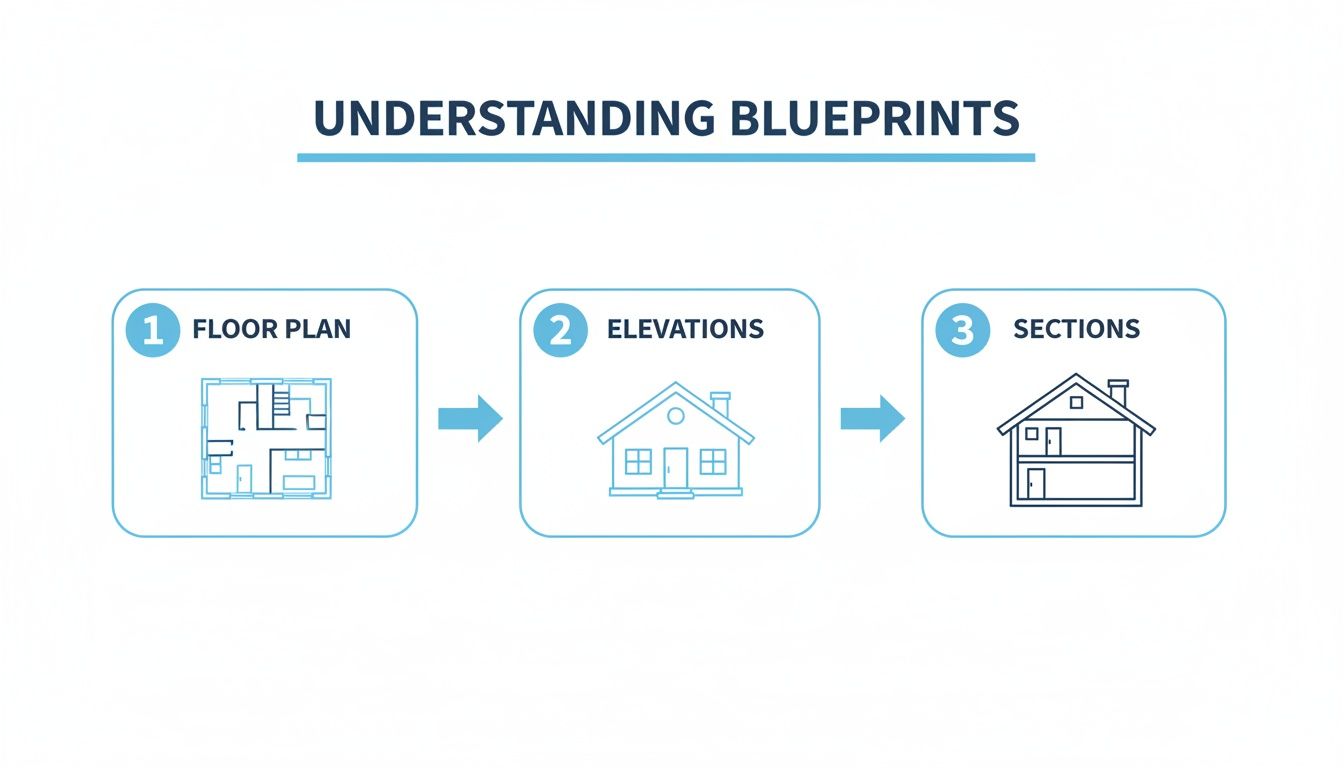
As you can see, each type of drawing gives you a different piece of the puzzle. Understanding how they all fit together is crucial for seeing the big picture of your future home.
Why Scale and Symbols Are Everything
Look in the corner of any drawing, and you'll find the scale, usually written as something like ¼" = 1'-0". This is the rule that connects the paper world to the real world. Once you get the hang of it, you can start to visualize the actual size of rooms and spaces. It's how you'll know for sure if that king-sized bed will fit in the primary suite or if placing your favorite armchair there will block the closet door.
With the global construction industry growing—output is expected to jump by 42.0% by 2030—clear, standardized plans are more important than ever to make sure every project is built right the first time.
Reading Between the Lines
Beyond the scale and symbols, you'll see notes scattered across the pages, often with arrows pointing to specific parts of the drawing. Don't gloss over these! They are direct messages from the architect or designer, spelling out crucial details that a simple symbol can't convey.
A practical example would be a note pointing to the kitchen floor that reads, "Install LVP flooring, Model #123, color 'Oak,' parallel to the longest wall." These details are what ensure the quality and your specific selections are part of the plan. It all connects back to how the house is physically put together, which you can learn more about by understanding what is framing in construction.
Expert Tip: Think of the legend, scale, and notes as your blueprint dictionary. Keep it handy. It’s your go-to guide for making sense of every line and symbol with complete confidence.
Truly getting the hang of this requires more than just a quick look; it takes practice. Developing critical reading strategies for technical drawings is what separates a casual observer from an empowered homeowner. My goal is to give you those skills, helping you see your choices come to life so the home you're personalizing in White Marsh or Edgewood is exactly what you’ve been dreaming of.
Getting to Know the Main Views of Your Home
Alright, now that you've got the lingo down, let's walk through the three main "views" that bring your home to life on paper. Each one gives you a totally different perspective, and when you put them all together, you get the complete picture. I like to think of them as different camera angles on a movie set—you really need all of them to understand the whole story.
The All-Important Floor Plan
The floor plan is the rockstar of your drawing set. Seriously, it's the one you’ll keep coming back to over and over. Imagine you could float above your house and lift the roof right off—that's what you're looking at. It gives you a bird's-eye view of a single level and is the best way to get a real feel for the flow of the space.
From the floor plan, you’ll be able to see:
Room Layout: You can trace the path from the kitchen to the family room or see exactly how private the bedrooms are from the main living areas.
Dimensions: Those little lines and numbers tell you the exact size of every room, which is a game-changer when you start thinking about where your sofa will go.
Key Features: It pinpoints the location of every wall, door (and which way it swings!), window, closet, and even major appliances.
This is the drawing that ensures your day-to-day life is going to fit perfectly into the home's design. If you want to get even more granular, we have a whole guide that explains what a floor plan is and how it guides your home design in greater detail.
Picturing the Exterior with Elevations
While the floor plan is all about the inside, elevation drawings are your window to the outside. These are flat, 2D drawings that show you exactly what your home will look like from each side—front, back, left, and right.
Think of elevations as the blueprint for your home's curb appeal. They spell out the exterior finishes (like siding or brick), the style and placement of windows and doors, and the pitch of the roof. This is the drawing that confirms the look and feel of your home before a single nail is hammered.
I always make it a point to walk my clients through the elevations. We'll often use visualizers to show how different material choices will actually look. It helps turn a black-and-white drawing into a vibrant picture of your future home in communities like White Marsh or Edgewood.
Seeing Inside the Walls with Section Drawings
Last but not least are the section drawings. These can look a little intimidating at first, but the concept is simple: imagine taking a giant knife and slicing right through the house like a layer cake. The section drawing shows you what the inside of that slice looks like, revealing all the vertical relationships.
A section view is incredibly useful for understanding things like:
Ceiling Heights: Is that a standard 8-foot ceiling or the soaring, dramatic one you wanted? This drawing confirms it.
Foundation Details: It shows you exactly how the house is anchored to the ground.
Structural Connections: You can see how the floors, walls, and roof all stack up and connect, which is crucial for the home's integrity.
You probably won't obsess over this drawing the way you will with the floor plan, but it’s a critical piece of the puzzle. It’s the one that gives you peace of mind that your home is structurally sound. Once you're comfortable with these three views, you're well on your way to reading your construction drawings like a pro.
Understanding Your Home's Hidden Systems
Behind the drywall and beneath the floors, a whole network of systems keeps your home humming along comfortably. These are the mechanical, electrical, and plumbing systems—often called MEP for short—and they each have their own set of drawings.
They might look a little intimidating at first glance, but you don't need to be an engineer to understand the basics. Think of these plans as the backstage tour of your home. A quick look is all it takes to see how everything works and, more importantly, how to make it work perfectly for you.
Your Roadmap for Power and Comfort
Of all the system plans, the electrical plan is where you can have the most fun with personalization. It’s a detailed map showing every single outlet, light switch, and fixture. This is your golden opportunity to think through how you’ll actually live in each room.
For example, do you love to cook with a stand mixer or an air fryer? Let's make sure there’s an outlet on the kitchen island right where you need it. Planning a cozy reading nook in the corner of the living room? We can add a dedicated switch that controls a floor outlet for a lamp. This is the drawing we'll pore over together to make sure your home is wired for your life.
The mechanical drawing is all about your heating, ventilation, and air conditioning (HVAC) system. It shows where the air vents, ductwork, and thermostat will be placed to keep every room comfortable year-round. Then there's the plumbing plan, which maps out every pipe, drain, sink, and faucet. It shows how fresh water gets to your kitchen and bathrooms and how wastewater is carried away. If you're curious about the work that happens before the walls go up, our guide on what is rough-in plumbing is a great place to start.
Why These Detailed Plans Matter
These system drawings are much more than a formality; they're an essential communication tool. In an industry facing a serious labor crunch—North America needs an additional 500,000 workers, after all—clear and accurate plans are everything.
They ensure every single person on the job site, from the seasoned pro to the newest apprentice, knows exactly what needs to be done. This documentation gives you peace of mind, knowing your specific requests are clearly recorded for the entire build team to follow.
A Pro Tip: As you look at the electrical plan, mentally walk through your daily routine. Where do you charge your phone at night? Where will the holiday lights plug in outside? A few minutes of this kind of visualization can help you place outlets and switches in the perfect spots.
Here in our Maryland communities, from White Marsh to Edgewood, I like to take it a step further. I provide my clients with unique visualization tools that bring these flat, 2D drawings to life. We can see exactly how your chosen light fixtures will illuminate a room or make sure your furniture layout won’t block a crucial air vent—all before a single nail is hammered. It’s this hands-on, forward-thinking approach that turns a good plan into your perfect home.
Bringing Your Vision to Life
Okay, this is where all that effort you put into understanding construction drawings really starts to pay off. Moving from a bunch of lines on paper to actually picking out the materials for your home is one of the most exciting parts of this whole process. Trust me, knowing your plans inside and out makes these decisions so much easier—and a lot more fun.
Suddenly, that floor plan isn't just a technical document; it's your new best friend. It’s what helps you picture exactly how that gorgeous backsplash tile you chose will look stretched across your kitchen wall, or whether that giant sectional you've been eyeing will actually fit in the great room.
From 2D Plans to 3D Reality
While the builder I represent provides high-quality homes, I go a step further—offering my clients unique proprietary visualization tools, hands-on service, and access to visualizers that help you bring your dream space to life. These tools are designed to close the gap between the flat, 2D drawings and what your home will truly look and feel like.
We essentially turn those plans into a living, breathing 3D model. You get to see your specific selections—the exact cabinets, flooring, and countertops—in your space before construction even begins.
This service is all about taking the guesswork out of the equation. It's about giving you the confidence that the granite you fell in love with online looks just as amazing in your kitchen as it did in a pristine showroom. That kind of clarity is priceless.
This tech-forward approach is thankfully becoming more common in the industry. If you're curious about where things are headed, check out how tools like Augmented Reality in Construction are changing the game.
Making Your Selections with Confidence
By using the blueprints and our visualizers hand-in-hand, we can dial in every last detail together. It’s a collaborative effort that ensures the home we build is the one you’ve been dreaming of, whether that's in White Marsh, Edgewood, or anywhere else in Baltimore County and Harford County.
Thinking about your final selections is just one piece of the puzzle. If you want to see how this fits into the grand scheme of things, you’ll find our guide to the new home construction process really helpful. It lays out every step, from breaking ground to finally getting those keys in your hand.
My job is to give you the tools and hands-on guidance to bring that vision to life. When you can combine your newfound ability to read the plans with these modern visualizers, you can make every single choice with absolute certainty.
Got Questions About Reading Home Plans? I've Got Answers
Staring at a big stack of blueprints for the first time can feel a little overwhelming. That's completely normal! It’s like learning a new language. Over the years, I've noticed a few questions pop up time and time again from homeowners just like you.
"Which Drawing Should I Pay the Most Attention To?"
Great question. While every single page has a job to do, you'll probably spend most of your time with the floor plan and the electrical plan. Think of the floor plan as the story of your daily life—it shows how you'll move from room to room, the size of your living spaces, and the overall flow of your home.
The electrical plan, on the other hand, is your chance to really dial in the details for how you actually live. For a practical example, think about where you'll charge your phone at night, where the holiday tree will go, or where your home office setup needs power. It's infinitely easier (and way cheaper) to add an outlet on paper than it is to cut into a finished wall.
"What if I Don't Understand Something... or Don't Like It?"
Speak up! Right away. I can't stress this enough: there are no dumb questions when building your home. The absolute best time to make a change, ask for clarification, or move a wall is when it's just a line on a piece of paper.
If you see a symbol you don't recognize or start having second thoughts about which way a door swings, just point it out. Your builder is your guide and partner. Constant, open communication is the secret sauce to a smooth project and a home you'll be thrilled with for years to come.
"Are 3D Renderings the Same as the Blueprints?"
Nope, but they're a powerful team. 3D renderings are amazing for getting a feel for the space. They help you visualize how your cabinet choice will look with your flooring and whether that open-concept layout feels as spacious as you imagined.
But the 2D construction drawings are the legally binding documents. They're the instruction manual for the build, packed with the exact measurements, materials, and technical details your construction crew will follow to the millimeter.
My advice? Use the 3D visuals to make confident design choices. Then, make sure those choices are perfectly captured in the 2D plans, because that’s what the builders will use as their ultimate source of truth. My own visualization tools are built to make this process seamless.
"What's Something People Usually Miss?"
It's almost always the small stuff—the little details that you don't think about until you're living in the house. I see homeowners overlook these things all the time:
Door Swings: Picture opening the pantry door. Does it bang into the fridge or block a walkway?
Light Switch Logic: Is the switch for the main lights right by the door where you'd expect it, or is it in a weird spot across the room?
Outdoor Stuff: Where are the hose bibs for watering plants? Do you have an outlet on the porch for holiday lights?
The best way to catch these is to mentally walk through your day in the new house. Imagine coming in with groceries, making coffee, or getting ready for bed. This simple exercise can uncover dozens of small tweaks that add up to a huge improvement in your daily life.
Getting comfortable with your home plans is a game-changer. At Customize Your Home, I combine that hands-on, personal guidance with unique visual tools to bridge the gap between the blueprint and your vision. If you’re building in White Marsh, Edgewood, or anywhere across Baltimore and Harford Counties and are ready to make your new house truly yours by selecting your flooring, cabinets, countertops and more, let’s get started.
Comments