

How to Reduce Utility Bills: A Practical Home Savings Guide

Ready to slash your utility bills? You don't need a massive budget or a major renovation to make a dent. The path to real savings is paved with a mix of smart habits, small upgrades, and using your appliances more efficiently. It's about making your home work smarter, not harder.
Things as simple as adjusting your thermostat a few degrees, finally switching to cold water for laundry, and unplugging those "vampire" electronics can start saving you money by your very next bill. It’s all about creating better habits that pay off month after month.
Your Quick Guide to Lower Utility Bills Today
Feeling the sting of high utility costs is no fun, but taking back control is a lot easier than you might think. We're not talking about a huge, expensive project. The journey to lower bills starts with small, deliberate actions you can take right now. These are the immediate wins—the low-hanging fruit.
Think of it as tweaking your daily routine. Each small adjustment, like turning off lights when you leave a room or taking slightly shorter showers, adds up to real money back in your wallet.
Small Changes, Big Impact
In almost every home, the big three energy hogs are heating, cooling, and lighting. It just makes sense to start there. By zeroing in on these areas first, you get the most bang for your buck with the least amount of effort.
Two of the simplest yet most powerful changes you can make are switching to LED lighting and installing a smart thermostat.
LEDs are a no-brainer. For example, swapping out just five of your home's most-used incandescent bulbs for LEDs can save you around $75 a year. They sip electricity and last for years, so it's a win-win.
Smart thermostats are your HVAC's best friend. Since your heating and cooling system can account for nearly half your energy use, optimizing it is key. A smart thermostat learns your schedule and can cut heating bills by 10-15% on its own, without you even noticing a difference in comfort.
For a deeper dive into global energy trends, check out the latest analysis from Ember, an independent energy think tank.
This image breaks down a few key areas where you can start saving immediately.
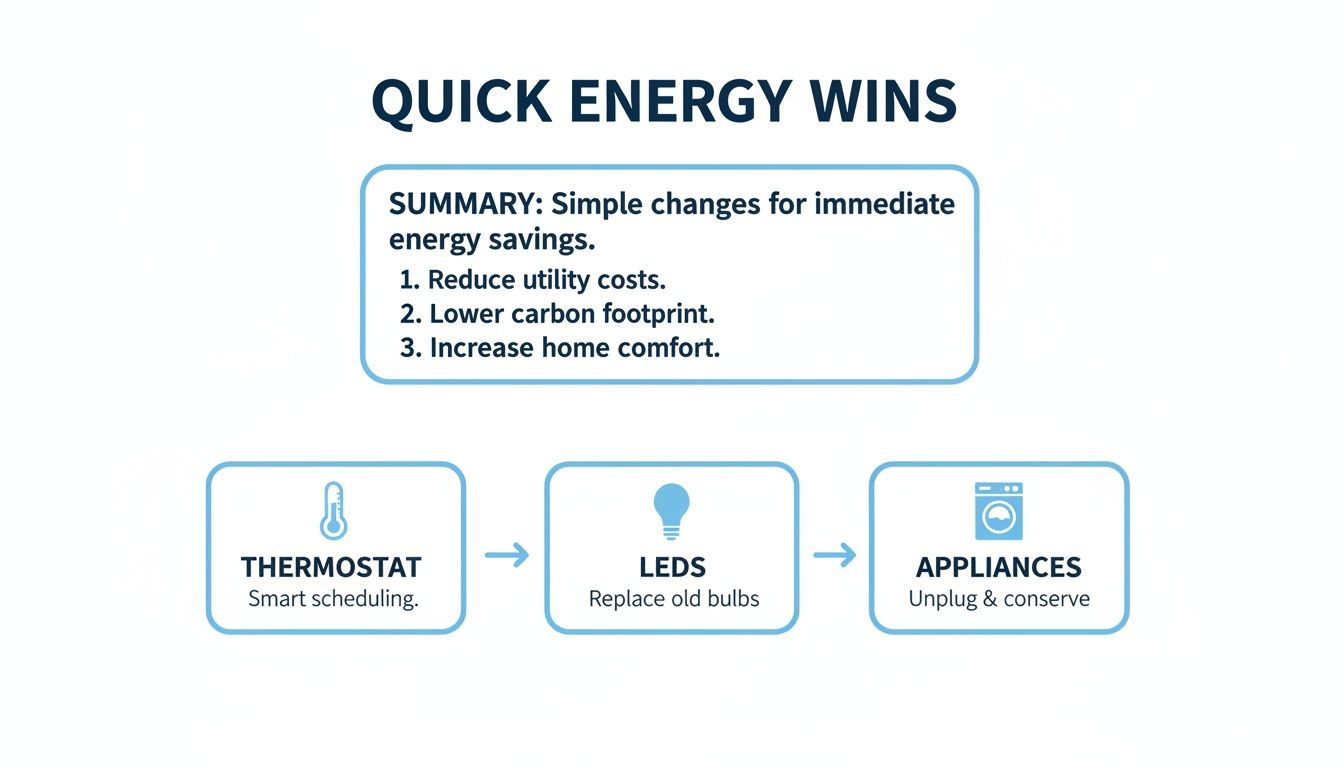
As you can see, a little focus on your thermostat, lights, and appliances is the fastest route to savings you'll actually notice.
To make it even easier, I've put together this quick cheat sheet. It breaks down the most effective, immediate actions you can take.
Quick Wins Energy Savings Cheat Sheet
Action Item | Estimated Cost | Potential Annual Savings | Effort Level |
|---|---|---|---|
Adjust Thermostat (3-5°) | $0 | $80 - $180 | Low |
Switch to LED Bulbs | $25 - $75 | $100 - $225 | Low |
Install a Smart Thermostat | $100 - $250 | $145 | Low-Medium |
Use Cold Water for Laundry | $0 | $60 - $150 | Low |
Unplug "Vampire" Electronics | $0 | $50 - $100 | Low |
Install Faucet Aerators | $10 - $20 | $25 - $50 | Low |
These small steps are proof that you don't need a huge budget to see a meaningful drop in your monthly bills. It's all about making smarter, more intentional choices.
Building Efficiency from the Ground Up
While these tips are great for any homeowner, just imagine the advantage of building these efficiencies into a new home from the very beginning.
I specialize in building exceptionally energy-efficient homes in Maryland communities like White Marsh and Edgewood. Our new constructions in Baltimore County and Harford County are designed to save you money from the day you move in because we build homes that often beat minimum code, resulting in more energy efficient homes than most builders build in Maryland.
We include high-performance windows, superior insulation, LED lighting, smart thermostats and energy-efficient systems standard in every home we build, you lock in decades of lower utility bills. It's about being proactive, not reactive.
Using my unique proprietary visualization tools, you can see exactly how your choices in flooring, countertops, and even smart home tech will look and function. Let's work together to build a home that's not just beautiful, but also incredibly smart and affordable to live in.
For more ideas, you might be interested in our guide on 10 essential home energy efficiency tips for 2025.
Unlocking Big Savings with Insulation and Air Sealing
Ready to move beyond the quick fixes and really tackle one of the biggest energy hogs in your home? Let's talk about the unsung hero of home efficiency: insulation. A poorly insulated house is a lot like wearing a jacket full of holes in a snowstorm—your furnace is working overtime just to keep you from shivering.
That constant battle means you're literally paying to heat or cool the outdoors as conditioned air escapes right through your walls and attic. A smart investment in better insulation and air sealing is one of the most effective ways to slash your utility bills for good.
Why Your Home's "Thermal Envelope" Matters
Think of your home's exterior—the walls, roof, foundation, and windows—as its thermal envelope. When this envelope is weak, riddled with thin insulation or tiny gaps, energy just pours out. But when it's strong and airtight, it holds onto that comfortable air, dramatically cutting the workload for your HVAC system.
The numbers don't lie. Global energy trend data shows that proper insulation can cut heating and cooling costs by up to 30%, since so much energy is lost through the walls and roof. Just imagine swapping out old, tired insulation for modern spray foam. For a practical example, on a typical 2,000 sq ft home, that simple upgrade could translate into $500 to $1,000 back in your pocket every single year. You can dig deeper into future energy system developments in this outlook from TotalEnergies.
Understanding the Power of R-Value
You’ve probably heard the term R-value thrown around when people talk about insulation. It's really just a simple score that measures how well the material resists heat flow. The higher the R-value, the better it insulates. It's that easy.
Different materials have different R-values, and the amount you need really depends on your local climate. Here in Maryland, having the right R-value in your attic and walls is crucial for staying comfortable during our humid summers and surprisingly chilly winters. To get a better handle on this, check out our guide on what R-value is and why it actually matters.
The Hunt for Sneaky Air Leaks
Here's the thing: insulation is only half the battle. Tiny air leaks can make even the best insulation perform poorly. These are the little cracks and gaps where air—and your money—slips right out.
You'll almost always find them in the same old places:
Around window and door frames
Where pipes and wiring come through the walls
Behind electrical outlets on exterior walls
Around recessed can lights in the ceiling
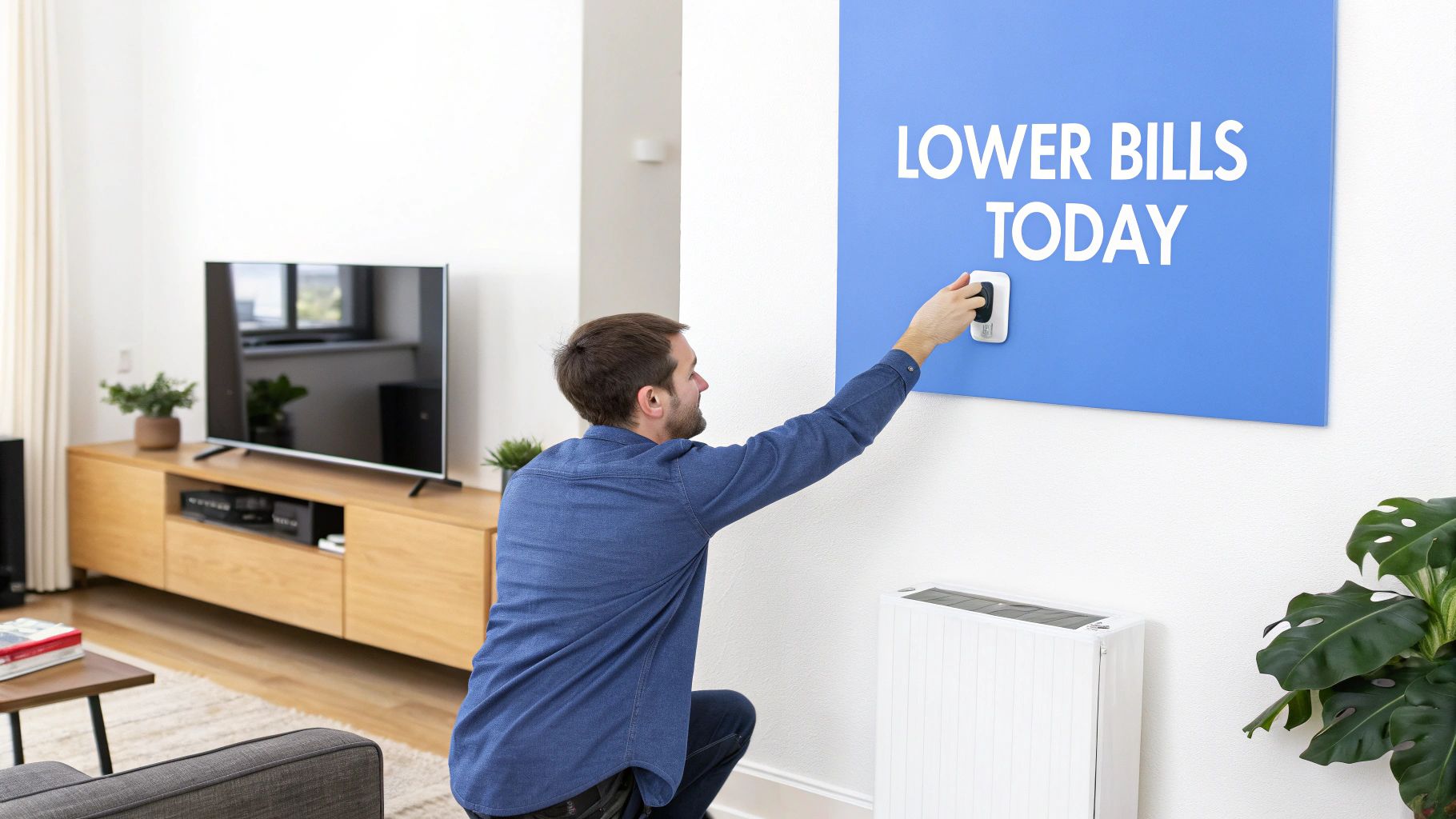
Sealing these up with some caulk, weatherstripping, or spray foam is a fantastic, low-cost DIY project. A simple trick I love is the "smoke test." On a breezy day, light an incense stick and hold it near these common weak spots. If you see the smoke get pulled or pushed, you've found a leak.
A home's energy efficiency is a complete system. Top-notch insulation, a tightly sealed envelope, and high-performance windows all have to work together. If one part is weak, the whole system suffers.
Building Efficiency in From the Start
Now, for anyone thinking about building a new home in places like White Marsh, Edgewood, or anywhere in Baltimore County, this is where you have a massive advantage. Instead of dealing with the headaches of retrofitting an old, leaky house, you get to build efficiency in from day one.
I take a lot of pride in building homes that don't just meet, but often exceed, the minimum energy code requirements. We do this by using superior insulation products from the get-go and focusing like a hawk on creating an airtight building envelope. This commitment means lower utility bills and a more comfortable home for my clients from the moment they get their keys.
With my hands-on service, you can do more than just pick out your flooring and cabinets. You can see and understand the long-term value of the high-performance materials we're putting behind your walls. If you’re looking to build a home in Harford County that’s as smart and efficient as it is beautiful, let's talk.
Putting Smart Home Technology to Work
When most people think about cutting utility bills, they picture themselves turning off lights and fiddling with the thermostat. But what if your home could do most of that for you? That's where smart home tech comes in—it’s not just about flashy gadgets; it’s about automating your savings so you barely have to think about it.
Let's move past the famous smart thermostat and look at the whole team of devices that can work together to bring those energy costs down.
For example, imagine it’s a blistering summer afternoon. Without you lifting a finger, your blinds automatically close to block the sun, taking a huge load off your air conditioner. Later that night, all your electronics—the TV, the game console, the chargers—completely power down instead of sipping electricity while you sleep. This isn't science fiction. It's a smart, practical way to save money, and it's available right now.
Beyond the Smart Thermostat
The smart thermostat gets all the glory, and for good reason. It can learn your routine and knock 10-15% off your heating and cooling costs. But honestly, it's just the tip of the iceberg. To really make a dent in your bills, you need a few more players on your team.
Here are a few of my favorite, often-overlooked devices for a truly energy-efficient smart home:
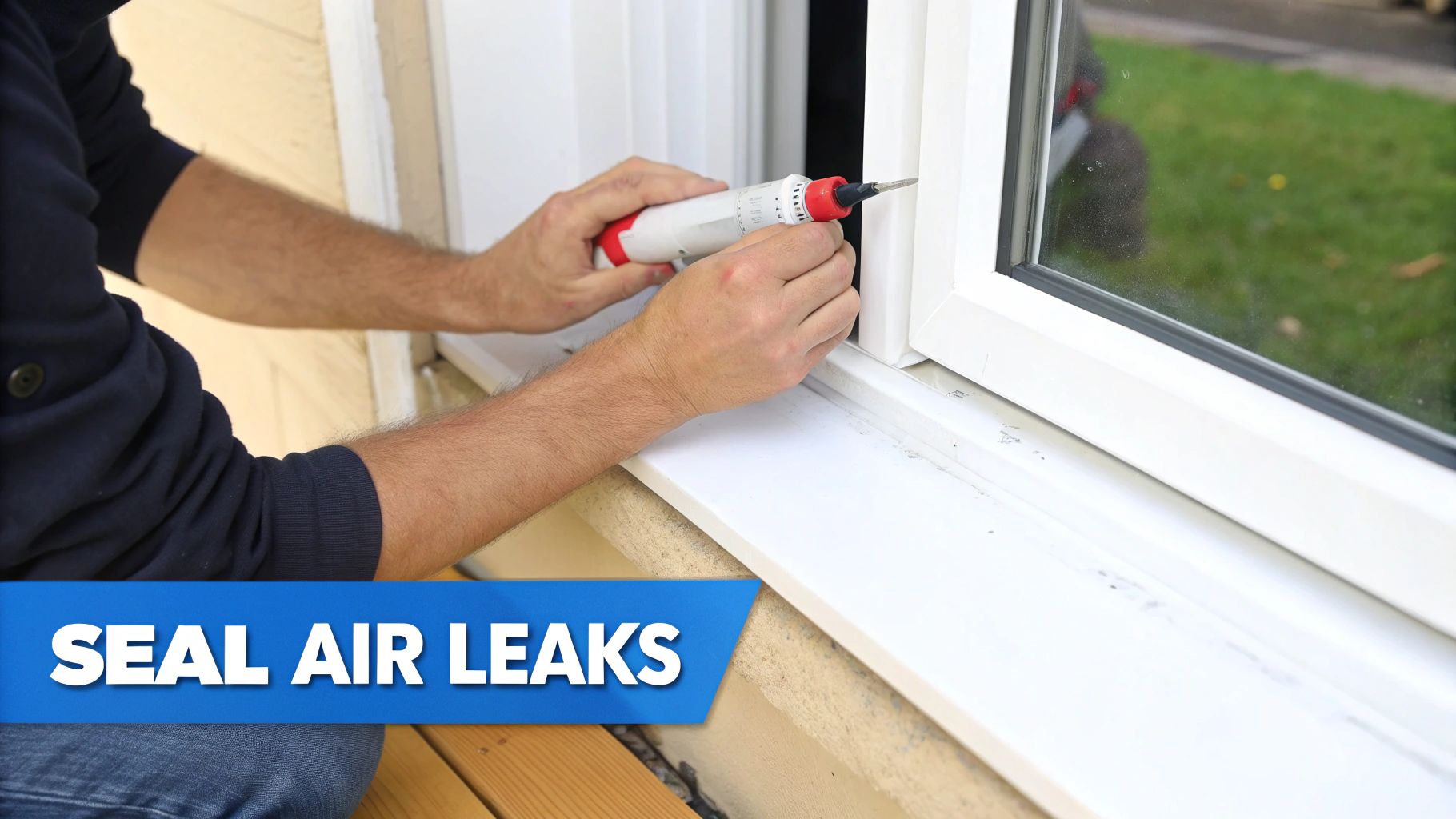
Smart Plugs: These little gadgets are your best defense against "vampire power"—that sneaky electricity drain from devices that are turned off but still plugged in. I tell my clients to put them on their entertainment centers or home office setups. Schedule them to shut off completely overnight, and you'll stop paying for power you're not even using.
Automated Blinds and Curtains: We all love natural light, but the solar heat that comes with it can make your AC work overtime. Programming your blinds to close on sun-drenched windows during the hottest part of the day is a brilliantly simple way to keep your home cooler without touching the thermostat.
Smart Lighting Systems: This is way more than just swapping in LED bulbs. With smart switches and bulbs, you can set schedules, dim lights from your phone, and use motion sensors so you’re never lighting an empty room. You’ll wonder how you ever lived without them, especially when you realize you accidentally left the basement light on again.
Creating a Smart Home Ecosystem
The real power move is getting all these devices to talk to each other. When they work in concert, the savings add up fast. For example, you can set up a "goodbye" routine so that when you leave, a single command turns off every light, sets the thermostat to an eco-friendly temperature, and kills power to non-essential electronics. It's pure efficiency.
This kind of integration is a game-changer, especially when you plan for it from the ground up in a new home. For anyone looking to build in Edgewood or Harford County, we can weave this connectivity right into the fabric of your house.
I always tell my clients: planning a smart home network during construction is infinitely better than trying to bolt it on later. You get a seamless system that works perfectly for maximum savings from the day you move in. The good news is, our homeowners don't have to worry about this, we include CAT6 home runs installed in an IT Panel and a WIFI mesh network pre-wire in every home we build
As a builder in communities all over Baltimore County and Maryland, my specialty is creating homes that aren't just stunning, but also incredibly efficient. We build homes that often beat minimum code, resulting in more energy efficient homes than most builders build in Maryland. If you want to dive deeper into what's possible, check out our practical guide to the best smart devices for your home.
With my hands-on approach and unique visualization tools, I can help you map out the perfect smart home setup. We’ll think beyond flooring and countertops to design a home that actively works to lower your bills, making it a brilliant investment for your future.
Choosing Energy-Efficient Appliances and Systems
Your home’s appliances, furnace, and water heater are the unsung heroes working around the clock. They're also the biggest culprits behind high utility bills. When it’s time to upgrade or you're picking them out for a new build, making smart choices here isn't just about features—it's a massive opportunity for long-term savings.
Think about it this way: that cheaper, less efficient refrigerator might look like a deal on the showroom floor, but it could easily cost you hundreds more in electricity over its lifetime. The smarter investment is the one that pays you back, month after month.
The ENERGY STAR Label is Your Shortcut
When you’re appliance shopping, that little blue ENERGY STAR label is your best friend. It’s not just a marketing sticker; it’s a certification from the U.S. Environmental Protection Agency guaranteeing that the product meets strict efficiency standards.
For a practical example, an ENERGY STAR certified refrigerator is about 9% more energy-efficient than a standard model. A certified clothes washer? It uses around 25% less energy and a whopping 33% less water. Those savings really add up.
Upgrading the Big Three in Your Kitchen
Your refrigerator, dishwasher, and washing machine are often the first places I tell people to look for some serious efficiency gains. Our homeowners don't need to upgrade, our standard appliances are already energy start certified!
Refrigerators: Modern fridges are lightyears ahead of older models. Just be sure to get the right size for your family—an oversized one just wastes energy keeping empty space cold. Pro tip: top-freezer models are usually more efficient than side-by-side units.
Dishwashers: Today's dishwashers use surprisingly little water. Look for one with a soil sensor that adjusts the cycle based on how dirty the dishes are. And here’s an easy win: use the air-dry setting. It can cut the dishwasher's energy use by 15-50%.
Washing Machines: Front-loaders are the clear winners here. They use way less water and their high-speed spin cycle wrings out more moisture. This means less work for your dryer, giving you a double whammy of savings.
And don’t forget the supporting players. Installing modern energy efficient ceiling fans helps circulate air, making your heating and cooling system work smarter, not harder.
Appliance Upgrade ROI Comparison
It helps to see the numbers side-by-side. Paying a bit more upfront for a high-efficiency model almost always pays for itself, often much faster than you'd think. Here’s a quick breakdown of what you can expect.
Appliance | Upfront Cost Increase (Est.) | Annual Savings (Est.) | Payback Period |
|---|---|---|---|
Refrigerator | $100 - $200 | $20 - $50 | 4 - 5 years |
Dishwasher | $50 - $150 | $15 - $35 | 3 - 5 years |
Washing Machine | $100 - $300 | $30 - $60 | 3 - 6 years |
Water Heater | $300 - $1,000+ | $100 - $300 | 3 - 7 years |
As you can see, the initial cost difference is quickly recovered through lower monthly bills, making it a sound financial decision for any homeowner.
Your HVAC and Water Heater: The Heavy Hitters
While appliances make a difference, your heating, ventilation, and air conditioning (HVAC) system is almost always your single biggest energy hog. Right behind it is the cost of heating your water.
A modern, high-efficiency furnace or heat pump is worlds apart from a system that's just 10-15 years old. The same is true for water heaters. A tankless water heater, for example, only heats water when you need it instead of keeping a huge tank hot 24/7. This simple change can slash your water heating costs by 24%–34% compared to an old storage-tank model.
Making an informed choice about your HVAC and water heater is one of the highest-impact decisions you can make for your home's long-term affordability. The technology has improved so much that the savings can be truly substantial.
If you want to dive deeper into this, our guide on how to choose the right water heater is a great place to start.
The New Construction Advantage
This is where building a new home gives you an incredible leg up. You aren’t stuck with someone else’s old, clunky, and inefficient systems. You get to call the shots from day one.
When I work with clients building new homes in communities like White Marsh, Edgewood, and across Baltimore County, this is a conversation we have right at the beginning. I'm proud to say our homes are built to exceed minimum code requirements, resulting in more efficient homes than you'll find from most builders in Maryland. We can select the perfect high-efficiency HVAC unit for your floor plan and a modern water heater that actually fits your family’s lifestyle.
Using my proprietary visualization tools, we go beyond picking out flooring and cabinets. I show you the real numbers—the upfront costs versus the projected long-term savings—so you can see the financial impact of your choices. It's about making a smart investment that will save you thousands over the life of your home. It's about building a better, more affordable home, right from the foundation up.
Taking the Leap: Power Your Home with Solar
When you're ready to make the biggest possible dent in your utility bills, it's time to look up—to the sun. Installing solar panels isn't some futuristic fantasy anymore; it's a practical and powerful way to grab the reins on your energy costs. For many homeowners, it's the most direct route to practically wiping out their electricity bill.
This isn't just about going green, though that's a great bonus. It's a serious financial decision. The technology has gotten so much better and the prices have dropped dramatically, putting solar panels within reach for families all over Maryland.
So, How Does Solar Actually Lower Your Bill?
The idea is pretty straightforward. Those photovoltaic (PV) panels on your roof catch sunlight and turn it into electricity for your house. Simple as that.
But here's the cool part: when your system makes more power than you're actually using, that extra juice gets sent back to the grid. Your utility company often credits your account for that power through a process called net metering.
Think about it—on bright, sunny days, you could literally be running your meter backward, racking up credits. Then, at night or on cloudy days, you just pull power from the grid like normal. Over the course of a year, a well-designed system can cover a massive chunk of your home's total electricity use.
Planning for solar from the very beginning of a new home's design is an absolute game-changer. You can get the roof's angle and orientation just right for peak sun, and we can pre-wire everything. It saves a ton of money and headaches compared to retrofitting later.
The Numbers: Making Solar Make Sense
Okay, the upfront cost is a real thing. But don't let that scare you off. A mix of tax credits and the sheer long-term savings make it a fantastic investment. Federal and state programs can knock a big slice off that initial price, which means your system pays for itself much faster.
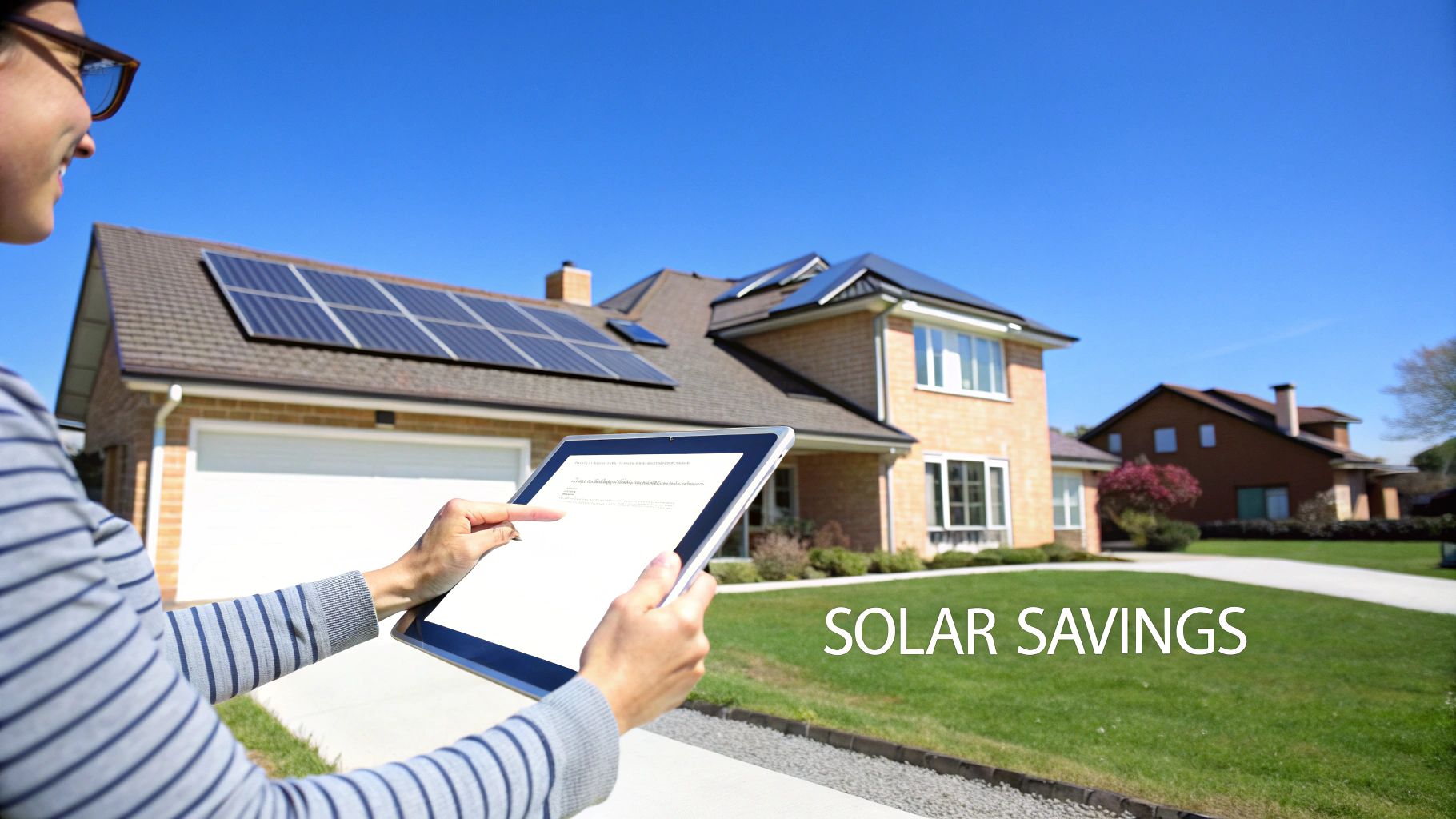
Installing solar is a proven way to pump up your home's value while crushing your utility bills. Projections even show solar and wind could be major players in our energy mix by 2050. For a standard Maryland home, a 5kW system can cover 70-100% of your electricity needs. That translates to real savings, often between $1,000 to $2,000 a year. With the current incentives, most systems pay for themselves in just 5 to 7 years. You can dig deeper into these global energy outlooks and their local impact.
Building a Solar-Ready Home in Maryland
This is exactly where building a new home gives you a massive advantage. Instead of trying to make solar work on an existing roof, we can design your home to be perfectly solar-ready from the get-go. This kind of forward-thinking is a huge part of how I build homes in places like White Marsh, Edgewood, and all over Baltimore County and Harford County.
I take a lot of pride in the fact that our homes often exceed the minimum code requirements. That means you get a more energy-efficient home than what many other builders in Maryland are offering. By baking solar-readiness right into the blueprints, we're future-proofing your home for decades of low-cost energy.
Using my visualization tools, I can actually show you what this looks like. We can model the roofline, figure out the best spot for panels, and plan the wiring. Building a home is about more than just countertops and paint colors; it’s about making smart choices that will pay you back, year after year. Let’s build a home that works for you.
Bringing Your Energy-Efficient Home to Life
A truly great home is more than just beautiful—it's comfortable, functional, and doesn't break the bank to live in. We've gone over a ton of ways to cut down utility bills, but let's be honest: designing your own home is the ultimate chance to build energy savings right into the studs and foundation.
While these tips are great for any homeowner, starting from scratch lets you lock in decades of efficiency from the moment you get the keys.
It’s all about creating a powerful, money-saving system from the ground up. Think superior insulation, high-performance windows, efficient appliances, and smart home tech all working together seamlessly. This isn’t about just scraping by to meet the minimum building code; it's about blowing past it. We take a lot of pride in building homes in Maryland that are far more energy-efficient than what you'll typically find, which means lower bills and a more comfortable home for you.
Your Vision, Your Savings
Imagine picking out every single detail of your home, not just for how it looks, but for how it performs. My unique proprietary visualization tools actually let you see exactly how those choices come together. You can play around with different options—from the flooring and countertops to the smart tech that runs the place—and immediately see the long-term impact on your wallet.
Building a new home is your chance to stop reacting to high utility bills and start proactively preventing them. It's the smartest investment you can make for your future.
Whether you're looking to build in White Marsh, Edgewood, or anywhere across Baltimore County or Harford County, my hands-on service is here to guide you through it all. Together, we'll design a space that perfectly fits your style and actively works to keep your living costs low.
Ready to stop stressing about unpredictable utility bills and start designing a home that puts money back in your pocket? Let's connect and explore how we can make your dream home in Maryland a smart, efficient, and beautiful reality.
Your Top Questions About Cutting Utility Bills, Answered
Over the years, I've heard just about every question there is when it comes to home energy savings. Here are the answers to the ones that pop up most often from folks looking to make a real dent in their monthly bills.
What’s the Single Best Thing I Can Do to Lower My Utility Bill?
This is the big one, and the answer almost always comes back to your home's "thermal envelope." Think of it as the shell of your house. By beefing up your insulation and sealing all those little air leaks around windows, doors, and pipes, you make a huge difference.
Your HVAC system is the undisputed king of energy consumption in your home. Anything you can do to make its job easier will pay off in a big way.
If you’re building a new home, this is where you can get a massive head start. Starting with superior insulation from day one is the most powerful long-term play. It's exactly why we build homes that go above and beyond the minimum code requirements, creating some of the most energy-efficient homes you'll find in Maryland.
How Much Can I Really Save with Smart Home Gadgets?
You can actually save a surprising amount. Just by swapping in a smart thermostat and letting it do its thing, most homeowners see their heating and cooling costs drop by 10-20%. It just makes sense—it learns your routine and adjusts automatically.
Then, when you start adding other smart devices, the savings multiply.
Smart plugs can kill that "vampire load" from electronics that are off but still drawing power.
Automated blinds can be programmed to close during the hottest part of a summer day, blocking out solar heat.
Combine these, and you could easily see your total energy savings climb into the 25-30% range. The trick is to set them up to automate all the little things you'd normally forget to do.
Should I Get Solar Panels or Make My Home More Efficient First?
Efficiency first, every time. It's a common question, but think about it this way: the less energy your home needs to run in the first place, the smaller and cheaper your solar panel system will need to be.
By tightening up your home's envelope with better insulation, air sealing, and high-efficiency appliances, you shrink your energy footprint.
The mantra in the industry is "reduce before you produce." It's hands-down the smartest and most cost-effective approach to long-term energy independence.
Do Energy-Efficient Homes Actually Sell for More?
They absolutely do. Study after study has shown that homes with proven energy-efficient features and green certifications don't just sell for more money, they often sell faster, too.
Buyers today, especially in places like Baltimore County and Harford County, are savvier than ever about the total cost of owning a home. Low, predictable utility bills are a massive selling point that they're willing to pay a premium for.
For a deeper dive into even more practical strategies, this is an excellent resource: How to Lower Utility Bills: A Practical Guide to Big Savings.
Ready to stop dreading that monthly utility bill and start designing a home that's built for comfort and savings? I offer my clients unique proprietary visualization tools and hands-on service to help you bring your dream space to life. We let buyers customize their homes by picking their flooring, countertops, cabinets, tile, and more, all while building a highly efficient home right here in Maryland. Let's build a smarter future together.
Comments