

What Is a Homeowners Association A Guide for Maryland Homebuyers

So, you’re looking at a beautiful new home, and the real estate agent mentions something called an “HOA.” What in the world is that? And more importantly, what does it mean for you?
A homeowners association, or HOA, is basically the governing body for a planned community or subdivision. Its main job is to create and enforce rules that keep the neighborhood looking sharp and protect everyone's property values. Think of it as a friendly agreement between neighbors to ensure the community looks just as great years from now as it did the day you moved in.
What's an HOA All About?
Let's use a friendly analogy. Imagine your neighborhood is like a community co-op garden. Everyone gets to enjoy the beautiful flowers and fresh veggies, but there's a catch: everyone has to pitch in. That might mean pulling weeds, taking a turn watering, or chipping in a few bucks for seeds. An HOA runs on that same idea—it’s a formal group that keeps the whole neighborhood running smoothly for the benefit of everyone who lives there.
This is exactly why you see HOAs in so many new construction communities, from White Marsh to Edgewood here in Maryland. They make sure shared spaces like parks, playgrounds, and the fancy entrance sign are always beautifully maintained. It creates a consistent, attractive vibe that helps protect your investment in the long run. If you're just starting your home-buying journey, getting a handle on this is a big deal. For more on the basics, check out our guide on how to buy your first home in Maryland.
Just How Common Are HOAs?
This isn't some niche concept. HOAs are a huge and growing part of the American housing scene. In fact, the market size for homeowners associations in the US was recently valued at a whopping $39.9 billion.
These organizations, along with their cousins—condominiums and co-ops—are home to over 77 million Americans. That’s about 33% of all housing in the entire country! This shows just how mainstream this model has become.
What's the End Goal?
At the end of the day, an HOA's main goal is pretty simple: protect and hopefully improve the property values of every home in the community.
How do they do it? Mostly in two ways:
Maintaining Common Areas: This covers everything from mowing the grass in shared parks and plowing snow off community sidewalks to keeping the neighborhood pool sparkling clean or the clubhouse in good shape.
Enforcing Community Standards: The HOA sets up rules, officially called CC&Rs (Covenants, Conditions & Restrictions), that every homeowner agrees to live by. These rules might dictate things like what color you can paint your front door, the style of fence you can install, or how you maintain your lawn—all to keep the neighborhood looking cohesive and appealing.
To make this a bit clearer, let's break down the moving parts.
HOA at a Glance: What It Is and What It Does
This table breaks down the core components of an HOA into easily understandable parts.
Component | Simple Explanation | Practical Example in Your Community |
|---|---|---|
The HOA Itself | The organization that manages the community. | The "Maple Creek Estates Homeowners Association." |
The Board | A group of elected volunteers (your neighbors!) who make decisions. | The board votes on hiring a new landscaping company for the common areas. |
CC&Rs | The official rulebook for the neighborhood. | A rule stating that all sheds must be placed in the backyard and match the home's color. |
Bylaws | The rules for how the HOA itself operates (e.g., how to run elections). | The bylaws state that board elections are held every June at the annual community meeting. |
HOA Fees | The money homeowners pay to fund the HOA's work. | Your $75 monthly fee pays for pool maintenance and snow removal from community sidewalks. |
Basically, the HOA is the engine that keeps the community running, and the fees are the fuel. The board steers, and the CC&Rs and bylaws are the map they follow.
How Your Community Is Actually Governed
So, who's actually in charge of the homeowners association, and how do they make the rules? It’s not some shadowy, faceless corporation pulling the strings. The truth is, the structure is surprisingly straightforward and built around the community itself.
Let's pull back the curtain on how your neighborhood is really run.
At the core of every HOA are two foundational documents. Think of them as the constitution and the instruction manual for your entire community.
The Big Rules vs. The Operating Manual
First up, you have the Covenants, Conditions & Restrictions, or CC&Rs. These are the big-picture rules everyone agrees to follow when they buy a home in the neighborhood. They’re all about maintaining a cohesive look and feel for the community, which is key to protecting everyone's property values.
Here’s a practical example: A CC&R might dictate that trash cans must be stored out of sight from the street, except on collection day. This simple rule keeps the entire neighborhood looking tidy and clean.
Then you have the Bylaws. While the CC&Rs focus on the properties, the bylaws are the operating manual for the HOA as an organization. They spell out exactly how the business of the HOA gets done—things like how board members are elected, how official meetings are run, and the specific duties of each board position.
This diagram shows how these components fit together.
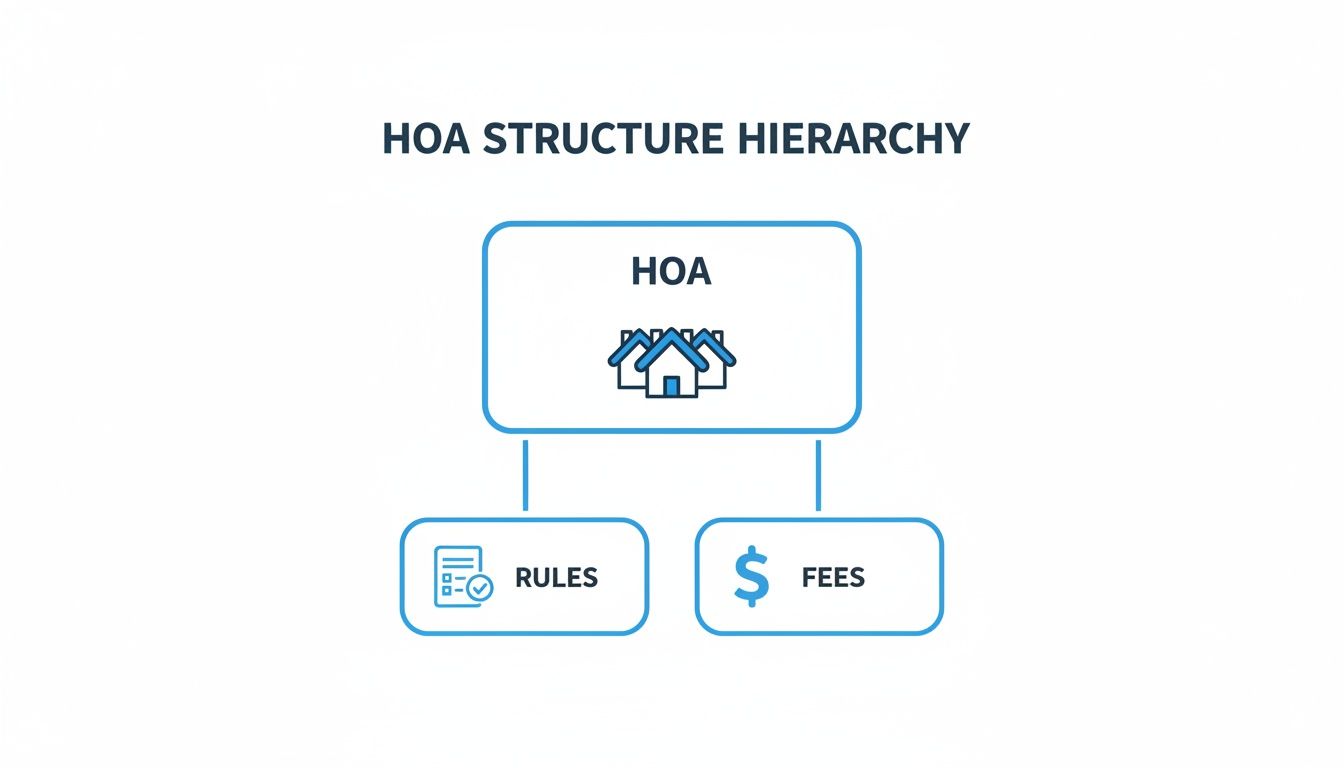
As you can see, the whole system is set up to manage the community's standards and its money.
Meet the HOA Board of Directors
The people making sure these rules are followed and handling the day-to-day operations? They're your neighbors.
The HOA Board of Directors is a small group of homeowners who volunteer their time and are elected by the rest of the community. They’re tasked with making the important decisions for everyone living there.
Their job is a big one, and it includes:
Managing the Money: The board is in charge of collecting HOA fees and creating a budget for how that money gets spent on things like landscaping, pool maintenance, and other shared services.
Overseeing Maintenance: They're the ones who hire and manage contractors for jobs like snow removal in White Marsh or lawn care for the common areas in Baltimore County.
Enforcing the Rules: It's their responsibility to make sure everyone is playing by the rules laid out in the CC&Rs and to handle any violations.
It's also worth noting that the way HOAs are run is getting a modern upgrade. The global HOA software market was recently valued at $2 billion, and it's on the rise. This shows a huge shift toward using digital tools to handle everything from collecting dues to communicating with residents. Securing the community is also a huge part of the board's job, and there are many different HOA security solutions they might consider to keep residents safe.
Making Sense of HOA Fees and What They Cover
Alright, let's talk about the money side of things—those monthly or annual dues that are part of living in an HOA community. It's a fair question to ask: "Where is all that cash actually going?"
The best way to think of your HOA fee is like a subscription for a well-kept, smoothly running neighborhood.
This isn't some random charge the board dreams up. It's the financial engine that keeps your community’s quality of life high and, just as importantly, helps protect your property value.
What Your Dues Typically Pay For
Most of your HOA fees cover the day-to-day operational costs—all the behind-the-scenes work that keeps your neighborhood looking great. For folks in Baltimore County or Harford County, this often includes services that are a lifesaver during our wild Maryland seasons.
Here’s a quick rundown of what’s usually funded by your dues:
Common Area Maintenance: Think landscaping for parks, mowing the grass along walking trails, and keeping the community entrance looking sharp.
Amenity Upkeep: If your neighborhood boasts a pool, playground, clubhouse, or gym, your fees pay for the cleaning, insurance, and repairs needed to keep them in good shape.
Essential Services: Many HOAs handle contracts for things like trash and recycling pickup. They also manage snow removal for community roads and sidewalks—a massive perk when a winter storm hits.
These fees are a real part of your homeownership costs, so you'll want to bake them into your monthly budget. If you're mapping out your finances, it's smart to get the full picture; you can see a complete breakdown in our guide to closing costs on a new home.
Planning for the Future: Reserve Funds and Special Assessments
A smart HOA isn't just focused on today; it's always planning for the future. That’s why a slice of your dues goes into what’s called a reserve fund.
Basically, it's the community's savings account for the big-ticket items that will eventually wear out. We're talking about things like repaving roads, replacing the clubhouse roof, or upgrading the playground equipment down the line.
Every once in a while, a huge, unexpected expense might pop up that the reserve fund can't cover—say, major storm damage to a community fence. In these rare situations, the HOA might issue a special assessment, which is a one-time fee every homeowner pays to cover that specific emergency cost.
HOA fees are pretty standard for millions of homeowners. In the U.S., about 21.6 million households pay them, which is roughly 25% of all owner-occupied homes. The cost can swing wildly from under $50 a month to over $500, all depending on the neighborhood's location and what amenities are included.
Weighing Your Options: The Real Pros and Cons of HOA Living
So, is an HOA right for you? It really boils down to your personality, your lifestyle, and what you’re looking for in a neighborhood. There’s no single right answer—it’s a trade-off, and there are definitely two sides to the coin.
Let’s get real about what it’s like to live in an HOA community, whether you're looking at a new home in White Marsh or a townhome in Edgewood.
The Upsides: What You Gain with an HOA
For a lot of folks, the benefits are a huge draw. Think about coming home to a neighborhood where the common areas are always pristine, the landscaping is immaculate, and you didn't have to do any of the work yourself.
One of the biggest selling points is the predictable neighborhood aesthetic. Those rules are there to make sure everything from home exteriors to shared green spaces is kept to a certain standard. This isn't just about looking good; it's about protecting your investment. In fact, studies have shown that homes in well-managed HOAs can be worth 5-6% more than similar homes just outside the community.
You also get access to some pretty sweet perks you probably wouldn't have otherwise.
Awesome Amenities: We’re talking about community pools, modern fitness centers, walking trails, and playgrounds for the kids. Building and maintaining these on your own would cost a fortune.
Less Work for You: The HOA often handles things like trash collection and snow removal from community roads. That’s a huge relief, especially when a classic Maryland winter storm hits.
A Built-in Mediator: Got a neighbor who decided to park their RV on the front lawn? Instead of having that awkward conversation yourself, the HOA board steps in to enforce the rules. It keeps the peace and saves you the headache.
The Downsides: What You Give Up
Of course, all those perks come at a price—both literally and figuratively. The most obvious drawback is the monthly HOA fee. It’s another bill you have to factor into your budget, on top of your mortgage, taxes, and insurance.
And those rules that keep everything looking so tidy? They can sometimes feel a bit… restrictive. You might find yourself limited on the color you can paint your front door, whether you can build a shed, or even what kind of flowers you can plant out front. For homeowners who value creative freedom, this can be a tough pill to swallow.
It's also worth remembering that the board is made up of your neighbors. While that's great in theory, it can sometimes lead to disagreements over rule changes or how things are enforced, creating a little tension in the community.
There's a lot to think about here. To make it a bit easier, let's break it down side-by-side.
Weighing Your Options: HOA Living Pros vs. Cons
This table gives you a quick snapshot to help you decide if the trade-offs of an HOA line up with what you want in a home.
Advantages of an HOA | Potential Disadvantages of an HOA |
|---|---|
Maintained Property Values: Rules protect your investment. | Monthly Fees: An added, ongoing expense. |
Access to Amenities: Pools, gyms, and parks. | Rules & Restrictions: Less personal freedom for exterior projects. |
Reduced Maintenance: Less yard work and snow shoveling. | Potential for Disputes: Disagreements with neighbors or the board. |
Consistent Look & Feel: A clean, uniform aesthetic. | Risk of Mismanagement: A poorly run board can cause major problems. |
Community Engagement: Often includes social events. | Special Assessments: Unexpected fees for large community repairs. |
Dispute Resolution: The board handles neighbor issues. | Approval Process: Getting approval for exterior changes can be slow. |
Ultimately, choosing an HOA community is about finding the right balance for you. The structure can provide amazing stability and amenities, but it means giving up a slice of your autonomy. By weighing these points carefully, you can figure out if the HOA life is your kind of life.
Personalizing Your Home Within HOA Guidelines
One of the biggest hang-ups for homebuyers looking at an HOA community is the fear of losing their creative freedom. It's a totally fair question: are you just signing up for a cookie-cutter life? The good news is, you have a lot more control than you might think to create a home that feels like you.
The reality is, an HOA’s reach usually stops right at your front door. Think of it like this: their job is to protect the neighborhood's overall curb appeal, but what happens inside your four walls is your domain. That's where you get to let your personality run wild.

Your Interior, Your Rules
When you buy a new home, the interior design choices are all yours. This is where the fun really begins! You get to handpick every finish that reflects your style and how you want to live, transforming a blueprint into a home. The HOA has zero say in any of it.
Here are just a few of the things you'll have complete control over:
Flooring: Go for durable wood laminate and LVP, cozy carpeting, or modern tile—it's up to you.
Countertops: Find that perfect slab of quartz or granite to bring your kitchen dreams to life.
Cabinets: Pick the style, color, and hardware that fits your personal taste.
Tile: Design a show-stopping bathroom or a unique kitchen backsplash.
I know, it can sound like a lot of decisions. That’s why my service includes proprietary visualization tools that let you see how everything looks together before it's installed. We can digitally test out different flooring or countertop options in your actual floor plan, so you can feel 100% confident in your choices. It’s all about helping you customize your home without the guesswork.
Planning for Future Exterior Updates
So, what about changes to the outside of your house later on? While it’s true that exterior projects need a thumbs-up from the HOA, the process is usually pretty clear and fair. It isn't meant to be a roadblock; it's about making sure new projects fit in with the community's overall character.
The goal of the approval process is to maintain a cohesive look that protects everyone's property values. A consistent, well-maintained exterior appearance across the neighborhood is a key benefit of what a homeowners association provides.
Typically, you’ll submit your plans for a new project—say, a deck, a fence, or a major landscaping change—to a specific group within the HOA. This is usually called the Architectural Review Committee (ARC) or Architectural Control Committee (ACC), and it's often made up of your neighbors.
They simply review your proposal against the community's design guidelines. For instance, if you want to add a screened-in porch to your White Marsh home, you’d show the ARC your design, materials, and color palette. They’ll check that it aligns with the neighborhood's standards and, once approved, you’re good to go. It’s a simple step that ensures your awesome new project also adds value to the entire community.
Bringing Your Vision to Life in a Maryland Community
An HOA does a fantastic job of keeping a neighborhood looking beautiful and consistent, but that framework shouldn't stop you from making a house feel uniquely yours. While the association is busy maintaining curb appeal, I go a step further—offering my clients unique proprietary visualization tools, hands-on service, and access to visualizers that help you bring your dream space to life on the inside.
Think of me as your guide through the entire new home journey, ensuring the final space is a perfect reflection of you and your family.
This hands-on approach means you get the best of both worlds. You'll have a home in a fantastic Harford or Baltimore County community that holds its value, and you'll step into a space that feels like it was designed just for you.
See Your Dream Space in Real-Time
One of the biggest challenges of buying a new home is trying to picture how all the finishes will come together. My proprietary visualization tools take all that guesswork out of the equation.
You can actually see your dream space take shape before the foundation is even poured. Want to see how different kitchen countertops look in your future Edgewood home? Or maybe test out a few bathroom tile options for a house in White Marsh? We can do it all right from a screen, making sure you love every single detail.
My goal is simple: combine the stability and long-term value of a great community with the personal touches that truly make a house a home. It’s all about empowering you to make confident design choices you’ll love for years.
This process is a game-changer when you're weighing your options. You can learn more about how it all works by reading our guide to new construction homes in Maryland.
If you’re ready to stop imagining and start seeing what’s possible, let’s connect and bring your future home to life.
Your Top HOA Questions, Answered
Let's be honest, HOAs can seem a little mysterious at first. Here are some of the most common questions I get from homebuyers in Maryland, with straightforward answers to help clear things up.
What Happens If I Don’t Pay My HOA Fees?
This is a big one, and the short answer is: it's best not to find out. Missing HOA payments can snowball quickly.
At first, you’ll probably just get hit with some late fees and penalties. But if you keep missing them, the HOA board can take more serious steps, like cutting off your access to the community pool or fitness center. Eventually, they can place a lien on your property.
In the most extreme cases, the association might even start foreclosure proceedings to settle the debt. It’s absolutely vital to stay on top of your dues to protect your home and your investment.
Can I Fight an HOA Rule or Fine I Disagree With?
You sure can. If you get a notice or a fine that you feel is unfair, you have the right to dispute it.
Your first move should be to grab your community’s governing documents—the CC&Rs and bylaws—and look for the formal appeals process. It’s all laid out in there.
Usually, you'll need to submit an appeal in writing or maybe even show up at a board meeting to state your case. For example, if you got a warning about your lawn during a drought when watering was restricted, you could present that information to the board. The key is to keep things professional and document every single interaction. The goal is to find a fair solution, not to start a fight.
How Do I Find Out an HOA’s Rules Before I Buy a House?
Excellent question! This is a non-negotiable part of your homework before buying.
When you make an offer on a home in an HOA, the seller must give you a "resale package." Think of this as the ultimate owner's manual for the community. It includes the CC&Rs (the official rulebook), the bylaws, the budget, and minutes from recent board meetings.
Go through these documents with a fine-tooth comb, and get your real estate agent to help. They’ll tell you everything you need to know about the rules, the HOA's financial stability, and the general atmosphere of the neighborhood. And if you're ever unsure about who to contact for community problems, these documents will point you in the right direction.
Getting a handle on the HOA is a massive part of finding the right home in a Maryland new-build community. At Customize Your Home, I take it from there, helping you make the inside of that home a perfect reflection of you. Using unique visualization tools and a totally hands-on approach, you can choose your flooring, countertops, and finishes feeling completely in control.
Ready to build a home that’s as unique as you are, in a neighborhood you’ll love? Let’s start the conversation at https://www.customizeyourhome.com.
Comments