

What Is a Punch List? Your Guide to a Perfect Home Finish

So, you’ve watched your dream home go from a patch of dirt to a nearly-finished masterpiece. The excitement is real! But before you pop the champagne and start moving in, there's one crucial final step: the punch list.
Think of the punch list as the final once-over, your last chance to make sure every little detail is just right before you officially take ownership. It's a list you create with your builder during the final walkthrough to catch any minor fixes or cosmetic touch-ups.
Your Guide to a Picture-Perfect Finish

After months of making big decisions—from the flooring you chose to the exact countertops you picked out—your home is finally standing tall. But it’s this last step, the punch list walkthrough, that truly brings it all together and ensures the finished product is flawless.
This walkthrough isn't a confrontational thing; it’s a partnership between you and your builder. You’ll walk the property together, eagle eyes ready, to spot anything that needs a final tweak. It’s not about finding major structural problems (those should have been caught long ago), but about perfecting the little things that make a house feel like your home.
To get you started, here's a quick rundown of the key concepts you need to know.
Punch List Quick Facts for New Home Buyers
Key Aspect | What It Means for You |
|---|---|
What It Is | A final to-do list for your builder, detailing minor cosmetic fixes. |
When It Happens | During the final walkthrough, just before closing on your new home. |
Who's Involved | You (the home buyer) and the builder's superintendent. |
The Goal | To ensure every detail is perfect and your home is 100% move-in ready. |
This table gives you the basics, but let's get into what these items actually look like in the real world.
So, What Actually Goes on the List?
We’re not talking about knocking down walls here. Punch list items are the small, easily fixable things that can get missed in the flurry of finishing a major construction project. They’re the final polish.
Here are a few practical examples you might spot:
A stray paint smudge on a baseboard or a scuff mark on a hallway wall.
The kitchen cabinet door you picked hangs just a little crooked or doesn't close flush.
An electrical switch plate that isn't quite level.
A tiny chip on the corner of the bathroom tile you selected.
The whole point is to create a clear, shared list of tasks for the builder to tackle. This simple document is your best friend for making sure every last detail meets your expectations and gives you total peace of mind. To get even more prepared, check out our complete guide to the final inspection.
A smooth punch list process is one of the best signs of a great builder. It shows they're committed to delivering a home that's not just built right, but finished with genuine care and pride.
Ultimately, the punch list is designed to be a positive and productive final check. It’s how you confirm that the beautiful home you've been dreaming of is exactly what you get—down to the last, perfect detail.
Why Your Punch List Is a Key Step to Homeowner Peace of Mind
Think of building your new home like commissioning a beautiful painting. The builder has handled the broad strokes—the foundation, the walls, the roof. The punch list is your chance to get up close and make sure every tiny brushstroke is perfect.
It’s that final, collaborative review that protects your huge investment and gives you that wonderful feeling of “it’s all done” before you even think about unpacking a single box. This isn’t about nitpicking or finding fault; it’s about putting the finishing touches on a masterpiece. A thorough punch list turns a great house into your home.
Your Final Check for Lasting Quality
A well-executed punch list is your best defense against those small, nagging issues that can turn into bigger headaches down the road. Catching a misaligned cabinet door, a tiny paint drip, or a drafty window seal now is so much easier than dealing with it a year from now.
It’s just simpler for the trade professionals to make these fixes while they’re still on-site or wrapping up the project. This ensures a quick and seamless resolution.
The idea isn’t new, either. The term "punch list" actually comes from the old-school practice of contractors using a paper list and physically punching a hole next to each task as it was completed. It was a simple but powerful way to track what still needed to be done before handing over the keys. You can read more about the history of the punch list to see how this classic quality-control tool has evolved.
Your punch list is the bridge between construction completion and homeowner happiness. It’s the final, satisfying step that confirms every detail, big and small, has been attended to with care.
It's More Than a List—It's an Agreement
At its core, the punch list is a documented agreement that ensures every item you've identified will be resolved. This process is a huge reason why buying a new home can be so satisfying—it’s a clear sign that your builder is committed to delivering a high-quality product and stands behind their work.
For example, let's say you picked out a specific dark bronze hardware for all your kitchen cabinets. During your walkthrough, you notice one handle is a slightly different, shinier shade. Adding this to the punch list guarantees the correct one gets ordered and installed, perfectly matching the vision you had from the start.
This process protects both you and the builder by creating a clear, actionable plan. It also works hand-in-hand with other protections, like your home warranty. For more on that, you can check out our guide on what home warranty coverage includes. A great punch list experience leads directly to peace of mind, letting you focus on the joy of settling into your new Maryland home.
How to Conduct a Successful Final Walkthrough
Alright, it's time to create your punch list. This final walkthrough is your big moment. Think of it less like a test and more like a detailed, friendly tour of your almost-finished home. As you walk through the home, standing 6 feet away from the wall, you get to point out things that need to be touched up.
This is your single best chance to catch those small things that, if left alone, can become big annoyances later. It's all about being thorough and having a simple game plan.
Gearing Up for Your Walkthrough
You don’t need to show up with a full contractor's toolkit, but having a few key items on hand will make the whole process a lot smoother and more effective. Before you head out, grab these essentials:
A Notepad and Pen: Old school, but it works. Perfect for keeping a running, organized list.
Your Smartphone: You'll want to take pictures of any issues you find. Explaining a crooked tile is a lot easier when you have a photo to back it up.
Blue Painter's Tape: When you spot something like a paint scuff, the superintendent will stick a small piece of tape next to it. It’s a huge help for the trade partners who come back to do the fixes.
This simple kit helps you document everything clearly, which in turn helps your builder get everything fixed right the first time.
This infographic really nails down why the punch list is so important—it protects your investment, guarantees quality, and ultimately gives you peace of mind.
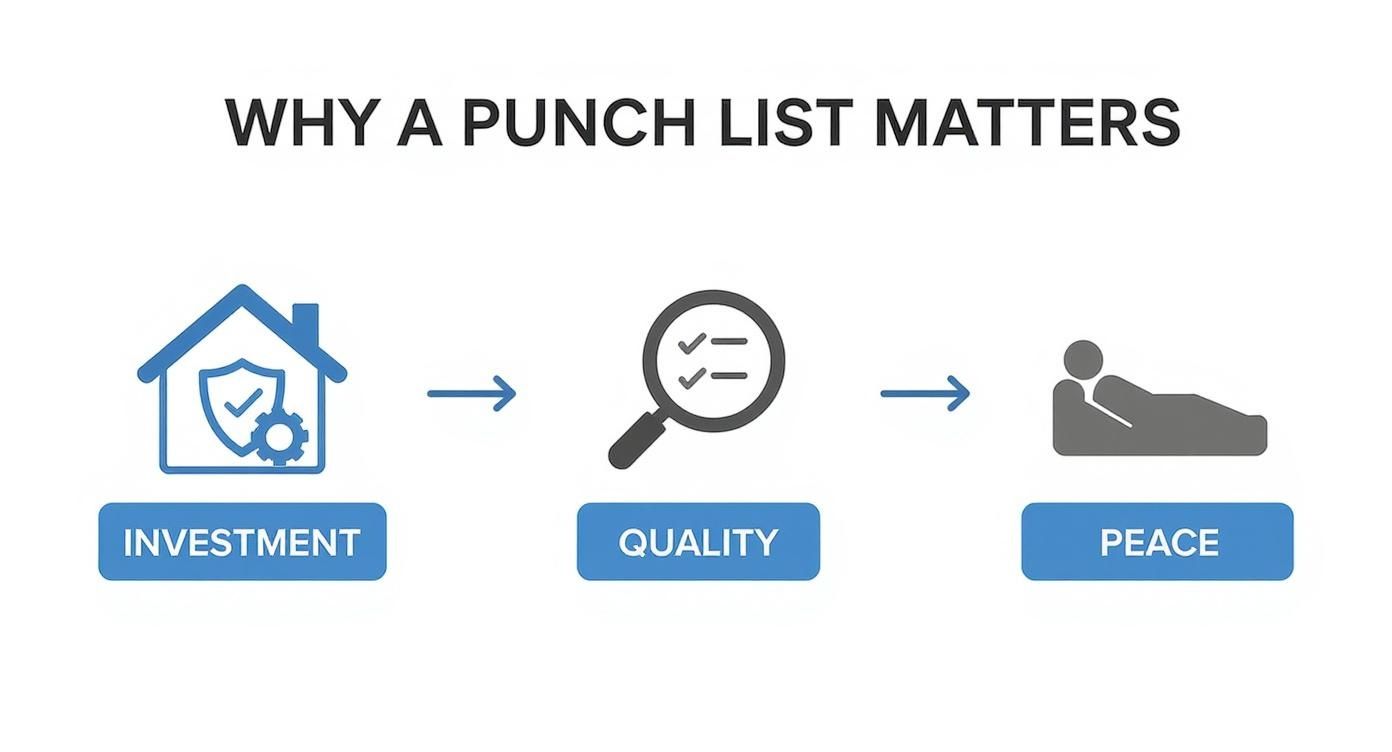
As you can see, the process is a straight line from securing your investment to truly relaxing in your brand-new home.
A Systematic Approach Room by Room
The secret to a great walkthrough is to be methodical. Don’t just wander from room to room. Instead, tackle one space at a time, moving in a consistent direction, like clockwise. This ensures you cover every square inch and don't miss a thing.
I always tell people to start at the front door and work their way through the house logically. In each room, get in the habit of scanning from top to bottom—ceiling, walls, then floor.
Pro Tip: Look at walls and surfaces from different angles, while standing 6 feet away. A paint drip or uneven texture might only show up when the light hits it just right.
Here’s a quick rundown of what to focus on in each area:
Test Everything Functional: Flip every single light switch. Turn on all the faucets to check for hot and cold water, good pressure, and any drips. Open and close all the doors and windows—do they stick or glide smoothly? Our superintendents are the best in the business. They will go over every detail with you so that you will know how everything works and you will have confidence in your new home.
Inspect Your Finishes: This is the fun part! Run your hand over those countertops you spent weeks picking out. Look at the flooring for any scuffs, scratches, or gaps between planks or tiles.
By having a plan, you can be incredibly thorough without feeling overwhelmed. If you want an even more detailed guide to take with you, check out your ultimate new custom home construction checklist. It's a fantastic resource to have in your back pocket.
A Room-by-Room Punch List Checklist
Alright, so you’re ready for the final walkthrough. The key here isn't just to hunt for problems; it’s about training your eye to see the tiny details that separate a "finished" house from a truly finished home. The best way to do this without getting overwhelmed is to take it one room at a time. A systematic approach is your best friend.
To give you a head start, I've put together a checklist of common items to look for. This isn't exhaustive—every home is unique—but it covers the usual suspects, from cosmetic flaws to functional checks.
The Heart of the Home: The Kitchen
Your kitchen is probably the most complex room in the house, packed with appliances, plumbing, and all those beautiful finishes you agonized over. It’s the perfect place to start, so grab your notepad and take your time.
Cabinets and Drawers: Don't just look at them—open and close every single one. Seriously, every one. Do they glide smoothly? Do any doors hang a little crooked or refuse to shut completely?
Countertops: Run your hand across the surfaces and along the edges. You're feeling for chips, scratches, especially where pieces of stone meet or around the sink.
Appliances: First, are they the right models you selected? Then, check them over for any dings, dents, or scratches that might have happened during installation.
Fixtures: Turn the faucet on and off. How's the water pressure? Let it run for a minute and check for drips from the tap and, just as importantly, from the plumbing underneath the sink.
This whole process isn't just some local quirk; it's a global standard for ensuring quality. In fact, projects that use a thorough punch list process see up to 25% fewer warranty claims after the homeowners move in. It’s powerful proof that this final check really does prevent future headaches. You can dig deeper into how punch lists improve project quality on rib-software.com.
Bathrooms and Wet Areas
Bathrooms are a lot like kitchens—lots of plumbing, tile, and fixtures that need a careful eye.
Tile and Grout: Get a good look at the tile on the floor and in the shower. Scan for any tiles that are chipped, cracked, or not set flush with the others.
Plumbing Fixtures: Test everything. Turn on the sink faucet and the shower. Flush the toilet and listen to make sure it stops running. While you're there, check for any leaks around the base of the toilet or under the sink vanity.
Ventilation: Flip the exhaust fan switch. Does it sound smooth, or is it making a weird rattling noise?
Living Areas, Bedrooms, and Hallways
These spaces are all about the final fit and finish. This is where you'll notice the quality of the paint, flooring, and trim work that pulls the whole home together.
Walls and Ceilings: Don't just glance at the walls. Look at them from different angles while standing 6 feet away and in different light to spot paint drips, scuffs, or spots that need another coat. Check the drywall for any noticeable seams or "nail pops" where a screw has pushed the surface out.
Flooring: Walk every square foot of the floor. Are there any scuffs or scratches on the flooring? Any gaps in the laminate? Any stains on the brand-new carpet?
Doors and Windows: Swing every interior door open and closed. Latch it. Do the same for every window. They should all operate smoothly without sticking. And don't forget to test the locks.
To help you stay organized, here's a simple table you can use as a starting point for your own checklist.
Sample Punch List Checklist By Room
Room/Area | Common Items to Check |
|---|---|
Kitchen | Cabinet doors/drawers align & close, countertops free of scratches, correct appliances installed, sink/faucet don't leak, garbage disposal works. |
Bathrooms | Toilet flushes correctly, no leaks at base/sink, shower/tub drain properly, tiles/grout are clean & intact, exhaust fan operates. |
Bedrooms | Windows open/close/lock, doors latch properly, closet doors/shelving secure, electrical outlets work, flooring is undamaged. |
Living/Family Room | Walls free of scuffs/nail pops, paint coverage is even, flooring is clean & without gaps, check fireplace/mantel for finish quality. |
Laundry Room | Correct hookups for washer/dryer, proper ventilation for dryer, check utility sink for leaks, shelving is secure. |
Hallways/Stairs | Handrails are sturdy, flooring is consistent, no scuffs on walls from moving materials, light fixtures work. |
Exterior | Siding/brickwork is clean & complete, windows/doors sealed properly, paint/stain is even, gutters/downspouts attached, landscaping is as agreed. |
Garage | Garage door opens/closes smoothly, floor is clean of debris/stains, electrical outlets work. |
By breaking down your walkthrough into these smaller, more manageable areas, you can build a punch list that is clear, comprehensive, and effective. It’s that crucial final step to making sure the beautiful new Maryland home you’ve been dreaming of is perfect, right down to the last little detail.
Visualize Your Perfect Home Before It’s Even Built
That punch list we've been talking about? It's the last hurdle. But a smooth finish really starts with a great beginning. The secret to a short, simple punch list isn't luck—it's having a rock-solid plan and knowing exactly what you’re getting from day one.
This is where I do things a little differently for my clients. While the builder I represent provides high-quality homes, I go a step further—offering my clients unique proprietary visualization tools, hands-on service, and access to visualizers that help you bring your dream space to life. These let you see your choices—from the flooring and countertops to cabinet styles and tile—come together in a digital model long before we ever start installing them.
See Your Design Choices Come to Life
Ever tried to imagine how a specific granite countertop will really look next to those shaker cabinets you've been dreaming of? It's tough. With our visualizers, you can stop guessing. You get to play designer, mixing and matching options on a screen to see a realistic preview of your future kitchen or bathroom. This takes all the guesswork out of the equation and makes sure the home you get is the one you actually pictured in your head.
That kind of clarity is a game-changer. When you can virtually walk through your home and feel confident about every single design choice, you're not just building a house—you're building peace of mind. It’s one of the best ways I know to guarantee a smoother process and a much shorter punch list at the end.
A well-visualized home is a well-planned home. Seeing your design choices in advance eliminates last-minute regrets and makes the final walkthrough a celebration, not a correction session.
This high-tech, hands-on approach means you can move into your new home in Baltimore County or Harford County feeling completely excited and at ease. We've got a lot more info on how you can design your own home online and really take control of the creative side of things.
And hey, why stop with the inside? To get the full picture of your dream property, you can even explore tools for AI landscape design for your dream yard to make sure your outdoor space is just as perfect as the interior.
Ready to Find Your Dream Home in Maryland?
So, feeling a bit more confident about tackling the home-buying process? That punch list is a critical final step, but it's really just one piece of the puzzle. It’s a snapshot of the kind of dedicated, client-first experience I bring to the table.
If you’re looking for a new home in vibrant Maryland communities like White Marsh or Edgewood—or anywhere across Baltimore County and Harford County—I'm here to help. My whole approach is built around making the journey to your dream home genuinely exciting, not stressful.
While the builder I represent provides high-quality homes, I go a step further—offering my clients unique proprietary visualization tools, hands-on service, and access to visualizers that help you bring your dream space to life. These visualizers are a game-changer; they let you see exactly how your flooring, countertops, and cabinet choices will look together, helping you design a space you'll absolutely love.
I don't just help you find a house; I help you create the perfect backdrop for your life's next chapter.
Taking this hands-on approach from day one means you get to make clear, confident decisions early on. When we do things right from the start, we build a home so spot-on that your final punch list ends up being refreshingly short.
Ready to talk? Contact me today to learn more about available homes and how we can start building a space that is uniquely yours.
Got Questions About Punch Lists? Let's Get Them Answered.
Even when you know what a punch list is, a few questions tend to bubble up as you get closer to the final walkthrough. It’s a unique step in the home-building journey, so it’s completely normal to have some "what ifs."
Let's walk through the most common questions I hear from homebuyers. Think of this as a quick chat to clear up any lingering confusion so you can head into your walkthrough feeling confident and prepared.
Who’s Actually in Charge of the Punch List?
This is probably the number one question people ask, and the answer is that it's a team effort. But you’re the star player.
It all starts with you, the home buyer. During that final walkthrough, you’re the one with fresh eyes, pointing out anything that seems off—a scuff on the wall, a drawer that doesn’t glide right, or a misaligned tile. Your builder’s superintendent will be right there with you, officially noting every single thing you find and explaining everything so you understand your new home.
Once that list is agreed upon, the ball is in the builder's court. They take the list and coordinate with their trade partners—the painters, the carpenters, the electricians—to get every single item checked off.
How Long Does This All Take?
The timeline really depends on what's on the list. Most of the time, we're talking about small, cosmetic fixes that are surprisingly quick to resolve. Things like paint touch-ups or adjusting a cabinet hinge can often be knocked out in just a week or two, usually before you even close.
Now, if there’s a bigger issue, like a custom window that has a scratch and needs to be reordered, that can obviously take longer. We will be upfront about any delays and give you a clear timeline. The goal is always to get everything wrapped up so you can move into your home without a list of worries hanging over your head.
What Happens if I Find Something After I’ve Moved In?
Don't worry—getting the keys isn't the end of our relationship. Every new home we build is backed by a solid home warranty, which is your safety net after you've settled in.
Think of it this way: The punch list handles the cosmetic and functional details you can see before closing. The warranty protects the major systems after you move in.
So, if a problem pops up later with your plumbing, electrical, or HVAC systems, you’re covered. You just submit a service request through our warranty portal, and our team will jump on it. It’s all about making sure you have peace of mind long after closing day.
At Customize Your Home, I work hard to make sure my clients in communities like White Marsh and Edgewood have the smoothest experience possible. By using unique visualization tools and providing hands-on service from day one, we catch things early and keep that final punch list incredibly short. Ready to build a home where the details are done right? Learn more about my process and view available homes in Baltimore and Harford County today!
Comments