

Mortgage Interest Rates Explained for First-Time Homebuyers

Navigating the world of home loans can feel like trying to solve a complex puzzle, but let's start with the most important piece: the mortgage interest rate. At its heart, an interest rate is simply the fee a lender charges you for borrowing their money to buy a home.
Think of it as the price you pay for the loan. This single percentage is a huge deal because it directly shapes how much your monthly payment will be and the total cost of your home over the long haul. Getting a solid grip on this one idea is your first—and biggest—step toward feeling confident as you start your homebuying journey.
What Is a Mortgage Interest Rate

So, what exactly is this rate? It's the percentage of your total loan amount that the bank charges you each year. This number is the main ingredient in the recipe for your monthly mortgage payment. A lower rate means a smaller payment and less interest paid over time. A higher rate? You guessed it—the opposite.
Lenders don't just pick these numbers out of a hat. Your rate is determined by a blend of things: what the overall economy is doing, your personal financial picture, and the specifics of the loan you're applying for. Knowing what's behind the number gives you the power to shop smart and find the best deal out there.
Why Your Interest Rate Matters
You might be surprised how much a small change in your interest rate can affect your bottom line. Even a difference of half a percentage point can mean paying—or saving—tens of thousands of dollars over the life of a standard 30-year mortgage.
For example, on a $350,000 loan, going from a 6.5% rate to a 6.0% rate saves you about $123 every single month. Over 30 years, that adds up to over $44,000! That's real money that could go toward furnishing your new place, saving for the future, or anything else you dream of.
Making sense of these numbers is a crucial part of the homebuying game. As you start comparing offers, you'll see there are many paths to financing. Our guide on first-time buyer mortgage options is a great resource to help you see the possibilities more clearly.
A Look at Historical Rate Changes
To really understand today's rates, it helps to look back. Mortgage rates have seen some wild swings over the years. Back in 1982, the average 30-year fixed-rate mortgage soared to an eye-watering 16.04%! Fast forward to January 2021, and rates hit an all-time low of just 2.65%. This history lesson, which you can dig into with historical charts on themortgagereports.com, shows just how much the economy can sway the cost of buying a home.
Your mortgage rate is one of the most powerful financial levers in your home purchase. Securing a competitive rate is the first step toward building long-term wealth and making your dream home a comfortable, affordable reality.
With a solid understanding of how these rates work, you'll be in a much better position for the big decision of choosing the right home loan. Whether you're looking for a home in White Marsh, Edgewood, or anywhere in between, my mission is to give you that clarity. I provide hands-on service and even use special visualization tools that let you see your dream space—from the floors to the countertops—before you even move in.
To help you keep track, here’s a quick rundown of the key terms we'll be covering.
Quick Guide to Key Mortgage Rate Concepts
This table breaks down the essential terms every homebuyer should know about mortgage interest rates.
Term | Simple Explanation | Why It Matters to You |
|---|---|---|
Interest Rate | The percentage a lender charges you for borrowing money. | It's the main factor determining your monthly payment. |
APR | The interest rate plus other loan fees, shown as a percentage. | Gives you a more complete picture of the loan's total cost. |
Fixed-Rate | The interest rate stays the same for the entire loan term. | Your monthly payment is predictable and won't change. |
Adjustable-Rate | The interest rate can change over time after an initial fixed period. | Offers a lower initial rate but carries the risk of future increases. |
Loan Term | How long you have to repay the loan (e.g., 15 or 30 years). | A shorter term means higher payments but less total interest paid. |
Getting familiar with this lingo is the best way to feel confident when you start talking to lenders.
Decoding Interest Rate vs. APR
When you get a loan estimate, two big percentages jump off the page: the interest rate and the Annual Percentage Rate (APR). They look similar, and it’s easy to get them mixed up, but they tell two very different stories about your loan. Getting this right is one of the most important steps in making a smart home-buying decision.
Here’s a simple way to think about it: The interest rate is like the sticker price of a car. It’s the base cost for borrowing the money. The APR, however, is the "out-the-door" price. It takes that interest rate and bundles in most of the lender fees and other loan costs, giving you one number that reflects the true cost.
The Interest Rate: Your Base Cost
The interest rate is the number you hear about most often. It’s the direct percentage used to figure out the interest part of your monthly mortgage payment. It’s just the cost of borrowing the principal loan amount, plain and simple.
Even a small difference here matters. On a $350,000 loan, for instance, the jump from a 6.0% to a 6.5% interest rate costs you about $123 more every single month.
The APR: The All-In Cost
The APR is where you get the full picture. It’s a broader, more honest look at your borrowing costs, and it’s designed to help you compare apples to apples when you have multiple loan offers. The APR is almost always higher than the interest rate because it rolls in all those extra charges.
So, what kind of costs get folded into the APR?
Origination Fees: This is what the lender charges just for setting up and processing your loan.
Discount Points: These are optional fees you can pay upfront to "buy down" your interest rate.
Private Mortgage Insurance (PMI): If you put down less than 20%, you’ll likely have this monthly insurance cost. You can learn all the details in our guide on what is private mortgage insurance (PMI).
Other Lender Charges: This can include various processing, underwriting, or administrative fees.
Lenders are required by law to show you the APR. It’s the great equalizer, preventing a lender from advertising a super-low rate while hiding a mountain of fees.
A Practical Comparison
Let's say you're looking for a new home in Harford County and get two different offers on a $350,000 loan.
Feature | Lender A | Lender B |
|---|---|---|
Interest Rate | 6.25% | 6.50% |
Lender Fees | $6,000 | $1,500 |
APR | 6.45% | 6.62% |
At first glance, Lender A's 6.25% interest rate looks like the clear winner. But wait—their fees are much higher, which pushes their APR up. Meanwhile, Lender B has a higher rate but much lower fees.
So, which is better? It depends on your plans. If you see yourself in this home for many years, Lender A's lower monthly payment could save you more in the long run. But if you think you might sell or refinance in a few years, Lender B's lower upfront costs might be the smarter financial move.
Comparing the APR helps you look past the flashy interest rate and understand the real, long-term cost of borrowing. It’s the power tool you need to find the absolute best financing for your beautiful new home in Baltimore County, Edgewood, or White Marsh.
Fixed vs. Adjustable: Picking Your Mortgage Path
Alright, let's talk about one of the biggest decisions you'll make when you get a mortgage. Once you start looking at interest rates, you’ll hit a major fork in the road: do you go with a fixed-rate loan or an adjustable-rate one? They sound similar, but they operate in completely different ways and can have a huge impact on your monthly budget.
Think of a fixed-rate mortgage as locking in a price on a long-term contract. The interest rate you get on day one is the same rate you'll have for the entire life of the loan, whether that's 15 or 30 years. Your payment for principal and interest will be the exact same amount every single month. No surprises.
An adjustable-rate mortgage (ARM), on the other hand, is more like a promotional offer. You start with a lower, fixed interest rate for a set period—maybe 5, 7, or 10 years. But once that initial period is over, your rate can change, or "adjust," based on what the market is doing at the time.
The Comfort of a Fixed-Rate Mortgage
For most people, especially if you're planning to put down roots and stay in your home for a long time, the predictability of a fixed-rate mortgage is its biggest selling point. You know exactly what your payment will be next year and ten years from now. That makes budgeting a whole lot easier.
This kind of stability is priceless, especially when you’re settling into a new community you love, whether it's in White Marsh, Edgewood, or anywhere else in Baltimore County. It gives you incredible peace of mind to know that even if interest rates in the market shoot up, your monthly housing cost won't budge.
It’s easy to take fixed-rate loans for granted, but they weren't always the norm. Before the late 1980s, most people had variable-rate loans that could change whenever the lender felt like it. The shift to widely available fixed-rate mortgages gave homeowners a level of financial security they'd never had before. If you're a history buff, you can dig into the evolution of mortgage statistics on bankofengland.co.uk to see how things have changed.
When an Adjustable-Rate Mortgage Might Be the Smarter Play
So if a fixed rate is so stable, why would anyone even consider an ARM? It all comes down to that lower initial interest rate. The "teaser" rate on an ARM can make your monthly payments noticeably cheaper for the first few years, which can really help your cash flow.
An ARM could be a great fit if:
You know you'll be selling the home before the introductory rate period ends.
You expect a big jump in your income down the road, so you'll be comfortable if payments go up.
You're okay with a bit of risk and have a good handle on the "caps," which limit how much your rate can actually increase.
An ARM offers a lower initial cost in exchange for future uncertainty. A fixed-rate mortgage offers long-term stability in exchange for a slightly higher starting rate. Your choice really depends on your financial plans and your personal comfort with risk.
Fixed Rate vs Adjustable Rate Mortgages At a Glance
To make it even clearer, here's a simple breakdown. This table should help you decide which mortgage type best fits your financial situation and your long-term plans.
Feature | Fixed-Rate Mortgage | Adjustable-Rate Mortgage (ARM) |
|---|---|---|
Interest Rate | Stays the same for the entire loan term. | A lower, fixed rate for an initial period (e.g., 5-10 years), then it adjusts periodically. |
Monthly Payment | Predictable. The principal and interest payment never changes. | Lower during the initial period, but can increase or decrease after that. |
Best For | Homebuyers planning to stay long-term who value stability and predictable budgeting. | Homebuyers who plan to move before the rate adjusts or who expect their income to rise. |
Risk Level | Low. You're protected from rising market interest rates. | Higher. Your payment could rise significantly after the fixed period ends if market rates go up. |
Ultimately, the right loan is the one that lets you sleep at night. Both have their pros and cons, and the best choice is entirely personal.
A Real-World Payment Scenario
Let's put some real numbers to this. Imagine you’re buying a home in Harford County and need a $350,000 loan.
Fixed-Rate Mortgage: Let's say you lock in a 30-year fixed rate of 6.5%. Your monthly payment for principal and interest would be $2,212, and that amount is set in stone for 30 years.
5/1 ARM: Instead, you opt for an ARM with an initial rate of 5.5% for the first five years. Your monthly payment starts at $1,987. That’s a savings of $225 every month for the first 60 months! But after year five, the rate will adjust, and if market rates have climbed, so will your payment.
Deciding which loan is right for you is a big deal, and it's a personal choice. While I'm always here to help my clients figure out their financing, my real passion is helping you create a space you absolutely love. With my unique visualization tools, you can see exactly how different countertops, cabinets, and flooring will look in your new home. It makes the design process fun instead of stressful.
Let's get the financial path sorted out so you can focus on what really matters—designing a home that's perfectly you.
What Factors Influence Your Mortgage Rate?
Have you ever wondered why your friend got a completely different interest rate last year than the one you’re being quoted today? It’s because mortgage rates are far from a one-size-fits-all deal. Lenders are really looking at two big things: your personal financial picture and the overall economic climate.
Think of it like this: when a lender hands you a massive loan, they're taking a calculated risk. Your interest rate is simply how they price that risk. Once you understand what they’re looking for, you’re in the driver’s seat. You’ll know exactly what you can do to buff up your finances and land a better rate.
Your Credit Score: The Financial Report Card
Of all the things lenders look at, your credit score is one of the most powerful. They see it as a direct reflection of how reliable you are with money. A great score screams "low-risk borrower" because it shows you have a solid track record of paying your debts on time.
A lower score, on the other hand, can suggest a history of late payments or carrying too much debt, which makes you look a bit riskier. To offset that perceived risk, lenders will often offer a higher interest rate. The good news? Your score isn't permanent. We’ve put together a guide to help you boost your credit score for a home loan and improve your odds.
Your Down Payment: Skin in the Game
How much cash you bring to the table upfront also makes a huge difference. A larger down payment means you're borrowing less money from the bank, which immediately lowers their risk. It shows you have some serious skin in the game.
Putting down 20% or more is the classic benchmark. It usually helps you snag a better interest rate and lets you skip out on paying Private Mortgage Insurance (PMI). While plenty of loan programs let you put down much less, a bigger down payment almost always translates into a lower rate and a smaller monthly bill.
Loan Details: Term and Type
Not all home loans are built the same. The specific type of loan you choose and how long you take to pay it back will directly impact the interest rate you get.
Loan Term: This is simply the length of your mortgage. A shorter-term loan, like a 15-year mortgage, typically has a lower interest rate than a 30-year mortgage. The catch is that your monthly payments will be higher, but you'll save a ton of money on interest over the long haul.
Loan Type: Different loan programs (like Conventional, FHA, or VA) come with their own interest rate rules and structures. Which programs you qualify for will depend on your situation, and each offers a different range of potential rates.
This visual gives you a quick look at the two main categories of mortgage rates you'll encounter.
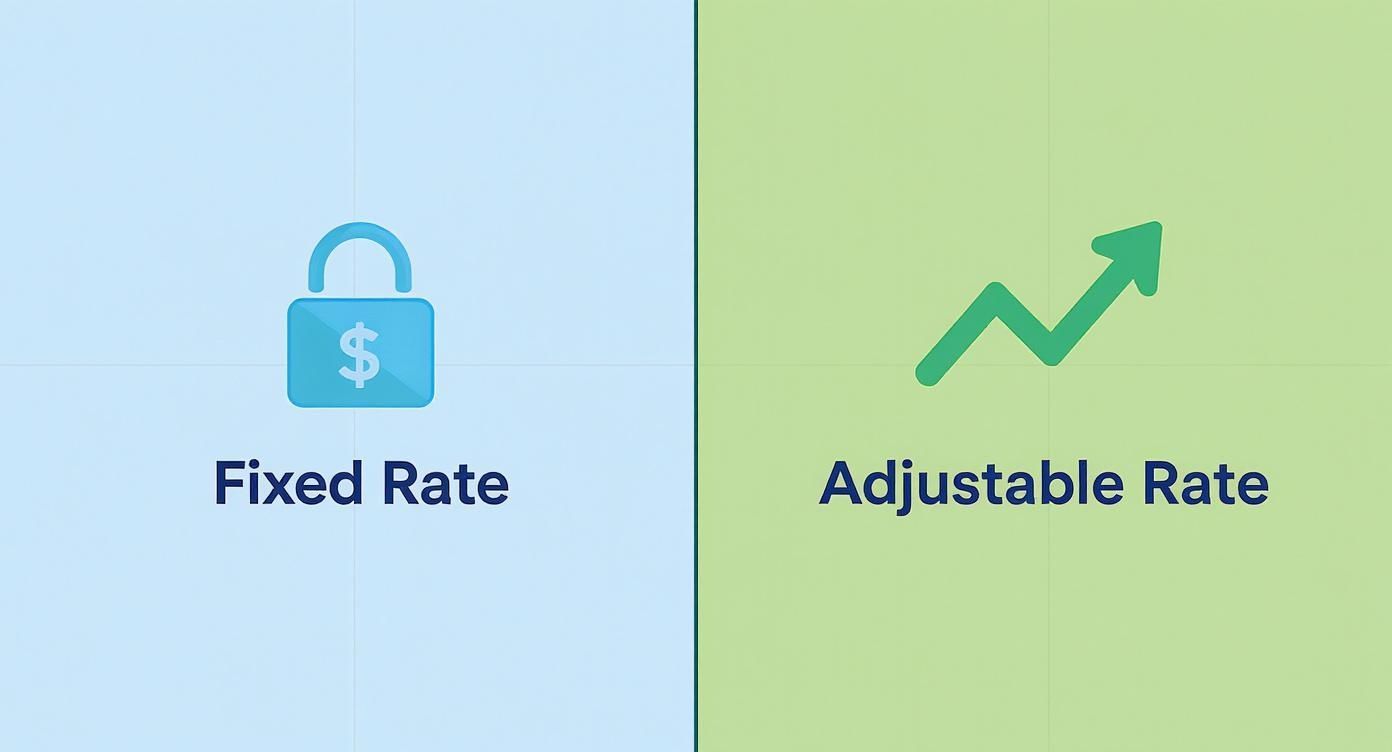
As you can see, the core difference is stability versus a lower initial cost. A fixed rate is predictable, while an adjustable rate can change over time.
Broader Market Forces: The Big Picture
While you have a lot of control over your own finances, some factors are completely out of your hands. These are the big-picture economic forces that make rates go up and down for everyone, no matter how great their credit score is.
We’re talking about things like inflation, Federal Reserve policies, and the general health of the economy. When the economy is booming, rates often climb. When it’s in a slump, rates tend to drop to encourage borrowing. Mortgage rates also look very different from country to country, shaped by each nation's unique economic situation.
Understanding these personal and market factors is the key to successfully navigating the mortgage process. By focusing on what you can control—your credit, your savings, and the loan you choose—you can position yourself to get the best possible rate.
Getting the financing squared away is the first major step. After that, the real fun begins. I work hands-on with clients in White Marsh, Edgewood, and across Harford and Baltimore Counties to not only find a house but make it a home. With my unique visualization tools, you can play around with different flooring, countertops, and cabinets to design your dream space before the first nail is even hammered.
How to Score a Lower Interest Rate (and Save a Ton of Money)
Alright, this is the part that can save you some serious cash. It's one thing to understand how rates work, but it's another thing entirely to actively work to lower yours. This is how you win the homebuying game.
Taking a few smart steps before you even start applying for a loan can shave a surprising amount off your monthly payment and the total interest you’ll pay over the years. This isn't about some complicated financial magic trick. It's about practical, proven moves that put you in the driver's seat.
Get Your Financial House in Order First
Long before you start dreaming about homes in White Marsh or Edgewood, your first stop should be a financial tune-up. Lenders want to see a responsible borrower, and a little prep work here goes a long, long way.
Make Your Credit Score Shine: This is your top priority, period. Pay every single bill on time. Chip away at high-interest credit card balances. And whatever you do, don't open any new lines of credit right before you apply for a mortgage. Even a small bump in your score can unlock a better interest rate.
Beef Up Your Down Payment: The more cash you bring to the table, the less risky you look to a lender. Saving for a bigger down payment doesn't just lower your loan amount; it often helps you qualify for a lower rate. The gold standard is 20% to avoid Private Mortgage Insurance (PMI), but honestly, any amount you can save above the bare minimum helps your case.
These two steps send a clear signal: you're a reliable, low-risk borrower. That’s exactly who lenders want to work with. The whole journey starts with getting your paperwork together, and our quick guide on mortgage pre-approval requirements is the perfect place to start.
Always Shop Around and Compare
You wouldn't buy the first car you see without checking out other options, right? Your mortgage is a much bigger deal, so treat it the same way. Getting quotes from at least three to four different lenders is an absolute must. Mix it up—check with big national banks, your local credit union, and a mortgage broker.
Every lender calculates risk differently, which means their offers can be surprisingly varied. When you get their loan estimates, lay them out side-by-side and compare everything: the interest rate, the fees, and that all-important APR. This simple act of comparison shopping is one of the most powerful things you can do to get a great deal.
Should You Pay for Mortgage Points?
Once you have a few offers, you’ll probably hear the term mortgage points (or "discount points"). This is basically an optional fee you can pay the lender upfront to "buy down" your interest rate for the entire life of the loan.
Think of it as pre-paying some of your interest. One point usually costs 1% of your total loan amount and can knock about 0.25% off your rate.
Let's break it down: Imagine you're taking out a $400,000 loan in Baltimore County at a 6.5% interest rate. One mortgage point would cost you $4,000 at closing. In return, the lender might drop your rate to 6.25%. That would save you roughly $63 every month.
So, is it worth it? You just need to find your "break-even point."
The Math: $4,000 (the cost) ÷ $63 (monthly savings) = 63.5 months. That's about 5.3 years.
If you know for sure you'll be in that home for longer than 5.3 years, buying the point is a smart move that will save you money over the long haul. But if you think you might sell or refinance before then, you're better off skipping the points and keeping that cash for yourself.
Scoring a great rate makes your dream home that much more affordable, freeing up your budget for the fun stuff. My hands-on service actually goes beyond the loan—I provide proprietary visualization tools that let you see exactly how your choices for flooring, cabinets, and tile will look in your new home, making the design process a blast.
Bringing Your Financial and Design Vision to Life
You’ve put in the work, shopped around, and landed a fantastic interest rate. It feels like the finish line, right? Almost. Before you start celebrating, there's one last, critical piece of the financial puzzle: deciding exactly when to lock in that rate.
Think of a rate lock as hitting the pause button. It’s a promise from your lender to hold your specific interest rate for a set amount of time, usually somewhere between 30 and 60 days. This gives you a clear runway to close on your home without worrying about what the market does next. It’s your best defense against last-minute surprises.
To Lock or to Float? That Is the Question
So, what happens if you don't lock your rate? It "floats." This means it can change daily—even hourly—bouncing up or down with the whims of the market. While it might seem tempting to float the rate in hopes it drops even lower, you're essentially rolling the dice. An unexpected jump could mean a significantly higher monthly payment for years to come.
For most homebuyers, especially if you're working with a specific budget, locking in a rate you feel good about is the way to go. It just provides invaluable peace of mind.
A real-world example: Imagine you've been approved for a 6.3% rate on a home in White Marsh. You lock it in for 45 days. Two weeks later, headlines are blaring about rates climbing to 6.7%. No sweat for you. Because your rate is locked, you still get that 6.3%, saving you from a world of stress and a chunk of change every month.
From Financials to Finishes
Securing your financing is a huge milestone, but honestly, it’s just the beginning of the adventure. Now you get to shift your focus from spreadsheets and loan documents to bringing your dream home to life. This is where the fun really begins, and it’s where my hands-on approach makes all the difference.
My job doesn't stop once you have a great rate. I provide my clients with unique visualization tools that let you see your design choices come to life before your eyes. Ever wondered how those quartz countertops will pair with cherry cabinets in your new Edgewood kitchen? My visualizers let you play designer, mixing and matching finishes until everything feels just right.
This turns what could easily be a stressful string of decisions into a creative and genuinely enjoyable process. Once the numbers are nailed down, you can dive into making the space your own, even exploring innovative AI solutions for interior design and real estate.
My goal is to be your guide from start to finish. From demystifying mortgage rates to helping you choose the perfect tile for the primary bathroom, I’m here to make sure your vision becomes a beautiful reality. Let’s connect and start building your home in Baltimore County or Harford County today.
Got Questions? Let's Talk Mortgage Rates.
Getting a mortgage can feel like learning a new language, and it's totally normal to have a ton of questions. Let's break down some of the most common things homebuyers ask, so you can move forward with confidence.
How Much Does a 1% Rate Difference Actually Save Me?
Honestly, it's a shocking amount of money. It’s easy to glance at rates and think a single percentage point isn't a big deal, but it has a massive impact over the life of your loan. We're talking tens of thousands of dollars.
Let's do the math: On a $300,000 loan with a 30-year term, the difference between a 6% and a 7% interest rate is about $180 per month. That might not sound huge at first, but over 30 years, it adds up to more than $64,000 in extra interest payments!
When Is the Best Time to Lock In My Mortgage Rate?
The simple answer? Lock your rate when you feel comfortable with the monthly payment. If you've found a rate that creates a payment that fits neatly into your budget, and the thought of it going up keeps you up at night, that's your sign to lock it in.
Now, if you have a higher tolerance for risk and you have a good feeling that rates might dip, you could "float" your rate for a bit. Just know that you're making a bet, and rates could just as easily go up. For most buyers, locking in the rate provides priceless peace of mind.
Can I Get a Good Mortgage Rate with a Lower Credit Score?
Yes, you absolutely can still get a mortgage. While it's true that people with top-tier credit scores get access to the lowest rates, there are some fantastic loan programs out there designed for real people with real-life credit.
FHA loans, for example, are a game-changer for buyers with less-than-perfect scores. Your interest rate might be a little higher to balance the lender's risk, but it's a well-traveled and proven path to owning a home. Focusing on simple things like paying every bill on time and keeping your credit card balances low can also give your score a surprisingly quick boost and open up even better options.
Ready to turn these numbers into your dream home? While the builder I represent provides high-quality homes, I go a step further—offering my clients unique proprietary visualization tools, hands-on service, and access to visualizers that help you bring your dream space to life. Let’s build your vision in White Marsh, Edgewood, or anywhere in Baltimore and Harford Counties. Explore your options at https://www.customizeyourhome.com.
Comments