

What Is a Zoning Ordinance and How It Affects Your Home

Ever wondered why you don't see a giant factory plopped down in the middle of a quiet residential street in White Marsh or Edgewood? You can thank zoning ordinances for that.
Simply put, these are the local rules that dictate how every piece of land in a community can be used. It's like a city's master plan, ensuring everything has its proper place so the whole community functions smoothly.
Your Quick Guide to Understanding Zoning Ordinances
Think of zoning as the invisible blueprint for your town. It’s what creates the distinct character of different areas, from bustling commercial districts to serene, tree-lined neighborhoods. Just like a grocery store has dedicated aisles for produce, dairy, and snacks, a city uses zoning to create an organized and friendly environment for everyone.
The core idea is to guide a community's growth in a logical way, protecting property values and quality of life for residents.
So, What's the Point of Zoning?
At its heart, zoning is about balancing individual property rights with the well-being of the entire community. It’s a tool that helps local governments manage growth and maintain a certain standard of living for everyday home life.
We can break down its main goals into a few key areas.
Zoning at a Glance
Zoning Goal | What It Means for You |
|---|---|
Promote Public Health & Safety | Keeps industrial pollution away from your backyard and ensures emergency vehicles can access your home. |
Maintain Community Character | Protects the unique look and feel of your neighborhood, whether it's historic or modern. |
Manage Growth & Development | Makes sure new construction fits in and that infrastructure like roads and schools can handle more people. |
Ultimately, these rules are in place to create predictable, stable, and safe communities for everyone to enjoy.
Why Zoning Matters for Your Home
This all becomes incredibly important when you start thinking about your own property. These local laws dictate everything from how tall your fence can be to whether you can add a second story to your home. They can even influence where on your lot you can build a deck or place a garden shed.
Zoning provides the framework that keeps the outside of our homes orderly, which in turn gives us the freedom for incredible personalization on the inside—like choosing the perfect kitchen layout or designing a dream bathroom. You can dive deeper into all the ways to make a house your own in our guide to customizing your home.
These community rulebooks aren't some new-fangled idea, either. Modern zoning really took off in the United States back in the early 20th century as cities were expanding at a dizzying pace. New York City’s landmark 1916 Zoning Resolution, for example, was created to stop skyscrapers from casting permanent shadows over entire neighborhoods. It was a pioneering effort to manage the chaos of a rapidly growing metropolis, and its influence can still be seen in cities across the country today.
Decoding the Rules: Common Zoning Terms Explained
Cracking open a local zoning ordinance for the first time can feel like trying to read a foreign language. It's full of specific terms and legal jargon. But don't worry—once you get a handle on a few key concepts, the whole rulebook starts to click into place. Think of this as your friendly decoder ring for what you can and can't do on your property.
This simple chart sums it up nicely: it shows who makes the rules (your local government), what the rules are (the ordinance), and why they exist in the first place (to protect the community).
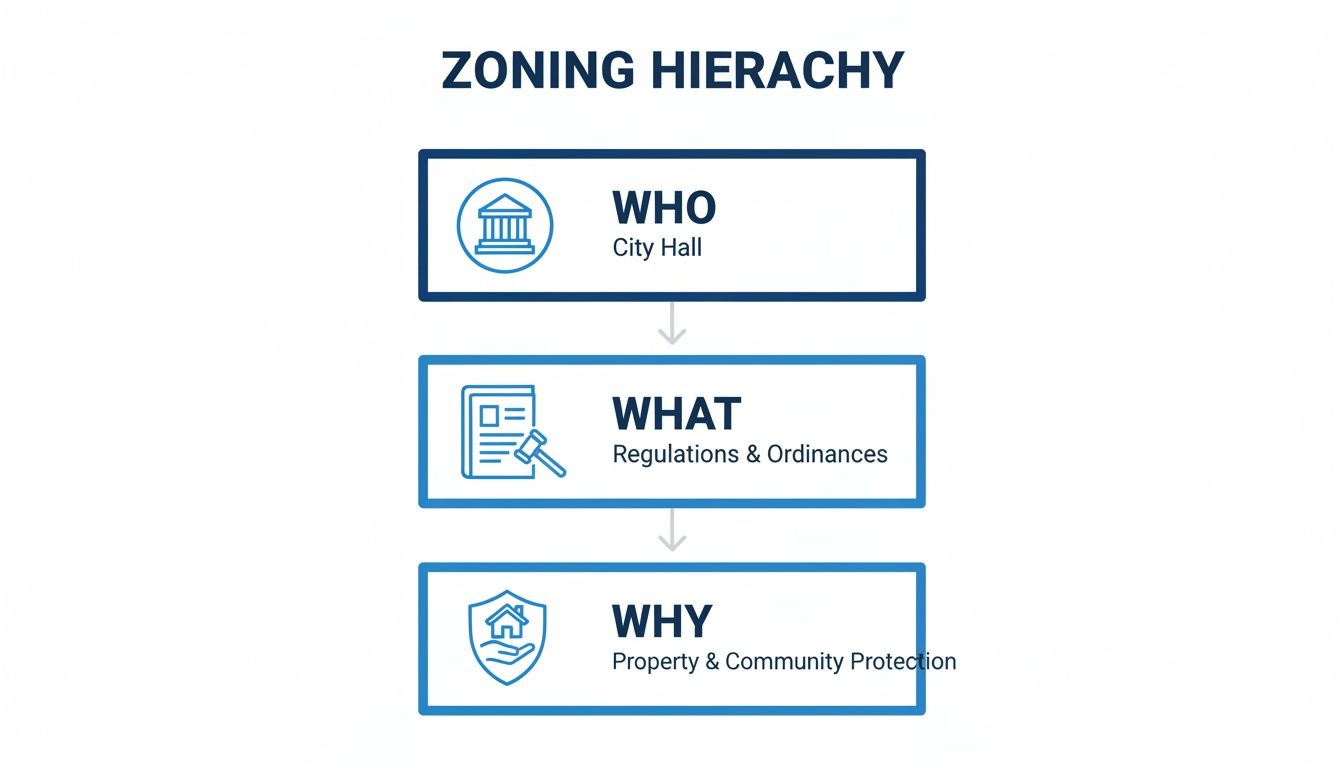
At its heart, zoning is all about creating and maintaining the kind of community people want to live in.
Breaking Down the Jargon
Let's translate some of the most common terms you'll run into. These are the building blocks of almost every zoning code, whether you're in Baltimore County, Harford County, or anywhere else.
Setbacks: This is just the required buffer zone between your house (or any other structure) and your property lines. Think of it as an invisible "no-build" border around your lot. For instance, a 10-foot rear setback means that new sunroom has to stop at least 10 feet short of your back fence.
Lot Coverage: This rule dictates what percentage of your land can be covered by "impervious surfaces"—things like your house, garage, shed, and even a paved driveway. If your lot has a 30% coverage limit, all those structures combined can't take up more than 30% of the total land area. It’s a way to prevent overbuilding and ensure there’s green space.
Use Classes: This is how the county categorizes land for specific purposes. It's the reason your quiet street in White Marsh is filled with homes (residential use) and not a loud factory (industrial use) or a bustling shopping center (commercial use). It keeps neighborhoods livable.
Getting a firm grip on these terms before you start planning is non-negotiable. Knowing your property's setbacks, for example, is the very first step to figuring out if that dream swimming pool will actually fit.
Height Restrictions and Property Lines
Beyond those basics, you'll almost always find rules about building height and how everything relates back to your property's official boundaries.
A height restriction is exactly what it sounds like. It puts a cap on how tall your home can be. In many residential zones, that limit might be around 35 feet. This simple rule is what prevents a massive new house from casting a shadow over its neighbors all day and helps maintain the overall look and feel of the neighborhood.
Of course, all of these rules—setbacks, coverage, you name it—are measured from your official property lines. That's why having a precise map of those boundaries is so critical. A professional property survey isn't just a good idea; it's essential. To learn more, check out our guide on what a property survey is and why you need one.
The whole idea of separating land uses isn't new. The period between 1908 and 1926 was a game-changer for modern zoning in the United States, as cities like Los Angeles and New York pioneered the first ordinances and the Supreme Court gave them the legal green light.
How Zoning Affects Your Home and Customization Ideas
Alright, we’ve waded through the technical stuff. Now, let's talk about what this all means for your home. How do these zoning rules actually play out in real life for everyday homeowners? This is where the rulebook hits your backyard.
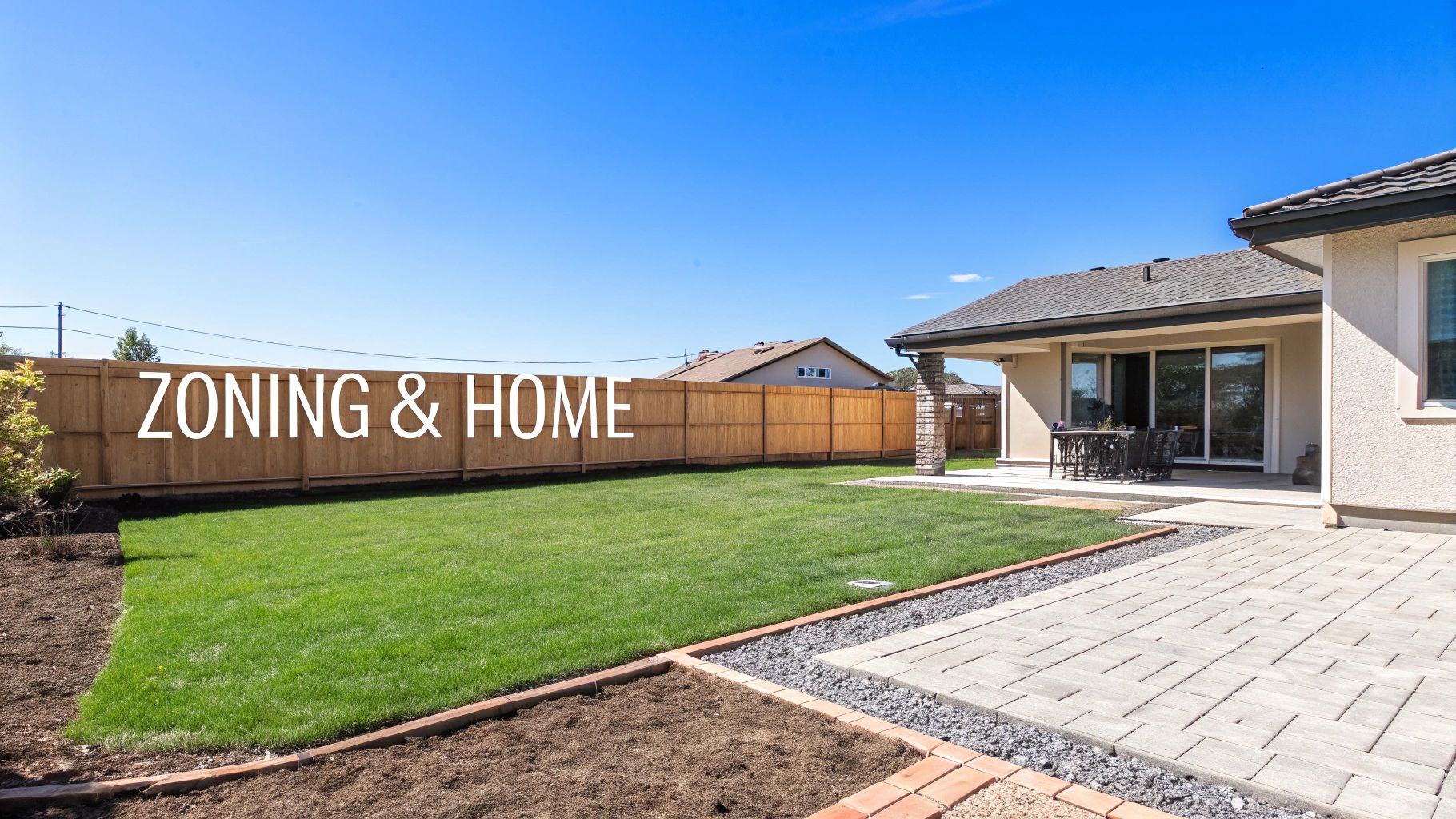
Ever wondered why neighborhoods in places like White Marsh or Edgewood have such a consistent, predictable feel? That’s zoning at work. Rules about density, which control how many houses can fit into an area, are a huge part of shaping a neighborhood’s character. Lower density usually translates to bigger lots and more green space, giving you that classic suburban vibe.
The Boundary Between Rules and Your Vision
Think of zoning as creating an invisible "envelope" around your property. It sets the maximum footprint, height, and location for your house and anything else you build, like a shed or a fence.
For example, that sprawling garden you've been picturing? Setback rules will tell you exactly how close to the property line it can get. Thinking about adding a big new patio for summer cookouts? Lot coverage rules will dictate just how large it can be. These regulations can feel like a buzzkill, but they’re there to protect everyone’s property values and quality of life. It’s actually a good thing that your neighbor can’t just decide to build a massive workshop right up against your fence.
Zoning ordinances primarily govern the exterior shell and placement of structures on your land. This leaves an incredible amount of freedom for you to express your personal style and create a living space that is uniquely yours on the inside.
Unleash Your Creativity with Interior Customization
Here’s the great news. Once you’re working within that zoning-approved "envelope," the world is your oyster on the inside. This is where you really get to make a house your own.
Zoning might tell you where the fence has to go, but it has zero say in the gorgeous custom tile you pick for your master shower. It might limit the home's footprint, but it can’t stop you from choosing beautiful hardwood floors or the perfect quartz countertops for that dream kitchen.
This is the fun part for my clients. Using our visualization tools, you can play around with:
Cabinet styles and colors to get your kitchen looking just right.
Flooring options, from classic oak to modern luxury vinyl, to set the mood in every room.
Countertop materials and designs that are both stunning and practical.
Tile selections for a backsplash or bathroom that shows off your personality.
Knowing the zoning rules isn't just about staying out of trouble; it's also about understanding your property's market potential. For example, before you start a big renovation, it’s smart to accurately determine your home's value, because zoning can definitely play a role in your return on investment.
These local rules have had a massive impact across the country. Between 1980 and 2010, the number of land-use court cases in the U.S. shot up by about 157%—a clear sign of how important these ordinances have become. While the legal battles can get intense, our goal is simply to help you bring your vision to life within the local guidelines. If you’re thinking about expanding, you’ll definitely want to check out our guide on how to plan a home addition.
A Homeowner's Guide to Navigating Maryland Zoning
Alright, let's bring all this zoning talk from the abstract down to your actual property line. It's one thing to understand the idea of a zoning ordinance, but it's another thing entirely to figure out what it means for the home you own or are looking to buy.
For homeowners here in Maryland—whether you're in a community like White Marsh in Baltimore County or over in Edgewood in Harford County—there are a few straightforward steps you can take. Getting this right from the start ensures your next project goes smoothly.

Think of it as your personal roadmap to cutting through the red tape.
Your Step-by-Step Maryland Zoning Checklist
Ready to dig in? Here’s how you can find the exact rules for your specific address.
Find Your Zoning Map Online: Your first move is to head to your county’s official government website. Look for the "Planning and Zoning Department" page, and from there, you should find a link to their interactive "Zoning Maps." Pop in your address, and it will show you your property's designation—something like 'R-1' for Residential-1, for instance.
Look Up Your Zoning Code: Once you have that zone code, you can find the chapter in the county's zoning ordinance that applies to you. This is the rulebook. It lays out everything for your zone, from setbacks and height limits to what kinds of accessory uses (like sheds or pools) are allowed.
Hunt for Key Details: Don't feel like you have to read the entire legal document cover-to-cover! Look for tables or specific sections that list the bulk regulations for your zone. The most common things homeowners need to know are setback distances, lot coverage percentages, and fence height rules. Zero in on those first.
When in Doubt, Call: If something isn't clear, don't guess. The county's planning and zoning staff are paid to help people like you. Give them a call or send an email with your address and zoning info handy, and they can answer your specific questions.
Knowing your zoning is a huge first step, but it's not the only one. Many projects, like building a new deck or finishing a basement, will also need separate approvals. To see how it all fits together, you can learn more about what a building permit is in our homeowner's guide.
A Quick Guide to Maryland Zoning Resources
Finding the right webpage can sometimes be the hardest part. To get you started, here's a quick reference table for some of the major counties we serve.
Location | Where to Find Zoning Maps & Codes | Helpful Tip |
|---|---|---|
Baltimore County | Visit the Baltimore County Zoning page. | Use their interactive map to find your zone, then cross-reference it with the BCZR (Baltimore County Zoning Regulations). |
Harford County | Check the Harford County Planning & Zoning department site. | Their maps are great, but the code can be dense. Don't hesitate to call their office for clarification on specific rules. |
Anne Arundel County | Go to the AA County Office of Planning & Zoning. | They have a helpful "Find My Zoning" tool that makes the first step really easy. |
Howard County | Find information at the Howard County Dept. of Planning & Zoning. | Look for their "Zoning & Land Use" section, which has links to both the maps and the full regulations. |
This table should point you in the right direction, but always remember that the county's official website is the ultimate source of truth.
What if a Rule Just Doesn’t Work for Your Property?
Every once in a while, you'll run into a situation where a standard rule simply isn't practical. Maybe your property is an odd shape, making it impossible to meet a 10-foot setback for a new garage.
In these rare cases, you have an option: applying for a zoning variance.
Think of a variance as a special permission slip from the local government. It allows you to bend a specific rule for your property because you can demonstrate a unique hardship. For example, if your zone's fence height limit is five feet but you need a six-foot privacy fence due to your lot's unique exposure to a busy road, you might apply for a variance.
Just know that getting one isn't a walk in the park. The process usually involves a public hearing and is never guaranteed, but it’s a critical tool when you’re dealing with a truly one-of-a-kind situation.
Your Partner in Creating a Beautiful and Compliant Home
Let's be honest, deciphering a zoning ordinance can feel like a heavy lift, especially when all you really want to do is start enjoying your new home. Digging through the fine print of local codes is definitely complex, but the good news is you don’t have to become a zoning expert or go it alone. My job is to handle all those details for you, so you can focus on the fun stuff—like picking out finishes and imagining where your furniture will go.
While the builder I represent provides high-quality homes, I go a step further—offering my clients unique proprietary visualization tools, hands-on service, and access to visualizers that help you bring your dream space to life.
See Your Vision Before You Commit
What if you could actually walk through a virtual model of your future home and swap out design elements on the fly? That's exactly what I offer.
Flooring: Wondering how dark hardwood looks next to light gray walls? Let’s check.
Countertops: We can compare the subtle veining of marble with the sleek, modern look of quartz in your kitchen.
Cabinets: See for yourself if you prefer a classic shaker style or something more contemporary.
Tile: You can design a show-stopping backsplash for the kitchen or a spa-like shower for the primary bath.
This tech is a game-changer. It lets you fine-tune every single detail until it’s just right. While you’re getting creative, I’m in the background making sure every choice, from the placement of a window to the pitch of the roof, lines up perfectly with the local rules in Baltimore County or Harford County. You get all the creative freedom, and your home gets the rubber stamp of full compliance.
My hands-on service and proprietary visualization tools are all about giving you clarity and confidence. You get to focus on making your home beautiful while I handle the complexities of making sure it's fully compliant with every local rule.
Let’s Bring Your Dream Home to Life
Buying a new home should be one of the most exciting experiences of your life, not a source of stress over permits and regulations. My whole approach is built around a seamless process that pairs your unique vision with my deep industry knowledge. The result? A beautiful, personalized home built on a foundation of regulatory confidence.
Ready to see how these design tools and my personal support can make your journey smoother and way more fun? Let's connect and start exploring what’s possible for your new home in one of our amazing Maryland communities.
Got More Zoning Questions? Let's Clear Things Up.
Even when you've got the basics down, a few more questions always seem to pop up. Zoning can feel like a tangled web, but a little clarity goes a long way. Here are some quick, straightforward answers to the questions I hear all the time from homebuyers.
Can Zoning Rules Actually Change After I Buy My House?
Yes, they absolutely can. Local governments are constantly tweaking and updating their zoning ordinances to reflect a community's growth and changing needs. But before you start to worry, know this: there's no need to panic if a new rule gets passed.
Your existing home is almost always "grandfathered in," a legal term meaning it's exempt from the new regulations. You won't be forced to tear down a deck or move your house because a setback rule changes. Any new rules would almost certainly apply only to future construction or major renovations, not what's already there. It’s one of the benefits of a well-planned community—that long-term vision provides stability for homeowners.
Does Zoning Really Care About My Fence, Shed, or Pool?
It sure does! In fact, these are the projects where most people have their first run-in with zoning rules. Your local ordinance will definitely have specific regulations for what they call "accessory structures" (like sheds and pools) and for fences.
These rules get into the nitty-gritty, covering things like:
Maximum Height: A front yard fence might be capped at four feet, while your backyard fence could go up to six feet.
Required Setbacks: That new shed might need to be at least five feet away from your side and rear property lines.
Total Size: Some codes even limit the total square footage of all accessory structures combined.
Here's a real-world example: A corner lot in Baltimore County might face much stricter fence requirements on the side facing the street compared to a neighbor's interior lot. It’s always, always a good idea to check the local code before you start digging post holes.
What Exactly Is a Zoning Variance and When Would I Need One?
Think of a zoning variance as a special permission slip from the government. It's an exception the zoning board can grant when a property has some unique physical feature that makes it unreasonably difficult to follow a specific rule to the letter.
Let's say your lot is an unusual wedge shape. Following the standard setback rule would leave you with an impossibly tiny sliver of land to build a much-needed garage. In a situation like that, you could apply for a variance to build slightly closer to the property line. The key is proving a "hardship" that's unique to your land—it can't just be about personal preference. Getting one involves an application, fees, and a public hearing, and there's no guarantee it will be approved.
How Can I Find the Zoning for a Property in Edgewood or White Marsh?
Finding the specific zoning for a property is easier than you might think. Both Harford County (which includes Edgewood) and Baltimore County (home to White Marsh) have some great online tools for this.
Your best bet is to head to the county's official website and look for their "Department of Planning and Zoning." They usually have interactive online maps where you can just type in a property address. The map will pop up with its official zoning classification, like "R-1" for a residential zone. Once you have that code, you can look up all the specific rules for that zone right there on the same website.
Figuring out these details is all part of the journey, but you don't have to go it alone. I provide the hands-on service and proprietary visualization tools to help you design a home you love, while I make sure it aligns perfectly with all the local guidelines. Ready to see how you can personalize everything from your flooring to your countertops with total confidence? Let’s connect and bring your vision to life.
Comments