

What Is Title Insurance Explained Simply

Think of title insurance as a safety net for what is likely the biggest purchase you'll ever make. It’s not like your car or health insurance, which protects you from future problems. Instead, it’s all about the past.
This one-time fee, paid at closing, is your shield against financial bombshells lurking in a property's history. It ensures that when you finally get those keys, the home is truly, legally, and completely yours. For anyone buying a home in Maryland, from White Marsh to Edgewood, it's an indispensable part of the process.
Why Title Insurance Is A Homebuying Essential

You get a title when you buy a car, and you get one when you buy a house. Simple enough, right? The difference is that a property's history can be a long, tangled story going back centuries, and it might be hiding some nasty surprises.
Here’s a practical example: you’ve moved into your dream home in Baltimore County, spent a small fortune picking out the perfect countertops, and finally feel settled. Then, six months down the line, a letter arrives. It turns out a contractor who worked for the last owner never got paid and has slapped a legal claim—a lien—on your house. Suddenly, their problem is your problem.
Protecting Your Biggest Investment
This is exactly the kind of nightmare title insurance is built to prevent. It’s backward-looking, protecting you from claims and issues that happened long before you ever saw the "For Sale" sign.
While your standard homeowner's policy covers future what-ifs like a fire or a hailstorm, title insurance digs into the past to protect your ownership rights. (If you want a refresher on that, we have a great guide on understanding homeowners insurance coverage).
This kind of protection isn't just a good idea; it's a cornerstone of modern real estate. The global title insurance market was recently valued at a whopping USD 67.42 billion and is expected to nearly double by 2033. That tells you just how critical this safeguard has become for homeowners everywhere. Learn more about the title insurance market's growth.
In short, title insurance is like a comprehensive background check on your property's legal history. It makes sure the seller actually has the right to sell it and uncovers any old debts, claims, or legal issues before you put your name on the deed.
A Quick Summary For You
To make it even clearer, here’s a quick breakdown of the core ideas.
Title Insurance Core Concepts | |
|---|---|
Concept | What It Means For You |
Past vs. Future Protection | It protects you from old, undiscovered issues, not future accidents. |
One-Time Premium | You pay for it once at closing, and you're covered for as long as you own the home. |
Ownership Guarantee | It guarantees that you are the rightful, legal owner of the property. |
Peace of Mind | It lets you sleep at night knowing a past owner's mistake won't cost you your home. |
This table helps put the most important takeaways in one place, so you can see why it's such a crucial step.
Your Partner in a Smooth Homebuying Journey
The homebuying process can feel overwhelming, but you don’t have to go it alone. While the builder I represent provides high-quality homes, I go a step further—offering my clients unique proprietary visualization tools, hands-on service, and access to visualizers that help you bring your dream space to life.
My job is to sweat the small stuff so you can focus on the fun parts—like picking out the perfect cabinets and tile that will make your new Harford County house feel like home.
Ready to start this journey with a partner who can simplify the complex parts? Let’s connect and talk about how we can help you find and customize your dream home with confidence and peace of mind.
Understanding The Two Types Of Title Insurance
When you hear people talk about "title insurance," it's easy to assume it’s a single product. But it actually comes in two distinct flavors, and each one protects a different key player in your home purchase. Getting this difference is the first step to understanding what you’re paying for at the closing table.
Think of it this way: not all insurance policies are created equal. You have one policy that protects the bank and another that protects you. Both are critical, but they serve very different purposes.
Lender’s Policy: The Bank’s Safety Net
First, there's the Lender’s Policy. As the name implies, this one is all about protecting the mortgage lender. Banks are in the business of managing risk, and before they loan you hundreds of thousands of dollars, they need to know their investment is secure.
This policy guarantees the lender that their mortgage is legitimate and that they are first in line to be paid if something goes wrong. If a surprise title issue pops up down the road, the lender's policy covers their losses. Because it’s their money on the line, virtually every lender will require you to buy this policy as part of getting the loan. It’s not optional.
A practical example: a lender's policy is like a car insurance policy that only covers the bank that financed your car. If it turns out the car was stolen before you bought it, the bank gets its money back—but you're still out a car.
Owner’s Policy: Your Personal Shield
That brings us to the second, and arguably more important, type: the Owner’s Policy. While the lender's policy protects the bank, this one is all about protecting you—the homeowner. This is your personal shield against those hidden problems from the property's past that could threaten your right to own your home.
An owner's policy defends your ownership and your hard-earned equity for as long as you or your heirs have the property. Imagine discovering years from now that a forged signature on an old deed calls your ownership into question. Without this policy, you'd be on your own, facing a mountain of legal bills. With it, the insurance company steps in to defend you. It’s a one-time fee for a lifetime of peace of mind.
To give you an idea of how essential both are, the Owner's Title Insurance market was recently valued at USD 1.5 billion, while the Lender's Title Policies market is projected to hit USD 2.4 billion. This shows just how fundamental both policies are to real estate transactions. You can explore more insights on title insurance market segments on marketresearchfuture.com.
Skipping an owner's policy is a huge gamble. When you're buying a home in a community like White Marsh or Edgewood, you’re investing in your future. This protection is priceless.
To make this crystal clear, here’s a quick breakdown of how the two policies stack up against each other.
Owner's Policy vs Lender's Policy At A Glance
This table offers a simple side-by-side comparison to help you quickly see the key differences.
Feature | Owner's Title Insurance | Lender's Title Insurance |
|---|---|---|
Who It Protects | You, the homebuyer and your heirs. | The mortgage lender. |
Is It Required? | Optional, but highly recommended. | Almost always required by the lender. |
Payment | A one-time fee paid at closing. | A one-time fee, often paid by the buyer. |
Coverage Duration | As long as you or your heirs own the property. | For the life of the loan. |
Coverage Amount | The full purchase price of your home. | The outstanding loan amount. |
Ultimately, one policy protects the bank's investment, and the other protects your investment.
While sorting through these details can feel a bit technical, my job is to make your journey to a new home as smooth as possible. I'm here to provide hands-on service and even have proprietary visualization tools to help bring your dream space to life. That way, you can focus on the fun stuff—like picking out your flooring and countertops—while I help make sure the crucial details, like your title, are buttoned up.
How A Title Search Uncovers Hidden Issues
Before you ever get a title insurance policy, a crucial step happens behind the scenes: the title search. Think of it as a background check on your future home, where a professional plays detective, digging through mountains of public records to piece together the property's life story.
This isn't just a quick Google search. A title expert meticulously combs through decades of documents—deeds, mortgages, tax records, court judgments, and even old wills. They're on the hunt for anything that could cast a "cloud" over your ownership rights down the road.
The Detective Work of a Title Search
This deep dive is all about spotting red flags before they become your problem. A trained examiner knows exactly what to look for—the little details that could jeopardize your claim to the property. It's the foundation of a secure home purchase.
So, what are they actually looking for? Here are some of the most common culprits:
Unpaid Bills from Previous Owners: This could be anything from forgotten property taxes to a mechanic's lien filed by a contractor who renovated the kitchen five years ago and never got paid.
Surprise Heirs or Ownership Claims: The search checks for unresolved claims from ex-spouses, business partners, or long-lost heirs of a previous owner who might suddenly show up with a legal right to the property.
Easements and Encumbrances: An easement might give a utility company the right to dig up your backyard, or an old covenant could restrict you from building that new deck you were dreaming of.
Clerical Errors and Forgery: You’d be surprised how often simple filing mistakes at the county courthouse can cause issues. In rarer cases, they might even uncover outright fraud, like a forged signature on a past deed.
Understanding this process is a key part of any solid home buyer's guide to real estate due diligence. It’s all about doing the homework upfront to clean up any messes before they land on your doorstep.
After a successful title search, the title company issues insurance policies. This visual shows the difference between the two main types.
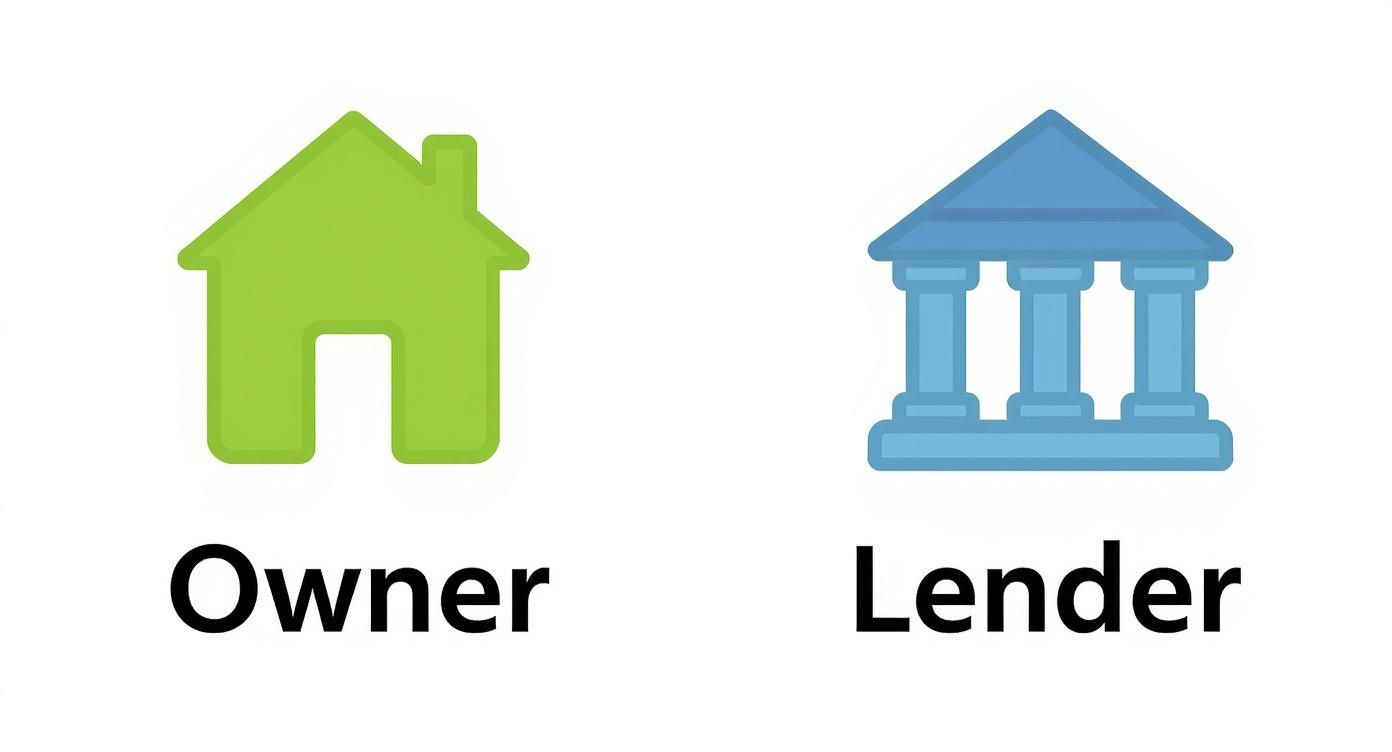
As you can see, an Owner's Policy protects your investment and equity, while the Lender's Policy just protects the bank's loan.
From Search to Resolution
Once the search is done, the title company gives everyone a "title commitment," which is basically a report card of their findings. If they found any problems, those have to be fixed before you can close on the house. This might mean the seller has to pay off an old lien or track down a previous co-owner to sign a legal document. The title company works with them to get all this sorted out and "clear the title."
The whole point of the title search is to make sure that when the seller hands you the keys, they're also handing you a "clean" title—one that's free and clear of any known claims or defects.
Sometimes, the title search overlaps with other important steps, like getting a property survey. While the search digs into the home's legal history, a survey maps out its physical boundaries. They're two different but equally important pieces of the puzzle. You can learn more about what is a property survey in our complete homebuyer guide.
This meticulous process ensures you’re starting your homeownership journey with a clean slate. My job is to help you navigate these details without the stress. While trusted partners handle the complexities of the title search, I’m here to provide hands-on service and tools to visualize your new home. That way, you can focus on the fun stuff—like picking out your flooring, cabinets, and countertops—knowing all the critical background checks are being handled by experts.
Common Title Problems Your Policy Covers

While a title search is an incredible tool, it's not a crystal ball. Think of it as a detailed background check based on what's available in public records. But what about the stuff that isn't recorded? This is where an owner’s title insurance policy becomes your homebuying MVP.
Some of the biggest threats to your ownership are completely invisible, even to a seasoned title examiner. This is exactly why it’s so critical to understand what is title insurance—it’s your shield against the unknown.
These hidden issues, often called "title defects," can pop up out of nowhere, sometimes months or even years after you've moved in. When they do, they can put your ownership and financial future on the line. Your policy is designed to step in and handle these fights for you.
Forgery, Fraud, And Impersonation
This one sounds like something straight out of a movie, but it happens more than you'd think. A previous seller could have easily forged a signature on a deed to offload the property without a co-owner's consent—think of a messy divorce or a soured business partnership.
For a practical example, imagine the person who sold you your home faked their estranged spouse's signature on the sale documents. A year later, that spouse shows up with a lawyer, claiming they never agreed to the sale and still have a legal right to half the property. Your owner’s policy would jump in to cover the legal fees to defend your title and protect you from a massive financial hit.
Documents like these are the bedrock of home financing. If you want to get a better handle on how ownership is legally structured, you might find our quick guide on what is a deed of trust helpful.
Undisclosed Heirs And Old Wills
Here’s another curveball. A previous owner passes away, and their property is sold by the person named in their most recent will. Everything looks perfectly legitimate. But then, an older, forgotten will suddenly surfaces, naming a completely different heir.
Out of the blue, that long-lost relative could appear with a valid legal claim to your home. Without title insurance, you'd be looking at a messy, expensive court battle with your ownership hanging in the balance.
An owner's title policy transforms a potential catastrophe into a manageable insurance claim. Instead of facing legal battles alone, the insurance company steps in to defend your rights, covering legal costs and financial losses.
Liens From Contractors, Creditors, Or Taxes
This is easily one of the most common title headaches. A previous owner might have skipped out on paying a contractor for a new roof, fallen behind on property taxes, or had a court judgment filed against them for unpaid debts.
These unpaid bills can trigger a lien, which is a legal claim against the property that has to be paid off. Even though the debt belonged to a former owner, the lien attaches to the property itself—which means it’s now your problem.
Mechanic's Liens: Filed by contractors or suppliers who were never paid for their work.
Tax Liens: Placed by the government for unpaid property or income taxes.
Judgment Liens: Pop up as a result of lawsuits and unpaid court judgments.
Your policy protects you by making sure these are paid before you close or by defending you if one is discovered later on.
Errors In Public Records
Sometimes, the problem is just simple human error. A clerk at the county records office could have made a typo when entering a deed, or the legal description of your property's boundaries might be flat-out wrong.
These seemingly small mistakes can snowball into huge problems, like boundary disputes with your neighbors or serious confusion over who legally owns what. Title insurance helps sort out these clerical messes and confirms you own exactly the property you paid for.
While buying a home in Baltimore County or Harford County has a lot of moving parts, my goal is to make it feel effortless for you. While the builder I represent provides high-quality homes, I go a step further—offering my clients unique proprietary visualization tools, hands-on service, and access to visualizers that help you bring your dream space to life. You get to focus on personalizing your dream space, and I'll help you navigate the rest.
So, What Does Title Insurance Actually Cost in Maryland?
Alright, let's get down to brass tacks. It’s one of the first questions I hear from homebuyers in Baltimore County and Harford County: "What's this title insurance going to set me back?" Great question. Unlike car insurance or homeowner's insurance with their pesky monthly bills, title insurance is a one-time fee you handle at the closing table.
That’s it. One payment, and you’re protected for as long as you own the home. No renewals, no annual statements—just a solid safety net. The price isn't pulled out of a hat; it’s tied directly to your home's purchase price. A more expensive home means a slightly higher premium, simply because there's more value at stake.
Who Foots the Bill in Maryland?
In Maryland, we have a pretty standard way of handling these costs at closing. Here’s the typical breakdown:
The buyer pays for the lender's policy. This makes sense, as it’s the lender who requires it to protect their investment in your loan. It’s just another one of the standard closing costs.
The owner's policy is a different story—it's often a negotiable item. Sometimes the seller covers it as an incentive, sometimes the buyer pays, and sometimes you meet in the middle and split it.
This is a key detail your real estate agent will help you navigate when you're putting together your offer. It's a crucial piece of the financial puzzle, and knowing the lay of the land is half the battle. To get the full picture, you can check out our guide on closing costs for a new home.
Let's Look at a Real-World Example
Numbers on a page can be a bit abstract, so let’s ground this in reality with a practical example. Say you’re buying a gorgeous new home in White Marsh for $450,000.
Here's a ballpark of what you could expect:
Lender's Policy: The premium might be around $900. As the buyer, you’d almost certainly cover this.
Owner's Policy: The one-time cost for your own protection could be about $1,125. This is the one you might negotiate with the seller.
Now, these are just estimates, but they paint a clear picture. Title insurance is a massive part of the real estate world—the industry brought in USD 4.5 billion in premiums in just one quarter recently. That stat alone shows you just how standard and essential this protection is for every single property sale. You can read more about title insurance market performance.
Pro Tip: Make sure you ask your title company about a "simultaneous issue" rate. When you get both the owner's and lender's policies at the same time from the same company, they usually give you a hefty discount. It’s a simple way to make complete coverage much more affordable.
While the builder I represent provides high-quality homes, I go a step further—offering my clients unique proprietary visualization tools, hands-on service, and access to visualizers that help you bring your dream space to life. That way, you can focus on the fun stuff—like picking out finishes—while I help make sure the financial side of things is crystal clear.
Putting It All Together for a Smooth Closing
Getting a handle on what is title insurance is a huge weight off your shoulders. Now that you know the ins and outs of the policies, the costs, and the scary "what-ifs" it protects you from, you can finally relax and focus on what really matters—turning that new house into your home.
While you're busy picking out paint colors and planning where the sofa will go, my job is to make sure all the complicated stuff behind the scenes gets done right. I connect all my clients with trusted, top-notch partners who live and breathe this work. They'll handle everything from the deep-dive title search to locking in your insurance, so you don't have to. Think of me as the one who clears the path for you.
From Blueprint to Your Personal Vision
While the builder I represent provides high-quality homes, I go a step further—offering my clients unique proprietary visualization tools, hands-on service, and access to visualizers that help you bring your dream space to life. My whole approach is about cutting through the complexity so you can pour your energy into the fun part: making the space a perfect reflection of you.
It’s one thing to hold a tiny square of countertop or a swatch of carpet. It’s a whole different world to see exactly how all your choices for flooring, countertops, cabinets, and tile will look together inside your actual home.
Flooring: Instantly see how a room transforms with different styles of hardwood, vinyl, or plush carpeting.
Countertops: Drag and drop granite, quartz, and other materials to find the one that completes your kitchen's look.
Cabinets: Play with different finishes and door styles until you land on the perfect combination.
Tile: Design a stunning backsplash or a beautiful bathroom floor and see your pattern come alive on screen.
This takes all the anxiety and guesswork out of the design process, giving you the confidence that you’re making choices you'll absolutely love.
Your Guide in Harford and Baltimore County
My goal isn't just to help you buy a house. It's to make the entire journey, from our first conversation to closing day, feel seamless and genuinely exciting. I'm here to walk you through every stage, answer every question, and connect you with the pros who handle the technical details like title insurance. That way, you're free to focus on the joy of creating a home that’s 100% you.
Buying a home should be one of life's great adventures, not a source of stress. When you combine expert guidance on the technical side with powerful tools for personalization, the process becomes both secure and incredibly inspiring.
If you’re ready to start looking at beautiful, customizable new homes in communities across White Marsh, Edgewood, Harford County, or Baltimore County, I’d love to chat. It would be an honor to be your partner on this journey, helping you find and customize a home that is uniquely yours. Let's start building that dream today.
Got Questions About Title Insurance? We've Got Answers.
Buying a home, especially for the first time, can feel like you're learning a whole new language. Let's clear up some of the most common questions people have about title insurance so you can feel confident at the closing table.
I'm Buying A New Construction Home. Do I Really Need Owner's Title Insurance?
Yes, and I can't stress this enough. While your house might be brand new, the land it's sitting on has been around for ages and has a history all its own. An owner's policy is what protects you from any skeletons in that land's closet.
Here’s a practical example: the land your new home in Edgewood is built on was likely part of a much larger farm or estate years ago. An owner's policy protects you from nasty surprises like an old contractor's lien that was never paid, a boundary line dispute with a neighbor, or even a simple filing error in public records from decades ago. It ensures your claim to the entire property—the house and the ground it's on—is clean and clear.
How Long Am I Covered By My Owner's Policy?
This is the best part. Unlike car or health insurance that you have to renew and pay for every year, owner's title insurance is a one-time purchase. You pay the premium once at closing, and you're covered for as long as you or your heirs own the home.
That single payment protects you from any title issues that happened before you bought the property, forever. It’s a one-and-done deal for a lifetime of security.
The real power of an owner's policy is its staying power. It's a shield for your family's biggest investment that lasts for generations, all from one single payment.
What If Someone Files A Title Claim Against Me?
First, don't panic. If someone shows up with a claim against your property that your policy covers, your first call should be to your title insurance company. This is precisely why you have the insurance.
From that point on, they take the wheel. The title company will handle the legal mess, which includes hiring and—most importantly—paying for a lawyer to defend your ownership. If it turns out the claim is valid, your policy will cover the financial losses, all the way up to the full value of the policy (which is typically what you paid for the house).
Can I Pick My Own Title Insurance Company?
You sure can! Your lender or real estate agent will probably suggest a company they like to work with, but the final choice is 100% yours. Shopping around is always a smart move.
Here in Maryland, the Insurance Commissioner sets the rates for the insurance itself, but other fees for services can vary between companies. It definitely pays to get a couple of quotes to compare costs and find a company you feel comfortable with.
While the builder I represent provides high-quality homes, I go a step further—offering my clients unique proprietary visualization tools, hands-on service, and access to visualizers that help you bring your dream space to life. You get to focus on the fun stuff—like picking out your perfect countertops and flooring for your new home in White Marsh or Baltimore County—and I’ll help make sure the whole process is as smooth and secure as possible.
Ready to see what your future home could look like? Head over to Customize Your Home at https://www.customizeyourhome.com and start designing.
Comments