

Structural Warranty for New Homes: A Homeowner's Guide

Buying a new home is one of the biggest moments of your life. All that hard work and saving has finally paid off. But what protects that massive investment? That's where a structural warranty for new homes comes in. It’s your ultimate protection against major defects in the home’s core components, like the foundation and frame.
Think of it as a long-term safety net for the most critical, load-bearing parts of your house. It's the builder's promise that your home is built on a solid, secure structure, giving you peace of mind for years to come.
What Is a New Home Structural Warranty
You’ve spent weeks, maybe even months, picking out the perfect flooring, countertops, and cabinets. You’ve pictured your life inside these walls. Now you have the keys, but what’s protecting the very foundation of that dream? This is the job of a structural warranty.
Let’s try an analogy. Your home is like the human body. You’ve got the cosmetic stuff (the paint colors and light fixtures) and the systems that keep things running (plumbing and electrical). But underneath it all is the skeleton—the bones that hold everything together. A structural warranty is insurance for that skeleton. It isn't for a leaky faucet or a nail pop in the drywall; it’s for the big stuff.
This warranty is laser-focused on covering major structural defects—the kind of problems that could make your home unsafe or unlivable. It provides a long-term safety net, usually for up to 10 years, so you can rest easy knowing the builder stands behind their construction.
Distinguishing It From Other Warranties
It’s easy to get warranties mixed up, so let's set the record straight. A structural warranty is completely different from a standard home warranty, which you might buy separately. That other warranty is more like a service contract for your appliances and major systems.
If your dishwasher suddenly quits or your AC gives out in the middle of July, that’s when a home warranty plan comes to the rescue.
We break this down further in our simple guide to home warranty coverage, but for now, just remember the key difference:
Structural Warranty: Covers the home’s foundational and load-bearing elements—the skeleton.
Home Warranty: Covers individual appliances and systems like HVAC, plumbing, and electrical.
While I ensure every home I represent is top-notch, the structural warranty provides that essential extra layer of assurance for your investment.
A structural warranty is your ultimate protection against catastrophic failures in your home's construction. It’s the promise that the very bones of your house are sound, secure, and built to last.
Why This Warranty Matters in Maryland
Here in Maryland, our homes have to deal with a lot. From the heavy snow we can get in Harford County to the humid summers in Baltimore County, your home's structural integrity is constantly being tested. A solid warranty ensures your home is built to withstand the elements for years.
When you’re buying a new home in a great community like White Marsh or Edgewood, you’re investing in your future. This warranty is a critical piece of that investment. It means you can focus on the fun stuff—like enjoying your brand-new kitchen or that beautiful bathroom you designed—without losing sleep over the hidden framework holding it all together. It’s the silent guardian of your new home.
What Your Warranty Covers and What It Excludes

Trying to read a warranty can feel like you need a law degree. It’s dense, filled with jargon, and frankly, a bit intimidating. Let's cut through the noise and translate this into plain English.
The whole point of a structural warranty for new homes is to protect you from what the industry calls a "major structural defect." This isn't just any old problem. It's a specific, high-stakes term for a failure in a load-bearing part of your home—the critical components that literally hold the house up.
If one of these parts fails, you’re not just looking at a simple repair; you could be facing catastrophic damage. That's what this warranty is for.
The Bones of Your Home: What’s Actually Covered
So, what parts of your house are we talking about? Think of it as the skeleton of your home. It’s all about the core components that provide stability and strength.
Here’s a breakdown of what a standard structural warranty will cover:
Foundations and Slabs: The very bedrock of your home. A major crack that threatens the stability of the entire house is a classic example.
Beams and Girders: These are the heavy-duty horizontal supports that carry the weight of your floors and ceilings.
Load-Bearing Walls and Partitions: These aren't just for dividing rooms; they're the interior and exterior walls that support the roof and upper floors.
Roof Framing Systems: This means the rafters and trusses that create the shape of your roof and hold it up against the elements.
Let's put this in perspective. Imagine you spot a large, horizontal crack creeping across your basement wall, and it seems to be widening over time. That’s a red flag. Unlike a tiny hairline crack from normal settling, this could signal a serious foundation issue—exactly the kind of thing your structural warranty is designed to address.
The Fine Print: Common Exclusions and What’s Not Covered
This is where a lot of homeowners get tripped up. It’s just as important to understand what your structural warranty doesn't cover. It’s not a bumper-to-bumper, catch-all repair plan for everything that could go wrong.
Many issues, while annoying, simply fall outside the scope of "major structural defects." These are usually considered cosmetic, related to regular homeowner maintenance, or are covered by other, shorter warranties from your builder.
To help clear things up, here’s a quick look at what’s usually covered versus what’s not.
Structural Warranty Coverage at a Glance
Covered Major Structural Defects | Typically Not Covered |
|---|---|
Foundation systems (footings, slabs) | Non-load-bearing walls and drywall (e.g., nail pops, cosmetic cracks) |
Beams, girders, and columns | Damage from natural settling (minor foundation cracks) |
Load-bearing walls and partitions | Weather-related damage (covered by homeowner's insurance) |
Roof framing systems (rafters, trusses) | Issues from poor homeowner maintenance (e.g., clogged gutters causing water damage) |
Floor framing systems (joists) | Detached structures (garages, sheds, pools) unless specified |
Damage to personal items or home systems (appliances, HVAC) | |
Problems caused by soil movement not related to construction defects (e.g., landslides, sinkholes) | |
Finishes and cosmetic items (tile, countertops, flooring, paint) |
So, what does this mean in the real world?
If your brand-new granite countertop gets a chip, that’s not a structural problem. If your dishwasher breaks down a year after you move in, you'll need to look at the manufacturer's warranty or a separate home warranty plan. Structural warranties are laser-focused.
A good way to remember the difference is to think of the home's "bones" versus its "skin" and "systems." This warranty protects the bones. For everything else, you’ll want to check your builder's workmanship warranty or your homeowner's insurance. To dive deeper into how these policies differ, check out our guide on home warranties vs. insurance.
Builder Warranties vs. Third-Party Warranties
When you get a structural warranty for new homes, you need to know who’s actually standing behind that promise. Not all warranties are created equal. They generally fall into two buckets: those offered directly by your builder and those backed by a separate, third-party insurance company.
Figuring out the difference is crucial for understanding the protection you actually have. Let's dig into the pros and cons of each so you can feel good about your coverage.
The Builder-Backed Warranty
A builder-backed warranty is exactly what it sounds like—a direct promise from the company that built your home. If a covered structural issue pops up, the builder is the one on the hook for handling the claim and making the repairs.
On the face of it, this seems straightforward. You know who to call—the same folks you’ve been working with all along. That direct line can feel comforting and simple.
But there’s a major catch. What if your builder goes out of business, retires, or just disappears? If the company is gone, your warranty could instantly become worthless. That leaves you holding the bag for what could be enormous repair bills.
Think of it like this: A builder-backed warranty is like getting a gift card to a small, local shop. It’s fantastic as long as the shop is open, but if it closes its doors for good, that card is just a useless piece of plastic.
The Third-Party Insurance-Backed Warranty
This is where third-party warranties have a serious leg up. These warranties come from a specialized insurance company, not the builder. Your builder is the one who buys the policy for your home, but the insurance company is the one with the financial duty to back it up.
This setup provides a vital safety net. If a structural problem comes up, the insurer is legally obligated to honor the warranty, no matter what happens to your builder. That's a massive advantage, especially since these warranties often last for a full 10 years.
Here are a few key perks of a third-party warranty:
Financial Stability: The insurance company is financially vetted and regulated, giving you a much more solid guarantee for your investment.
Clear Procedures: These companies have formal, established processes for filing claims, which helps cut down on disagreements and gray areas.
Long-Term Security: You're covered even if your builder isn't around ten years from now.
Your builder is such an important partner in this journey, so it's vital to pick one you can really count on. You can find out more about what to look for in our guide on how to choose a home builder for your new home. This decision affects everything, from build quality straight through to the reliability of your warranty.
As you compare new homes in beautiful communities across Prince George's County or Harford County, always ask who backs the structural warranty. Knowing the answer gives you a much clearer picture of the long-term protection you're really getting. While I'm proud to work with builders who construct high-quality homes, offering an insurance-backed warranty provides my clients with that extra, non-negotiable layer of security.
How to Navigate the Warranty Claim Process
Finding what looks like a structural problem in your brand-new home is a stomach-dropping moment. The good news is, you have a warranty for this exact situation. Knowing the right steps to take can turn that wave of anxiety into a clear, manageable plan of action.
Let’s walk through what this looks like in the real world. Imagine you’ve just moved into your dream home in White Marsh, Maryland. You go to close your home office door one morning, and it suddenly sticks at the top. A few days later, you spot a thin, diagonal crack creeping across the drywall just above the doorframe.
This isn't just a simple nail pop from the house settling. It could be a sign of a bigger issue, and it's the perfect reason to put your structural warranty to work.
Your First Steps: Reporting an Issue
The second you suspect a structural problem, your smartphone is your most important tool. Before you even think about making a call, start documenting everything.
Take Pictures and Videos: Get clear, well-lit photos of the problem. For our sticking door example, you’d snap pictures of the crack, the door itself, and the surrounding wall to give a full picture.
Show the Scale: Place a ruler or tape measure next to any cracks. This creates a hard-and-fast record of its size and helps you track if it's getting worse over time.
Keep a Running Log: Grab a notebook or open a new note on your phone. Jot down the date you first saw the issue and any changes you notice. Be specific: "Jan 15: Office door started sticking. Jan 20: Saw a 3-inch crack above the door."
This simple evidence is gold when it comes to building a strong and straightforward claim.
Who to Contact and What to Expect
With your documentation in hand, it’s time to make it official. Pull out your warranty paperwork and find the specific instructions for filing a claim. You’ll usually start by notifying your builder or the third-party warranty company in writing.
A polite but direct email is your best bet. Stick to the facts, describe what you've observed, and attach all those photos and notes you took. This gets the ball rolling and creates a paper trail right from the start.
Once your claim is filed, the next step is usually an inspection. The warranty provider will send an engineer or a claims adjuster to your home. Their job is to assess the problem, figure out the cause, and determine if it's a covered "major structural defect" under your policy.
This is where the difference between a builder-backed warranty and a third-party insured warranty really matters. The diagram below breaks down the two paths.
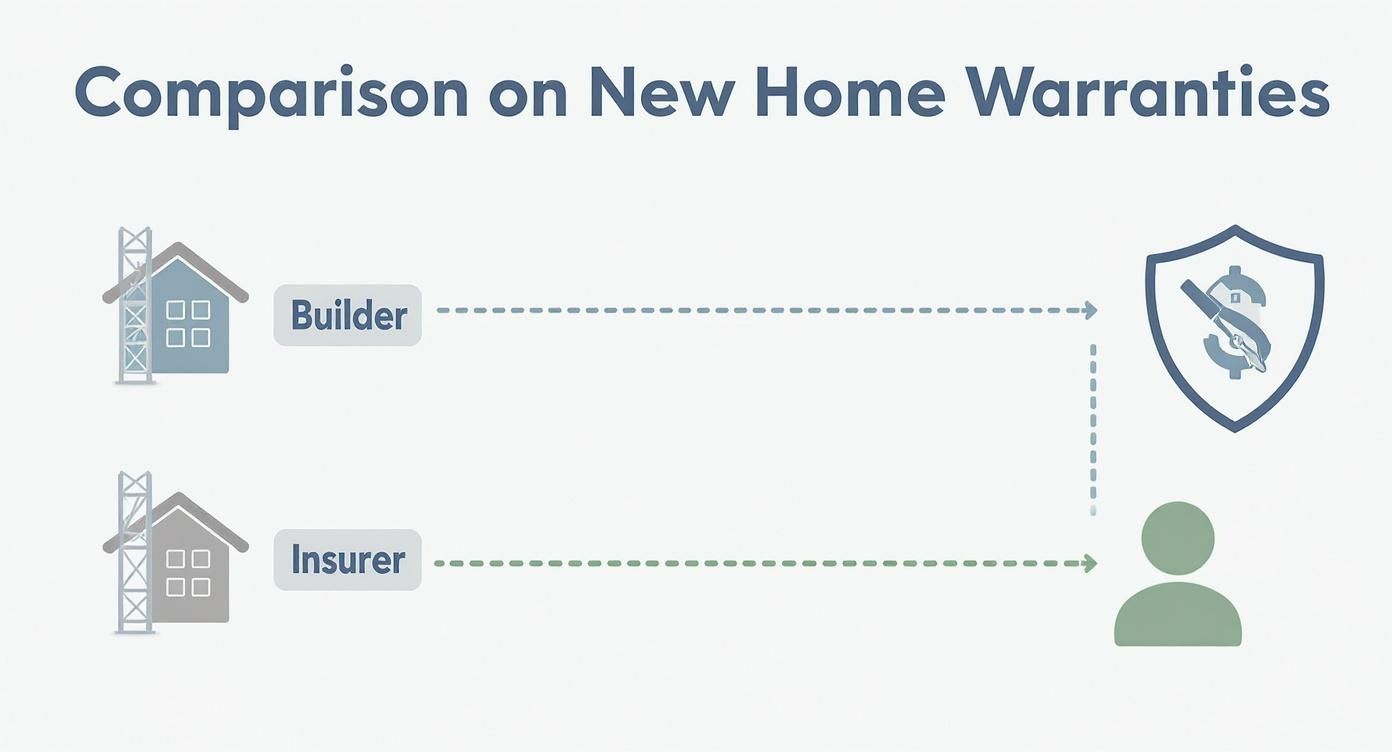
Having that third-party insurer provides a critical safety net. It ensures your claim will be handled even if your builder goes out of business down the road.
From Resolution to Repair
How a builder handles a warranty claim says a lot about them. In fact, a 2005 J.D. Power study found that warranty and customer service accounted for a whopping 20% of a buyer’s total satisfaction. Interestingly, homeowners who had problems resolved quickly and professionally often reported feeling more satisfied than those who never had an issue at all.
If the inspector confirms that you have a covered defect, the warranty provider will lay out a plan for the repairs. If they deny the claim, they have to give you a clear, written explanation why. If things get complicated and you find yourself in a dispute, resources like a homeowner's guide to NCAT building disputes can be incredibly helpful for understanding your options.
While the builder I represent aims to build homes that stand the test of time, I also know that seeing your vision come to life is just as important. That’s why I provide hands-on service and unique visualization tools for my clients in communities like Edgewood or Baltimore County. My goal is to make sure you're thrilled with every single choice—from the flooring to the fixtures—long before you ever need to think about your warranty.
Maryland Home Warranties and Buyer Protections
Buying a home is one of the biggest investments you'll ever make. Here in Maryland, the state gives you some built-in consumer protections to make sure that investment is a sound one. State laws provide what are called implied warranties, which are basically a legal safety net. They hold builders to a certain standard for things like good workmanship and ensuring the home is safe and livable, even if it’s not written down in your contract.
But let’s be honest, a great homebuying experience is about so much more than just meeting the legal minimum. A paper warranty is crucial, but it’s just the starting point. The real peace of mind comes from working with a builder who’s a genuine partner—someone committed not just to quality construction, but to bringing your specific vision for the home to life.
More Than Just a Contract
Think of a structural warranty for new homes as your home’s safety net. It’s there to protect you. But the process of actually creating your home should be exciting and fun, not a source of anxiety. It’s all about blending the security of a well-built house with the joy of making it your home from the ground up.
This is where my hands-on approach really sets things apart for my clients. I’ve found that true peace of mind comes from two things: knowing your home is built to last and knowing it perfectly reflects your personal style. It’s incredibly frustrating to try and guess how your home will look based on a handful of tiny samples.
A home warranty is the builder's promise of quality for the things you can't see. A great homebuying experience is the builder's commitment to delivering exactly what you can see—and making sure you love it.
That’s why I go the extra mile. I give my clients access to proprietary visualization tools you won't find elsewhere. These visualizers let you see your actual design choices—the exact flooring, the specific cabinets, the countertops you fell in love with—all inside a virtual model of your new home. It completely removes the guesswork and ensures the home you walk into is the one you’ve been dreaming of.
Bringing Your Vision to Life in Maryland
Imagine you're building a new home in one of our beautiful communities in White Marsh or Edgewood. Instead of just crossing your fingers and hoping the backsplash tile you chose goes with your countertops, you can see it all come together on a screen before a single thing is installed. This visual, hands-on process is a huge part of my commitment to my clients.
Choosing a new home is an amazing journey, and knowing all your options is the first step. For a deeper dive into finding the perfect fit in our local communities, check out our guide to new construction homes in Maryland. It’s full of useful insights for navigating the market in Baltimore County, and Harford County.
At the end of the day, you deserve a home that's built to last and designed to be loved. While Maryland law gives you a solid foundation of protection, I believe in building on that with superior quality, transparent service, and tools that empower you to create a space that is truly and uniquely yours. Let’s build a home you can feel secure in and be proud of for years to come.
Your Next Step to a Home You Can Trust
So, now you've got the inside scoop on structural warranties for new homes. Knowing what's covered—and what isn't—is a massive part of feeling confident in your purchase. But let's be honest, finding the right home isn't just about contracts and paperwork. It's about the feeling you get when you walk through the door.
A solid, insurance-backed structural warranty should be a non-negotiable, but the journey to get there should also feel exciting and personal.
This is where I come at things a little differently. I believe in a hands-on approach that turns what can be a stressful process into a genuinely satisfying one. It’s one thing to have a high-quality house; it’s another thing entirely to build your home, exactly the way you imagined it.
Beyond the Blueprint: A Personalized Experience
While the warranty guarantees the bones of the house, the real magic happens when your personal style starts to shine through. That's why I offer my clients something special: exclusive access to my own visualization tools.
These aren't generic apps. They let you play around with your actual choices for flooring, cabinets, countertops, and tile, so you can see exactly how they’ll look together in your new space before we even break ground.
It completely removes the guesswork and anxiety. The home you move into is the one you already designed and fell in love with. It's this combination of rock-solid construction and deeply personal design that creates a home you can both trust and adore.
More and more, homeowners are looking for this kind of security. In fact, the global home warranty service market is expected to hit $15 billion by 2025. It’s clear that peace of mind is a top priority. You can read the full analysis of home warranty market trends to dig deeper into the numbers.
A structural warranty protects your investment for the future. A personalized building experience ensures you love that investment from day one.
I represent builders in some of Maryland’s best communities, from White Marsh and Edgewood to locations across Baltimore and Harford Counties. My entire focus is on a building process that’s all about you.
If you’re ready to partner with a team who values both quality construction and your unique vision, let's talk. We can find a home you’ll feel proud of—and secure in—for years to come.
Common Questions About Structural Warranties

We've covered a lot of ground, but you've probably still got a few things on your mind. Let's tackle some of the most common questions homebuyers ask about a structural warranty for new homes. Getting straight answers can give you that final boost of confidence you need.
One of the first things people ask is whether the warranty is transferable if they sell the house. The answer is almost always yes. If you move within the warranty period, the coverage usually passes right along to the new owner, which can be a fantastic selling point.
Is a Structural Warranty the Same as Homeowner's Insurance?
This is a big one, and the answer is a firm no. They cover completely different things.
Think of it like this: your homeowner's insurance is there for sudden, accidental events—things like fires, hail storms, or a break-in. A structural warranty, on the other hand, is all about protecting you from flaws in the builder's original work on the home's most critical components.
Your homeowner's insurance is for what might happen to your home. Your structural warranty is for how your home was built. They are two separate, essential layers of protection.
Do I Have to Pay a Deductible for a Claim?
It really depends on the specific policy. Many third-party structural warranties do have a deductible or a service fee when you file a claim, just like your car or health insurance.
The amount can vary quite a bit, so this is a crucial detail to look for when you're reviewing the warranty documents before closing. You should always ask your builder to clarify any out-of-pocket costs tied to making a claim. This way, there are no nasty surprises down the road if you ever need to use the coverage.
Getting a handle on these details helps you see the whole picture. While a solid warranty is your safety net, the experience of building your home should be exciting, not stressful. My focus is on providing that next level of service, combining quality construction with a truly personalized journey.
While the builder I represent provides high-quality homes, I go a step further—offering my clients unique proprietary visualization tools, hands-on service, and access to visualizers that help you bring your dream space to life. We let buyers customize their homes by getting to pick their flooring, countertops, cabinets, tile, etc. Ready to build a home you can truly trust and love in White Marsh, Edgewood, or greater Maryland? Let's connect at https://www.customizeyourhome.com.
Comments